Earlier quoted context omitted.
It's the case not just in Korea and Japan but in most cities outside of America. It's one of American peculiarities, like checks or no public health care. China has a fantastic subway system in most big cities, for example. I once took a subway ride from the Shenzhen airport to the Hong Kong border, crossed the border, switched to another subway and arrived in downtown Hong Kong. That's around 65km (40 miles) by publ…
I wouldn't say most cities unfortunately. European cities are quite walkable and not as sprawling as American ones. But it is still pretty easy to end up were only cars can go not that far from the city center, or where there is only the occasional bus. Asia is really the leader in public transport now. I think the article is slightly misleading. Currently in Europe things like bike infrastructure and public transpor…
Europe is edging towards making post-car cities a reality
431–440 of 619 posts
Re: Europe is edging towards making post-car cities a reality
#432Earlier quoted context omitted.
It's the case not just in Korea and Japan but in most cities outside of America. It's one of American peculiarities, like checks or no public health care. China has a fantastic subway system in most big cities, for example. I once took a subway ride from the Shenzhen airport to the Hong Kong border, crossed the border, switched to another subway and arrived in downtown Hong Kong. That's around 65km (40 miles) by publ…
I wouldn't say most cities unfortunately. European cities are quite walkable and not as sprawling as American ones. But it is still pretty easy to end up were only cars can go not that far from the city center, or where there is only the occasional bus. Asia is really the leader in public transport now. I think the article is slightly misleading. Currently in Europe things like bike infrastructure and public transpor…
In general people are less reticent to bring a foldable bike in the subway for instance.
Re: Europe is edging towards making post-car cities a reality
#433The flipside of the coin needs to be mentioned too. What Europe is doing around zoning and infrastructure is, as is often the case, the "Big Government" model, compared to the U.S.'s more "Small Government" approach. I get the impression that, outside of a few major metropolitan areas with real estate booms, most areas within the U.S. have been comparatively more successful than most areas within Europe at enabling d…
>> When you get to a certain age and want to settle down and start a family, priorities start to change and you realize how trapped you are, with the European model. It's hard to overstate how happy I would be if the street outside my apartment wasn't a canyon of speeding vehicular death for a toddler. I love everything about living in the city with my child except for the sheer number of cars that pass through in th…
Cars are really only a problem in densely populated cities. But they are also the thing that makes less-densely populated areas viable to live at.
Public transport is what makes it possible to live without a car. But public transport is only economically viable in densely populated areas.
So: This equation resolves into something pretty obvious: Have car-free cities, but also continue car-based development of areas of lesser density, probably with "park and ride" being the interface.
Making the car and low population density out to be the devil and a remnant of the past, and car-free high-density development to be the future and solution of all transport-problems is a completely one-sided view.
Re: Europe is edging towards making post-car cities a reality
#434Earlier quoted context omitted.
For Paris, it depends on the line. I'm taking line 10 daily (and a bit of T2) and it's confortable enough.
When I lived in Paris, I used (for various jobs) lines 2, 6 and 13 to commute, also RER B. The mere idea of getting a seat during rush hour was delusional. I remember once, at Denfert-Rochereau, I had to let two RER go to the south without me, as there was litteraly no place for me to go inside. Could not even put a foot in.
Re: Europe is edging towards making post-car cities a reality
#435Earlier quoted context omitted.
But you are fucked with a huge bill that would cripple your life in a way that you might as well be dead.
And folks do skip going to the doctor, ration their medicines, and other such things. Folks suffer until things are an emergency as well and hospitals won't always help if you, say, need surgery for cancer that isn't presently killing you and isn't an emergency.
Re: Europe is edging towards making post-car cities a reality
#436Its amazing to me how cheap these changes are, and how much people love them after they are implemented. You go to a neighborhood meeting in the US and all you hear about is "loss of parking", "traffic", but when you remove the cars, everyone loves it.
I never knew loss of parking was even a thing in the US. I can't imagine it being as bad as within European cities where most of the streets (and adjacent buildings) have been built before cars were a thing. Probably one of the main reasons why alternatives to cars are well-received is that cars have never been an option anyways, especially in historic districts. Big cars are another dimension of this problem. Americ…
Thing is, historic districts don't make up most of cities, even before the post-war rebuild/new cities expansion.
Re: Europe is edging towards making post-car cities a reality
#437Earlier quoted context omitted.
To the people who say you need a car if you have kids - this is how we do it in Copenhagen: https://live.staticflickr.com/3662/3465284112_5aab494014_b.j... A transporter bike can carry 2-3 kids easily. It's the most convenient, cheap and healthy option. As soon as the kids are old enough they get their own bike. Of course, it's convenient to have access to a car a couple of times a month. But definitely not on a dail…
As someone who commutes by bike regularly, transporters are one of the primary reasons for why it is so miserable. They usually go 15km/h or even slower (presumably due to the extra weight and/or overprotective new parents), and they're so wide that they take up the whole lane, preventing you from overtaking them. And since we usually have grade-separated bike lanes here (supposedly the holy grail, according to HN!)…
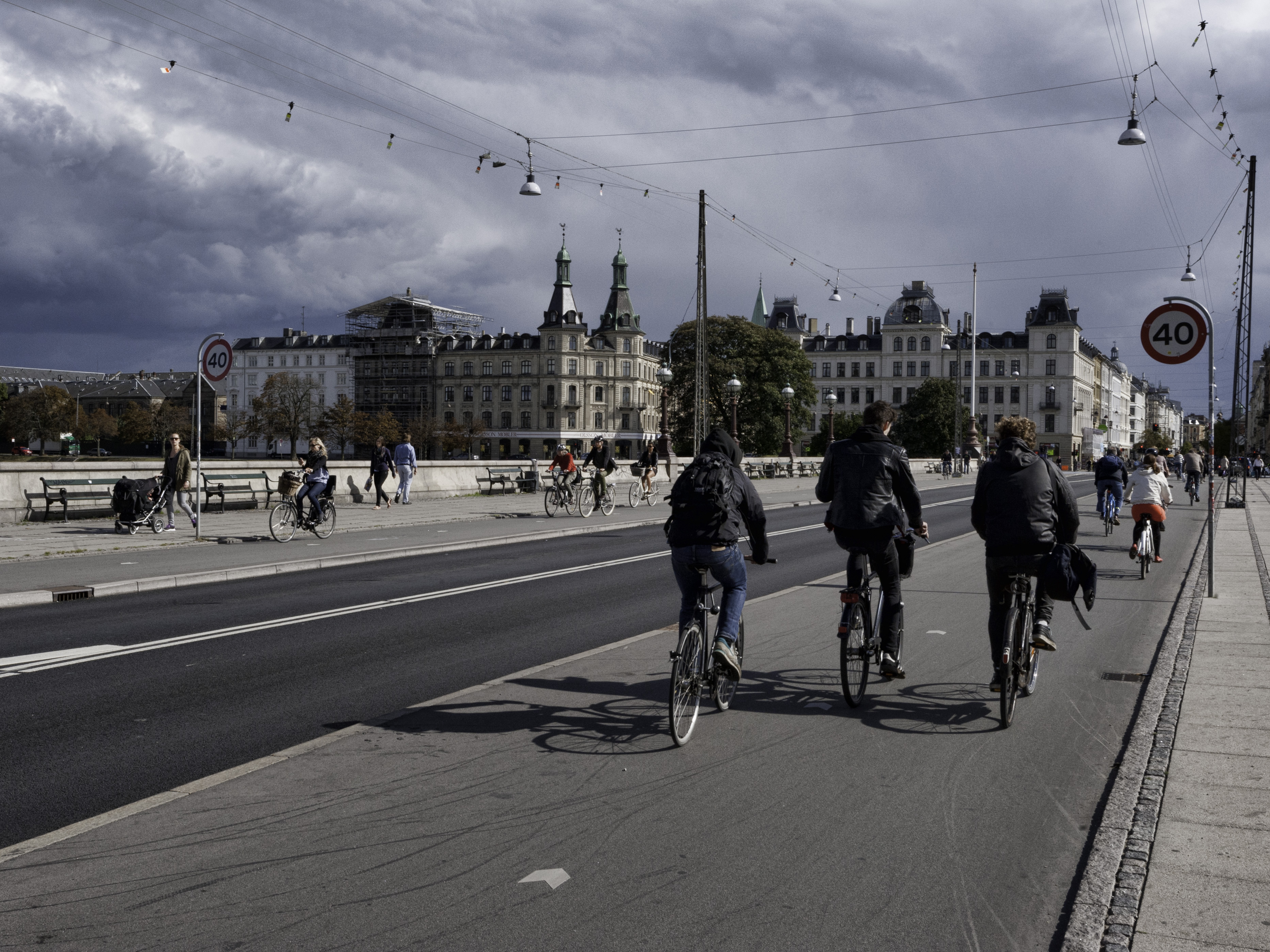
https://upload.wikimedia.org/wikipedia/commons/5/5e/Dronning...
You can easily ride 3 bikes next to each other (and also four if you want). A single slow transporter won't block the traffic on wide lanes like this.
Re: Europe is edging towards making post-car cities a reality
#438Earlier quoted context omitted.
Sorry to the American folks here, this might sound offensive, but I agree with bllguo. As an European colechchristensen's point of view feels alien. I'd argue that for the average European this kind of comment would seem paranoid bordering on insane. I guess some cultural differences are found way deeper than you'd expect. The European point of view about the whole "government opression" thing is that you don't fight…
on the cultural differences.. I've always loved the saying: Europeans see 100km as a long distance, while Americans/Australians see 100 years as a long time.
Re: Europe is edging towards making post-car cities a reality
#439Earlier quoted context omitted.
Most people are coming from outside of London and what you find is that it is usually quicker to drive in and just sit in the traffic than mess about doing park and rides and then travelling in.
It was far quicker to walk a mile to Twyford station, get the train to Ealing, and the tube to White City (or fast train to Paddington and tube to Shepherds Bush now) than to drive. It was a long time ago, and I don't work in Shepherds Bush any more, but the trip today would be 0835 - leave home 0856 - get slow train to London 0935 - arrive Ealing 0950 - arrive White City 0955 - arrive at office Or 0840 - leave home…
Outside of London the train is always slower. I used to live in Manchester and get the train into Stoke. Driving was always faster without exception. Generally it was cheaper as well (I have a crappy old diesel astra that is even cheaper to repair and I will drive it til the wheels fall off).
Re: Europe is edging towards making post-car cities a reality
#440EU has the advantage that most of its small and old cities are very dense. I think it makes a lot of sense to start removing cars from their city centers. Cars are not particularly efficient or convenient anyway in narrow streets. That being said I really wonder why Amsterdam still allows cars to drive in its rings.