Some points:
(1) Does the climate change? Apparently.
E.g., we had glaciations, most recently
IIRC, about 12,000 years.
(2) What is a greenhouse gas: Leading
examples are water vapor, CO2, and
methane. Each of these is transparent to
visible light, e.g., if water vapor or CO2
were not transparent to visible light,
then we could see our breath as we exhale.
So, since greenhouse gasses are
transparent to visible light, visible
light from the sun passes through
greenhouse gasses in the atmosphere,
strikes the surface of the earth, and gets
absorbed by and warms the surface. That
warmer surface then radiates as in Planck
black body radiation. That radiation is
mostly out in the infrared we cannot see
with our eyes. But here is what a
greenhouse gas does: It absorbs the
Planck black body infrared radiation from
the surface of the earth, gets warmer, and
warms the atmosphere. Without a
greenhouse gas, that infrared radiation
might just continue and escape into outer
space. The glass in the ceiling of a
greenhouse works similarly -- it lets
visible light from the sun in but blocks
infrared light from the warm interior
surfaces of the greenhouse from getting
out (there is some controversy in how a
greenhouse works, but a greenhouse is
still the source of the term greenhouse
gas).
(3) Since CO2 is a greenhouse gas, CO2 in
the atmosphere warms it? Yup.
(4) What are the sources of CO2 in the
atmosphere? I don't have good data on all
the sources and how much each contributes
(it's not clear that anyone does).
Supposedly one of the largest sources is
volcanoes, and there we have to count the
ones under the oceans, too. Supposedly
rotting vegetation is a source. All
animals exhale CO2. Burning fossil fuels,
wood, etc. releases CO2. Baking calcium
carbonate to make lime for cement, etc.,
releases CO2. Supposedly a large source
of CO2 is the oceans: Supposedly warmer
water can absorb less CO2. So, as ocean
water warms, from circulation, volcanoes,
the seasons, warmer climate, etc., CO2 can
be emitted. A guess is that the oceans
are an overwhelmingly large store of CO2
and a major source/sink of CO2 (as a
source emits CO2, a sink absorbs it).
Yes, rotting vegetation emits CO2, but,
then, sure, as that vegetation originally
grew, it was a sink of CO2.
(5) Does CO2 absorb all the infrared
light? Nope, not even close. CO2 absorbs
in just three narrow frequency bands, one
for each of bending, twisting, and
stretching of the molecule. More
generally, say, for other gasses, the
subject is molecular spectroscopy, based
on, e.g., quantum mechanics, some group
theory, etc.
(6) Okay, CO2 is a greenhouse gas and,
thus, warms the atmosphere. If someone
lights a match, then that, too, will warm
the atmosphere. A question is, how much?
In particular, how much CO2 warms the
atmosphere how much?
So, we believe that what CO2 does follows
only from well understood principles of
physics and chemistry. For large changes
in CO2 concentrations over long terms,
say, centuries, maybe we would have
carefully to consider biology, that is,
how plants, the oceans, etc., respond to
the extra CO2.
But, already just for small changes in CO2
over just a few decades, apparently the
calculations from principles in physics
and chemistry are quite challenging.
E.g., for flows in the atmosphere and
oceans we would have to use the equations
of fluid flow, the Navier-Stokes
equations, for the whole planet, including
the oceans. Of course, for such a
calculation, we would need boundary
conditions, e.g., what all the CO2
concentrations, temperatures, and flow
rates are now. For the oceans, our best
data for the boundary conditions is often
crude.
Still there have been efforts to do the
calculations. The efforts resulted in
predictions of temperature for a few
decades.
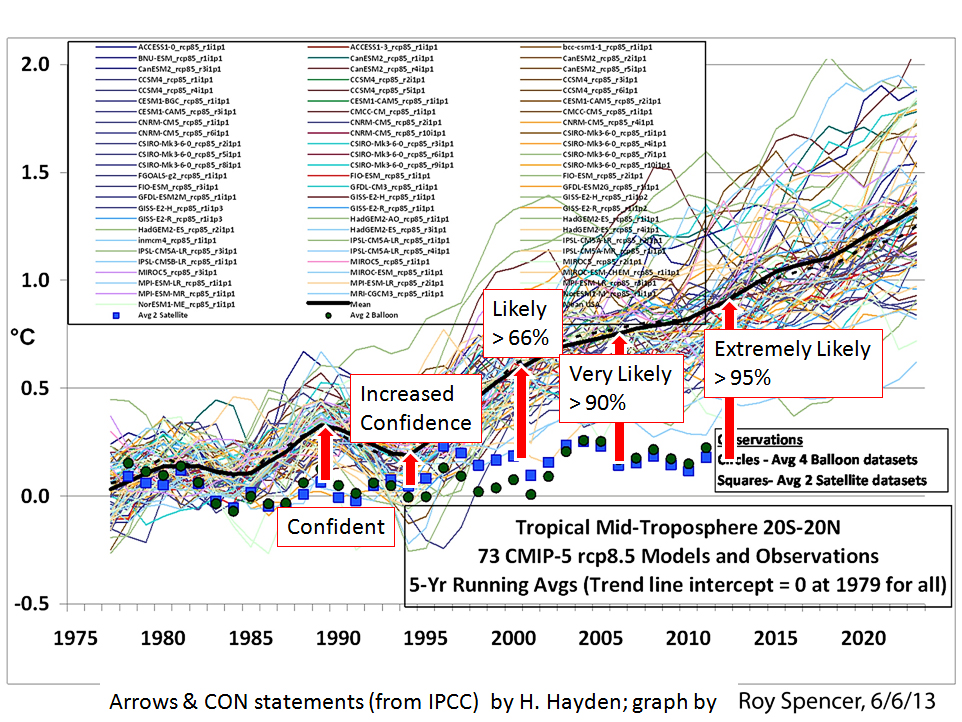
The results of some dozens of efforts to
do these calculations have been summarized
in, e.g.,
http://www.energyadvocate.com/gc1.jpg
By now we have been able to compare the
predicted temperatures with the observed
ones. The result is that in nearly all
cases of the calculations, the predicted
temperatures were way above the observed
temperatures. In simple terms, as
science, the calculations flopped.
So, for the question of how much CO2 warms
the planet how much, we don't have solid
scientific information.
(7) Apparently a common Claim is that
essentially the only cause of changes of
the temperature of the planet is
greenhouse gasses, essentially just CO2,
from human or other sources. So, with
more CO2, the temperature will go up; with
less CO2, the temperature will go down;
the times the temperature went up was due
to more CO2; the times the temperature
went down was due to less CO2.
Well, we can test this Claim. We have
three tests, A-C:
Test A. As at
https://en.wikipedia.org/wiki/Little_Ice_Age
there was the Little Ice Age:
"The NASA Earth Observatory notes three
particularly cold intervals: one
beginning about 1650, another about 1770,
and the last in 1850, each separated by
intervals of slight warming."
It was significantly colder, certainly in
both Europe and the US. Some of the
effects are famous: E.g., in the famous
painting of General Washington crossing
the Delaware River, there was ice in the
river. IIRC, usually there isn't. There
was winter ice skating on the Thames River
in London; IIRC usually there isn't.
Was this cooling caused by lower CO2
concentrations? Apparently there is no
such evidence. So, the cause was
something else. So, the Little Ice Age
serves as a counterexample to the Claim
above. So, there can be causes of
significant changes in temperature that
have little or nothing to do with CO2.
Test B. Can say the same for the Medieval
Warm Period, as at
https://en.wikipedia.org/wiki/Medieval_Warm_Period
from "lasting from about 950 to 1250".
Test C. For more, at Vostok Station in
Antarctica, the Russians took some ice
cores and from them measured CO2
concentrations and temperature back
ballpark 1 million years. They found
several times when temperature went up and
CO2 concentrations went up. Al Gore's
movie An Inconvenient Truth showed a
graph of those two over several hundred
thousand years. E.g., as at Web page
http://www.globalchange.umich.edu/globalchange1/current/labs...
can see graph
http://www.globalchange.umich.edu/globalchange1/current/labs...
Gore claimed that the higher CO2 caused
the higher temperatures. Well, due to the
long time interval of the horizontal axis
of the graph, not easy to see on the graph
was that the CO2 peaks occurred about 800
years after the temperature peaks. So,
really, just by common sense, the higher
temperatures were not caused by higher
CO2. Instead, something caused the higher
temperatures; they caused more biological
activity, and in 800 years that activity
caused higher CO2.
So, here we have three failed tests of the
Claim, three counterexamples of the Claim
above. For anything scientific, those
counterexamples are an overwhelmingly
serious problem for the Claim about CO2.
=== The Current Scientific Situation ===
If we get a case when CO2 went up and soon
temperature went up, that still is poor
evidence that the higher CO2 caused the
higher temperature, that is, the several
counterexamples to the Claim remain.
That is, from the data, we already know,
e.g., the end of The Little Ice Age, the
Medieval Warm Period, and the Vostok data,
that there are causes of significant
warming that have nothing to do with CO2.
Indeed, it is not at all clear that at
realistic concentrations CO2 has anything
at all significant to do with the
temperature of the earth; to the Claim
from climate data we have several
overwhelmingly serious counterexamples,
and otherwise we just don't have any solid
scientific evidence: We tried with
calculations from principles of physics
and chemistry, and they flopped.
Net, from the calculations and from the
historical record, we have no solid
evidence that, at anything like realistic
levels, more CO2 in the atmosphere will
cause significant increases in the
temperature of the earth. Yes, CO2 is a
greenhouse gas, but we just don't have any
solid evidence, from either calculations
or observations, that CO2 will be causing
any significant warming of the earth.
So, can we use science to urge reductions
in burning fossil fuels, subsidize wind
and solar sources of electric power,
impose carbon taxes, etc.?
IMHO, my view is that such steps would be
extremely irresponsible, would shoot our
economy in the gut for reasons that are
little more solid than some ancient
religion, e.g., when the Mayans killed
people to pour their blood on a rock "to
keep the sun moving across the sky" --
e.g., as at
http://books.google.com/books?id=DgqLplWtGPgC&pg=PA76&lpg=PA...
on page 76 of
Susan Milbrath, 'Star Gods of the Maya:
Astronomy in Art, Folklore, and Calendars
(The Linda Schele Series in Maya and
Pre-Columbian Studies)', ISBN-13
978-0292752269, University of Texas Press,
2000.
with
"Indeed, blood sacrifice is required for
the sun to move, according to Aztec
cosmology (Durian 1971:179; Sahaguin 1950
- 1982, 7:8)."