Live data from Hacker News

Scientists caught off-guard by record temperatures linked to climate change

reuters.com

151–160 of 198 posts

Re: Scientists caught off-guard by record temperatures linked to climate change

#151

Earlier quoted context omitted.

"Serious problems" is pretty disingenuous. They're facing increased risk as a result of using updated 2nd-generation technology, rather than licensing the Westinghouse AP-1000 design at enormous cost. They're aware of the chance they're taking, but they also seem to consider that less of a risk than being beholden to a US firm. Whether that's an accurate assessment in the long run or not, it's their choice to make, a…

Different people have different opinions, but I would personally consider these serious issues: > The country should set a 2020 ceiling on reactors in operation at 70,000 megawatts to avoid a shortfall of fuel, equipment and qualified plant workers > "By bypassing the passive safety technology of the AP1000, which, according to Westinghouse, is 100 times safer than the CPR-1000, China is vastly increasing the aggrega…

Thank you for making my point for me.

Here in the US, we're not constrained by fuel shortages, and we don't have to make ourselves beholden to a potentially hostile foreign state in order to take advantage of the AP-1000 design. We also have the world's broadest and deepest reservoir of institutional knowledge on the subject of nuclear power - a technology invented in the United States, and which we have arguably developed to the greatest extent of any nation on Earth, even if we have thus far chosen not to reap the full benefits of our efforts.

You're right that we aren't building out modern nuclear technology as well as we could be. But we aren't facing the same structural limitations China is, and we therefore do not face a similar choice between unpalatable options. The deficit we face is merely one of will - that is, we're not building out new nuclear because we can't, but rather because the very same people who inveigh most strongly against ignoring AGW have an ideological and frankly emotional objection to modern nuclear infrastructure, an objection which arises entirely from industrial accidents which occurred with technology now half a century old, and from which the industry has learned.

To be quite clear, I have significant concerns of my own with how new nuclear is likely to be implemented. Specifically, as I've stated in this forum and others, the existence of a profit motive around the operation and safety management of nuclear reactors is in my opinion a substantial risk. That risk is, however, susceptible of mitigation or elimination by quite realistic measures, and even if left completely as is, collapses into negligibility alongside the risks posed by either continuing to ignore AGW, or building a response that relies entirely on ill-tested, seasonally variable, and enormously inefficient power generation methods to supply life-critical baseload power.

Re: Scientists caught off-guard by record temperatures linked to climate change

#152

Earlier quoted context omitted.

A confounding factor is that there is apples in a lot of things you may not think of, and somethings use apples in their production... even if you never see the apples yourself.

And even some products which supposedly provide free apples are made with apples, and require themselves to be used beyond their serviceable lifetime to provide more apples than went into making them. In short, we either need a radical new source of apples, or we need to find a way to use far fewer apples.

Pulling away from the metaphor for a moment, I was under the impression that with today's technology (not the panels of 20 years ago), solar panels take about 4 years to produce as much power as it took to manufacture them and then service lives of 25 years minimum. I'm honestly curious, do you have a source?

Re: Scientists caught off-guard by record temperatures linked to climate change

#153
Some points:

(1) Does the climate change? Apparently. E.g., we had glaciations, most recently IIRC, about 12,000 years.

(2) What is a greenhouse gas: Leading examples are water vapor, CO2, and methane. Each of these is transparent to visible light, e.g., if water vapor or CO2 were not transparent to visible light, then we could see our breath as we exhale. So, since greenhouse gasses are transparent to visible light, visible light from the sun passes through greenhouse gasses in the atmosphere, strikes the surface of the earth, and gets absorbed by and warms the surface. That warmer surface then radiates as in Planck black body radiation. That radiation is mostly out in the infrared we cannot see with our eyes. But here is what a greenhouse gas does: It absorbs the Planck black body infrared radiation from the surface of the earth, gets warmer, and warms the atmosphere. Without a greenhouse gas, that infrared radiation might just continue and escape into outer space. The glass in the ceiling of a greenhouse works similarly -- it lets visible light from the sun in but blocks infrared light from the warm interior surfaces of the greenhouse from getting out (there is some controversy in how a greenhouse works, but a greenhouse is still the source of the term greenhouse gas).

(3) Since CO2 is a greenhouse gas, CO2 in the atmosphere warms it? Yup.

(4) What are the sources of CO2 in the atmosphere? I don't have good data on all the sources and how much each contributes (it's not clear that anyone does). Supposedly one of the largest sources is volcanoes, and there we have to count the ones under the oceans, too. Supposedly rotting vegetation is a source. All animals exhale CO2. Burning fossil fuels, wood, etc. releases CO2. Baking calcium carbonate to make lime for cement, etc., releases CO2. Supposedly a large source of CO2 is the oceans: Supposedly warmer water can absorb less CO2. So, as ocean water warms, from circulation, volcanoes, the seasons, warmer climate, etc., CO2 can be emitted. A guess is that the oceans are an overwhelmingly large store of CO2 and a major source/sink of CO2 (as a source emits CO2, a sink absorbs it). Yes, rotting vegetation emits CO2, but, then, sure, as that vegetation originally grew, it was a sink of CO2.

(5) Does CO2 absorb all the infrared light? Nope, not even close. CO2 absorbs in just three narrow frequency bands, one for each of bending, twisting, and stretching of the molecule. More generally, say, for other gasses, the subject is molecular spectroscopy, based on, e.g., quantum mechanics, some group theory, etc.

(6) Okay, CO2 is a greenhouse gas and, thus, warms the atmosphere. If someone lights a match, then that, too, will warm the atmosphere. A question is, how much? In particular, how much CO2 warms the atmosphere how much?

So, we believe that what CO2 does follows only from well understood principles of physics and chemistry. For large changes in CO2 concentrations over long terms, say, centuries, maybe we would have carefully to consider biology, that is, how plants, the oceans, etc., respond to the extra CO2.

But, already just for small changes in CO2 over just a few decades, apparently the calculations from principles in physics and chemistry are quite challenging. E.g., for flows in the atmosphere and oceans we would have to use the equations of fluid flow, the Navier-Stokes equations, for the whole planet, including the oceans. Of course, for such a calculation, we would need boundary conditions, e.g., what all the CO2 concentrations, temperatures, and flow rates are now. For the oceans, our best data for the boundary conditions is often crude.

Still there have been efforts to do the calculations. The efforts resulted in predictions of temperature for a few decades.

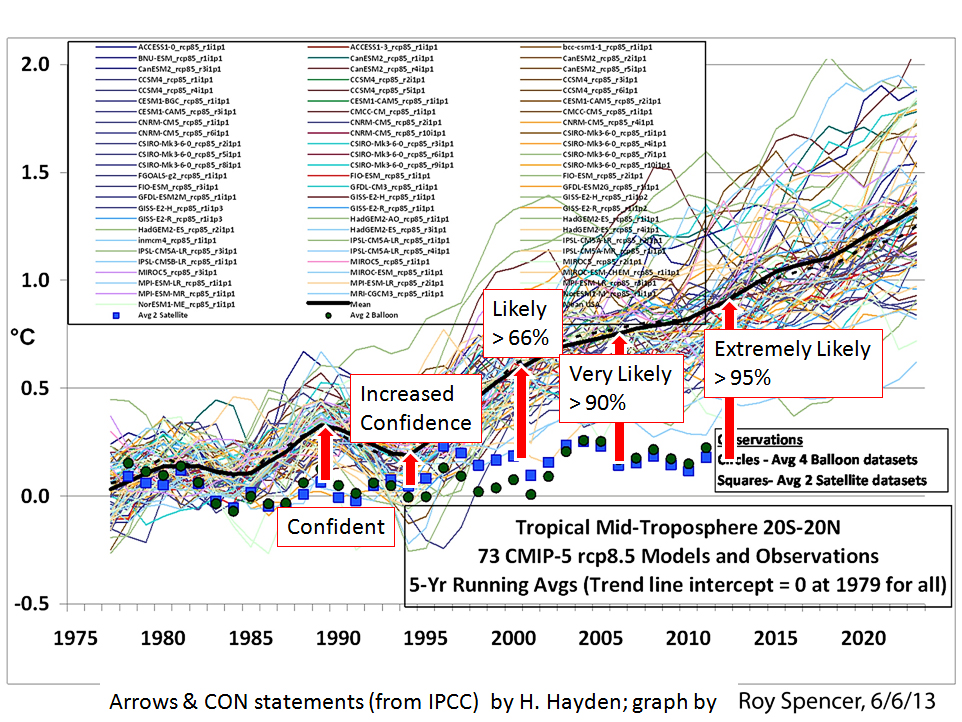
The results of some dozens of efforts to do these calculations have been summarized in, e.g.,

http://www.energyadvocate.com/gc1.jpg

By now we have been able to compare the predicted temperatures with the observed ones. The result is that in nearly all cases of the calculations, the predicted temperatures were way above the observed temperatures. In simple terms, as science, the calculations flopped.

So, for the question of how much CO2 warms the planet how much, we don't have solid scientific information.

(7) Apparently a common Claim is that essentially the only cause of changes of the temperature of the planet is greenhouse gasses, essentially just CO2, from human or other sources. So, with more CO2, the temperature will go up; with less CO2, the temperature will go down; the times the temperature went up was due to more CO2; the times the temperature went down was due to less CO2.

Well, we can test this Claim. We have three tests, A-C:

Test A. As at

https://en.wikipedia.org/wiki/Little_Ice_Age

there was the Little Ice Age:

"The NASA Earth Observatory notes three particularly cold intervals: one beginning about 1650, another about 1770, and the last in 1850, each separated by intervals of slight warming."

It was significantly colder, certainly in both Europe and the US. Some of the effects are famous: E.g., in the famous painting of General Washington crossing the Delaware River, there was ice in the river. IIRC, usually there isn't. There was winter ice skating on the Thames River in London; IIRC usually there isn't.

Was this cooling caused by lower CO2 concentrations? Apparently there is no such evidence. So, the cause was something else. So, the Little Ice Age serves as a counterexample to the Claim above. So, there can be causes of significant changes in temperature that have little or nothing to do with CO2.

Test B. Can say the same for the Medieval Warm Period, as at

https://en.wikipedia.org/wiki/Medieval_Warm_Period

from "lasting from about 950 to 1250".

Test C. For more, at Vostok Station in Antarctica, the Russians took some ice cores and from them measured CO2 concentrations and temperature back ballpark 1 million years. They found several times when temperature went up and CO2 concentrations went up. Al Gore's movie An Inconvenient Truth showed a graph of those two over several hundred thousand years. E.g., as at Web page

http://www.globalchange.umich.edu/globalchange1/current/labs...

can see graph

http://www.globalchange.umich.edu/globalchange1/current/labs...

Gore claimed that the higher CO2 caused the higher temperatures. Well, due to the long time interval of the horizontal axis of the graph, not easy to see on the graph was that the CO2 peaks occurred about 800 years after the temperature peaks. So, really, just by common sense, the higher temperatures were not caused by higher CO2. Instead, something caused the higher temperatures; they caused more biological activity, and in 800 years that activity caused higher CO2.

So, here we have three failed tests of the Claim, three counterexamples of the Claim above. For anything scientific, those counterexamples are an overwhelmingly serious problem for the Claim about CO2.

=== The Current Scientific Situation ===

If we get a case when CO2 went up and soon temperature went up, that still is poor evidence that the higher CO2 caused the higher temperature, that is, the several counterexamples to the Claim remain.

That is, from the data, we already know, e.g., the end of The Little Ice Age, the Medieval Warm Period, and the Vostok data, that there are causes of significant warming that have nothing to do with CO2.

Indeed, it is not at all clear that at realistic concentrations CO2 has anything at all significant to do with the temperature of the earth; to the Claim from climate data we have several overwhelmingly serious counterexamples, and otherwise we just don't have any solid scientific evidence: We tried with calculations from principles of physics and chemistry, and they flopped.

Net, from the calculations and from the historical record, we have no solid evidence that, at anything like realistic levels, more CO2 in the atmosphere will cause significant increases in the temperature of the earth. Yes, CO2 is a greenhouse gas, but we just don't have any solid evidence, from either calculations or observations, that CO2 will be causing any significant warming of the earth.

So, can we use science to urge reductions in burning fossil fuels, subsidize wind and solar sources of electric power, impose carbon taxes, etc.?

IMHO, my view is that such steps would be extremely irresponsible, would shoot our economy in the gut for reasons that are little more solid than some ancient religion, e.g., when the Mayans killed people to pour their blood on a rock "to keep the sun moving across the sky" -- e.g., as at

http://books.google.com/books?id=DgqLplWtGPgC&pg=PA76&lpg=PA...

on page 76 of

Susan Milbrath, 'Star Gods of the Maya: Astronomy in Art, Folklore, and Calendars (The Linda Schele Series in Maya and Pre-Columbian Studies)', ISBN-13 978-0292752269, University of Texas Press, 2000.

with

"Indeed, blood sacrifice is required for the sun to move, according to Aztec cosmology (Durian 1971:179; Sahaguin 1950 - 1982, 7:8)."
Re: Scientists caught off-guard by record temperatures linked to climate change

#154
post #107

Earlier quoted context omitted.

This "we've gotten this far!" argument applies to global warming as well, doesn't it? I don't believe the proposition that global warming is not a problem because human ingenuity will fix it. Our land and oceans are already straining under our population load.

Yes, they're straining. But they've always been, through recorded history. The only difference is that when we look back at them through 21st century glasses, the problems don't even look like problems anymore. I mean, we stopped denuding the forests to get firewood, so a visitor from, say, 3 centuries ago would be astonished at how well wooded the land is near cities. You can canoe down the Delaware River today and…

We are numerous enough and produce enough toxins and pollution that we are close to the point where no one can escape the effects. That's why this time is different. The scale is much larger now.

Re: Scientists caught off-guard by record temperatures linked to climate change

#155
post #73

Earlier quoted context omitted.

Good on you. I've drastically reduced the amount of meat I eat to about once a week, for many reasons including environmental. I feel western society almost worships meat (especially in America - bacon, anyone?) and links it to masculinity. I think most people would rather watch the world burn than give up meat.

To my mind, if you are concerned about your impact on the environment, what kind of food you eat is not nearly as important as how much money you spend. It's a coarse grained rule of thumb, but money basically represents a share of the world's abundance. When you spend money, you are claiming a part of that abundance for yourself. And the more you spend, the larger share you are claiming. So if you eat a vegetarian m…

"fruit and most leafy-green vegetables have a similar cost per calorie to meat. Thus, I would argue that they have about the same environmental impact as meat."

Unfortunately, this is provably false. For beef, you need to grow 12,000 calories of plants to produce (i.e. feed) 1,000 calories of beef. About 8 to 1 for pork, 6 to 1 for turkey, and 5 to 1 for chicken.

Re: Scientists caught off-guard by record temperatures linked to climate change

#156

Earlier quoted context omitted.

flat blocking of nuclear is unreasonable. But in my opinion disagreement on the issue is a relatively marginal issue in the general sweep of tackling climate change. The new DNC platform coming out of the convention this week doesn't seem to agree with you. It focuses solely on renewable sources, sweeping nuclear under the carpet. 70-80% of people agree that anthropogenic climate change is happening I don't understan…

As to the importance of the term "anthropogenic"... If we aren't causing it (or contributing significantly), then stopping what we're doing won't fix it . So yes, it's important to the conversation that we're actually causing the problem.

If we aren't causing it (or contributing significantly), then stopping what we're doing won't fix it.

That's not correct. If I'm sitting in my car and it starts to roll downhill, it's gravity that's causing the movement, not my car. Yet applying the brakes is still the correct course of action.

Moreover, even if we assume that humans are the cause of the problem, it doesn't necessarily follow that the cessation of human activity is the optimal course of action. There may be other effective alternatives (e.g., large-scale engineered efforts to increase planetary albedo via cloud formation) that are significantly cheaper. It might be that the costs of mitigating the problem exceed the expected damage that the problem is expected to cause.

To be sure, I don't know that either of those possibilities hold in this case, but it's mistaken to simply assume them away.

Re: Scientists caught off-guard by record temperatures linked to climate change

#157
post #64

Earlier quoted context omitted.

The only viable, realistic solution is for people to stop having as many children as they currently do. The population of the planet is beyond carrying capacity at current levels of consumption.

Making the "save the world for my kids " argument particularly ironic.

It's not at all ironic since I'm not advocating that there be no children.

Re: Scientists caught off-guard by record temperatures linked to climate change

#158

Earlier quoted context omitted.

Different people have different opinions, but I would personally consider these serious issues: > The country should set a 2020 ceiling on reactors in operation at 70,000 megawatts to avoid a shortfall of fuel, equipment and qualified plant workers > "By bypassing the passive safety technology of the AP1000, which, according to Westinghouse, is 100 times safer than the CPR-1000, China is vastly increasing the aggrega…

Thank you for making my point for me. Here in the US, we're not constrained by fuel shortages, and we don't have to make ourselves beholden to a potentially hostile foreign state in order to take advantage of the AP-1000 design. We also have the world's broadest and deepest reservoir of institutional knowledge on the subject of nuclear power - a technology invented in the United States, and which we have arguably dev…

> building a response that relies entirely on ill-tested, seasonally variable, and enormously inefficient power generation methods to supply life-critical baseload power.

Many nuclear advocates seem to share this misconception. Fighting climate change is not about simply switching all power generation to one and only one alternative source. It's not about whether we are going to rely 100% on nuclear or 100% on solar, and it's not even only about generation.

A large part of the efforts are focused on things like increased efficiency. Alternative energy also plays a role (including nuclear, though it plays a relatively small role). These efforts will help cut emissions until we get below 450 (or 350), not entirely eliminate emissions. We don't need solar (for example) to provide electricity 24/7 - we need it to help decrease the emissions. If we have enough elements that decrease the emissions some amount, we'll eventually get below 450 (or 350).

There seems to be a fundamental misunderstanding by some about what the fight against climate change actually entails. It is not about picking the one and only energy source for the future.

> The deficit we face is merely one of will

This ignores the economic and construction issues that nuclear plants have.

Re: Scientists caught off-guard by record temperatures linked to climate change

#159
post #155

Earlier quoted context omitted.

To my mind, if you are concerned about your impact on the environment, what kind of food you eat is not nearly as important as how much money you spend. It's a coarse grained rule of thumb, but money basically represents a share of the world's abundance. When you spend money, you are claiming a part of that abundance for yourself. And the more you spend, the larger share you are claiming. So if you eat a vegetarian m…

"fruit and most leafy-green vegetables have a similar cost per calorie to meat. Thus, I would argue that they have about the same environmental impact as meat." Unfortunately, this is provably false. For beef, you need to grow 12,000 calories of plants to produce (i.e. feed) 1,000 calories of beef. About 8 to 1 for pork, 6 to 1 for turkey, and 5 to 1 for chicken.

The beef you buy in stores is not fed leafy green vegetables or fruit.

Re: Scientists caught off-guard by record temperatures linked to climate change

#160

Earlier quoted context omitted.

The Malthusian argument is threadbare and false. Humanity has always been on the brink of demise. We've always been barely able to feed our people. This took us from hunter-gatherers to the development of agriculture, on to irrigation, fertilization, terraced farming, crop rotation, selective breeding, genetic manipulation. In terms of energy, as we depleted the forests of wood for burning, we've gone through similar…

I'm not making a Malthsian argument. I'm stating a fact. At current levels of consumption (which includes much more than food) we are beyond carrying capacity of the planet. Technology may eventually make this a false statement but it currently isn't false. There is much more to living than just food. That we can grow enough food is not a persuasive argument that there aren't too many people on the planet. People shi…

At current levels of consumption (which includes much more than food) we are beyond carrying capacity of the planet. Technology may eventually make this a false statement but it currently isn't false.

But this has ALWAYS been true. You haven't given any reason to think differently.

There is much more to living than just food. ... People shit, pollute, destroy, and consume.

Exactly. Yet we've invented sanitation. And if you look at the trends, our higher standard of living has given us the luxury to curtail the pollution and destruction. America's air and water is MUCH cleaner now than it was when I was growing up (just as the Clean Air Act was getting started).

Thanks to smart scientists and engineers, we've learned new ways to do things that that are far more environmentally friendly.

In a way you're right. The problems will never be entirely fixed, because nothing is infinite. But a very long history shows that while we're always on the brink of destruction, we're also always on the brink of brilliant new insights that break us through those barriers.

The source of those brilliant insights is the minds of the people. Calling for drastic reductions in birth rates would be killing the goose that lays the golden eggs: innovation is what's going to keep saving our butts.

Post reply on HN