Live data from Hacker News

We, the peoples of the Amazon, are full of fear. Soon you will be too

theguardian.com

81–90 of 168 posts

Re: We, the peoples of the Amazon, are full of fear. Soon you will be too

#81

Earlier quoted context omitted.

>Personal use of passenger vehicles accounts for a tiny fraction of transportation related CO2 emissions. The overwhelming majority comes from cargo ships and associated logistics. while this might represent a small fraction of the global total emissions, the CO2 (and other harmful particles) produced by cars is much more detrimental to human health since it will be concentrated in the cities and near humans live. Th…

This is correct. If we ignore catastrophic climate change, the next worst thing is being directly exposed to personal transportation pollutants - amongst which CO2 is pretty benign but there is far worse stuff. Living next to major roads or highways significantly reduces life expectancy. https://www.lung.org/our-initiatives/healthy-air/outdoor/air...

But at this point we need to prioritize, and climate change is arguably becoming more important than direct exposure to personal transportation pollutants.
Re: We, the peoples of the Amazon, are full of fear. Soon you will be too

#82

Earlier quoted context omitted.

> Primarily vegetarian diets and less driving would make mountains of difference for the world. Changing diets yes. Changing driving habits, not really. Personal use of passenger vehicles accounts for a tiny fraction of transportation related CO2 emissions. The overwhelming majority comes from cargo ships and associated logistics. A typical cargo ship will burn about 30 liters of bunker fuel (far more polluting than…

> will burn about 30 liters of bunker fuel.. to travel 1 meter That's either a typo or a thinko. 30 litres per metre would be 30,000 litres (a guess; 25 tons?) of bunker per kilometre. From your own link "These mammoth engines [of the emma maersk] consume approx 16 tons of fuel per hour or 380 tons per day while at sea." I don't have time to work it out but 30 litres per KM would be less wrong anyway.

Poking around I found the numbers 6300 liters pr hour at ~20 knots for optimal fuel consumption and 13600 liters pr hour at 31 knots at full engines.

That breaks down to 170 liters per km optimally or 237 liters per km at full engines.

Re: We, the peoples of the Amazon, are full of fear. Soon you will be too

#83
post #72
post #43

Earlier quoted context omitted.

> The tragic thing is that there's this idea you have to live life as an austere pioneer hippie to address this. You really don't. A world of mostly-vegetarian people living in modern, timber (for carbon sequestration) flats in mixed-use environments, using renewable electricity to power their heat pumps and AC, traveling primarily via bike, walking, and public transport, and owning less disposable crap would go a lo…

"It's easier to imagine the end of the world than the end of Capitalism."

I think it is a dire logical error to equate capitalism, which arises naturally out of fair and mutually consensual dealing between humans, and the neverending consumer consumption drive epitomized by the global west.

They are not the same thing, and the former does not necessitate the latter. Same goes for all the other ills of our society that people misguidedly invoke under the “capitalism” umbrella, like intellectual property, patents, and regulatory capture.

Military-industrial complex-flavored capitalism is the problem. It sounds like that is part of the problem described in the article, too.

Re: We, the peoples of the Amazon, are full of fear. Soon you will be too

#84

Earlier quoted context omitted.

Not even that far. Primarily vegetarian diets and less driving would make mountains of difference for the world. As someone who is fairly new to adulthood I dont really see why we work so much - there just doesn't seem like there is much to "get". There should ve a greater focus on tending our environments around us, spending money on experiences and creating art (or even just having a hobby).

> Primarily vegetarian diets and less driving would make mountains of difference for the world. Changing diets yes. Changing driving habits, not really. Personal use of passenger vehicles accounts for a tiny fraction of transportation related CO2 emissions. The overwhelming majority comes from cargo ships and associated logistics. A typical cargo ship will burn about 30 liters of bunker fuel (far more polluting than…

This is simply false.

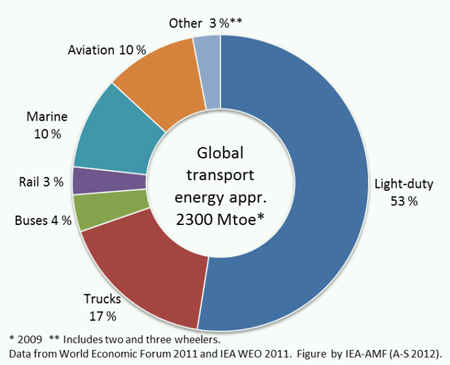
http://www.etipbioenergy.eu/images/overview-fig-3.jpg

Worldwide, light-duty vehicles, mostly passenger transport cars and light trucks, account for 53% of transport fuel use.

Trucks are 17%.

Rail and busses are 3% and 4%.

All marine fuel use is 10%.

Aviation is another 10%.

All other uses: 3%.

For the US, use is even more strongly skewed to passenger vehicles: 59%.

http://www.yaleclimateconnections.org/wp-content/uploads/201...

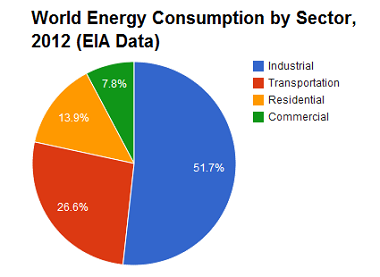
Overall, transportation is a quarter of primary energy use, industrial uses are half:

https://cfnewsads.thomasnet.com/images/sites/3/2012/04/World...

Ships individually use vast amounts of fuel, but are small in overall number (there are about 60-80,000 registered cargo vessels), and achieve efficiencies up up to ton-miles per gallon of fuel, as compared with 500 ton-miles/gallon for rail, 100 for trucks, and less than 10 for cars. Moving cargo by water is the most efficient option that exists by a long shot.

Where cargo ships have bad emissions is in particulates and sulfur, based on what fuels are burnt and how. CO2 emissions, however, are quite low relative to any other transport mode.

Re: We, the peoples of the Amazon, are full of fear. Soon you will be too

#85
post #44

Earlier quoted context omitted.

And a huge 24/7 mechanism is used to make this vast bulk of people want, work for, and buy, those products...

I doubt more than a handful of people would trade their lives for subsistence farming, and those would likely trade back after a year or two.

No doubt. But who claimed otherwise? The closest I could find is that CalRoberts said thay theyd'd spend more time gardening and cooking if they had the time, which is hard to refute unless you know them personally, is not an overgeneralisation -- and even if it was, growing a few tomatoes is a far fetch from subsistence farming.

You're making a classic straw man argument.

Re: We, the peoples of the Amazon, are full of fear. Soon you will be too

#86

Earlier quoted context omitted.

Not even that far. Primarily vegetarian diets and less driving would make mountains of difference for the world. As someone who is fairly new to adulthood I dont really see why we work so much - there just doesn't seem like there is much to "get". There should ve a greater focus on tending our environments around us, spending money on experiences and creating art (or even just having a hobby).

> Primarily vegetarian diets and less driving would make mountains of difference for the world. No, it wouldn't. Look at pandas, they are bears (omnivores, like us), living on a primarily vegetarian diet. They sleep 16 hours a day and when they are awake they eat, because a vegetarian diet is not really energy efficient. If we are talking about a true vegetarian diet, environmental friendly. if we are talking about "…

Pandas eat eucalyptus, which is the worst plant they could eat. Don't know why they do it, but it is what it is.

Re: We, the peoples of the Amazon, are full of fear. Soon you will be too

#87
post #83
post #72

Earlier quoted context omitted.

"It's easier to imagine the end of the world than the end of Capitalism."

I think it is a dire logical error to equate capitalism, which arises naturally out of fair and mutually consensual dealing between humans, and the neverending consumer consumption drive epitomized by the global west. They are not the same thing, and the former does not necessitate the latter. Same goes for all the other ills of our society that people misguidedly invoke under the “capitalism” umbrella, like intellec…

They are exactly the same thing. Capitalism requires endless growth, which requires endless production and consumption. Those in turn require imperialism, to have a supply of desperate workers and consumers. Imperialism is not always overtly military, but it is always a threat of violence in order to assert power.

Read Lenin's "Imperialism, the Highest Stage of Capitalism", he makes it very easy to understand.

Re: We, the peoples of the Amazon, are full of fear. Soon you will be too

#88

Earlier quoted context omitted.

> Primarily vegetarian diets and less driving would make mountains of difference for the world. No, it wouldn't. Look at pandas, they are bears (omnivores, like us), living on a primarily vegetarian diet. They sleep 16 hours a day and when they are awake they eat, because a vegetarian diet is not really energy efficient. If we are talking about a true vegetarian diet, environmental friendly. if we are talking about "…

Pandas eat eucalyptus, which is the worst plant they could eat. Don't know why they do it, but it is what it is.

Pandas eat bamboo.

Koalas eat eucalyptus.

Re: We, the peoples of the Amazon, are full of fear. Soon you will be too

#89

The tragic thing is that there's this idea you have to live life as an austere pioneer hippie to address this. You really don't. A world of mostly-vegetarian people living in modern, timber (for carbon sequestration) flats in mixed-use environments, using renewable electricity to power their heat pumps and AC, traveling primarily via bike, walking, and public transport, and owning less disposable crap would go a long…

> A world of mostly-vegetarian people living in modern, timber (for carbon sequestration) flats in mixed-use environments, using renewable electricity to power their heat pumps and AC, traveling primarily via bike, walking, and public transport, and owning less disposable crap would go a long, long way

Can you quantify that into something more precise than a fuzzy feeling?

Re: We, the peoples of the Amazon, are full of fear. Soon you will be too

#90
post #44

Earlier quoted context omitted.

And a huge 24/7 mechanism is used to make this vast bulk of people want, work for, and buy, those products...

I doubt more than a handful of people would trade their lives for subsistence farming, and those would likely trade back after a year or two.

First, they don't have to "trade their lives" for subsistence farming. Nobody described subsistence farming above.

That said, for many "subsistence farming" would be an improvement over their current living conditions / culture / psychological issues...

Post reply on HN