Live data from Hacker News

SpaceX Hyperloop Pod Competition

spacex.com

111–120 of 132 posts

Re: SpaceX Hyperloop Pod Competition

#111

Any engineers or mechanically inclined folks around LA interested in assembling a team? Let's chat. About me: full stack software engineer with a degree in Systems Engineering from University of Illinois Urbana-Champaign. I work on classic cars and build shit with my hands when I'm not coding. I'm into efficiency, and I loooove the idea of building a better, faster cheaper CA high-speed railway.

I'm a Toronto-based Mechanical Design Engineer with an Electrical Engineering education, I've worked in Toronto and Mountain View.

I've designed airborne laser LIDAR scanning systems and large-scale lighting solutions. I've also done a lot of work with stress and heat management, mass electronics production and packaging.

I'd be interested in taking up a project like this and seeing how far we could go with it!

If you're interested, shoot me a message: vpsanta@gmail.com.

Re: SpaceX Hyperloop Pod Competition

#112
post #3

I thought this was an interesting tidbit from the linked rules pdf: > In addition to hosting the competition, SpaceX will likely build a pod for demonstration purposes only. This team will not be eligible to win.

I think that's admirable, and doesn't strike me as out of the ordinary for Elon. SpaceX has some remarkable engineering talent (which also transfers tech to Tesla; see their friction stir welding technique that is used by both companies now). It wouldn't be fair for SpaceX to be able to win.

Serious observation.

Why do people (here) feel they can refer to Elon Musk as just 'Elon' - using his first name, that is? It seems overly familiar, and impolite to me. Being from the UK, I would refer to him as 'Musk' in both writing and speech, and perhaps even as 'Mr. Musk' in formal writing. Is it a SV, or even just American, thing perhaps? It seems to depend on the person, though.

For instance, the Google founders are often referred to as 'Larry and Sergey' rather than 'Page and Brin' here, although 'Eric' was rarely used, his full name seeming to be preferred instead. Similarly, nobody would talk about 'Tim' from Apple, rather 'Cook' or 'Tim Cook', although the nickname 'Jony' is often used instead of 'Ive' or 'Jonathan Ive', and 'Jobs' more often than 'Steve' although that coulkd have been due to the possible confusion over the two founders.

In general, it seems that certain engineering icons and luminaries are granted this informal status. In a similar way to actual rock stars, perhaps because the referers feel the informality gives a sense of familiarity that brings them closer to their idols?

Re: SpaceX Hyperloop Pod Competition

#113
Does anyone know about the relationship between SpaceX and Hyperloop Technologies? It looks like Hyperloop Tech has a lot of ex SpaceX engineers/execs, but they don't seem to have an active partnership with Musk or SpaceX

Re: SpaceX Hyperloop Pod Competition

#114
post #95

Earlier quoted context omitted.

Because steel is very ductile and tough, where as concrete is very strong, but brittle. Make a tunnel in the ground with concrete and if the ground moves, your tunnel moves too, along with it. Unless your tunnel is stronger than the ground. Which it isn't. Or if it is, it's a 10ft diameter tunnel with 40 foot thick walls. Which is SEVERELY uneconomic. Make it out of steel and put it in the air, and things get a lot d…

If the pylons are every 100 feet and the joint offset is 20 feet between pylons then that implies a shear strain of .20. This is LARGE for a shear strain. Assuming a shear modulus of 11500 ksi then a shear strain of .2 results in a shear stress of 2300 ksi which is well beyond the ultimate strength of any steel that I've ever worked with. Now your argument that the tube will just break free of the pylons seems like i…

> why do we have all these pylons every 100 ft if we only need them every XXX ft?

Because most of the time people want to have their design include a safety factor.

Further there's a huge difference between "what this system is designed to do all day every day" and "what this system will do in the 5 minutes between an earthquake beginning and the time that the system is fully halted until repairs can be made"

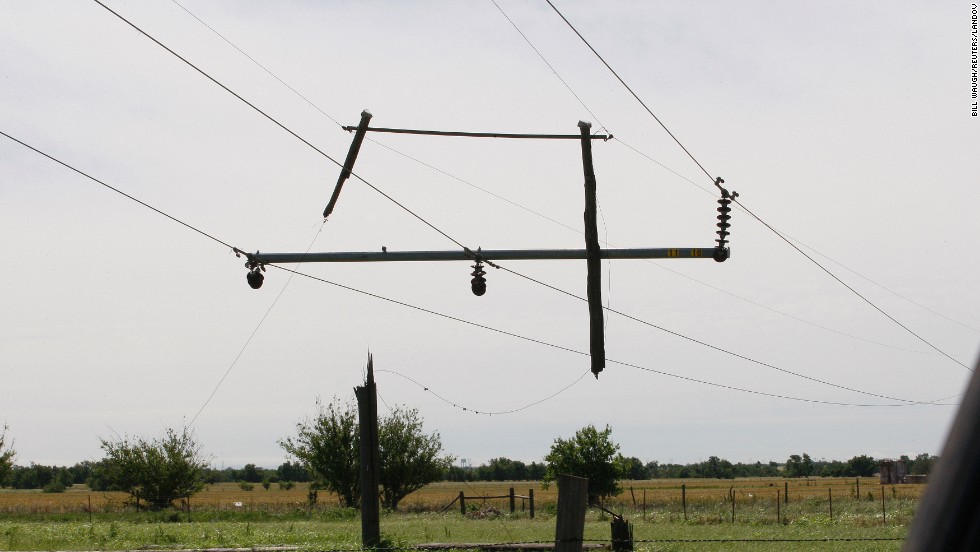
Have you ever seen the remains of a power pole hanging from a power line? That would seem to indicate that there exists excess strength in the system, or that the line support structures are substantially overbuilt.

http://i2.cdn.turner.com/cnnnext/dam/assets/130601193956-15-...

I suspect that in a hyperloop you could lose 5-10 pylons in a row and what would happen is that the tube would sag well beyond normal operational parameters between the remaining pylons, quite possibly even touching the ground. The reason that so much extra strength will probably exist in the system is that there's a limit to how much deflection you can tolerate without jostling passengers too much for them to buy tickets on a regular basis. And that small deflection means that there's a lot of extra strength in the system, even though it's not strictly needed just to hold things up.

This is why machine tools have giant castings well in excess of the strength needed for the machine to stay together. It's because the Young's modulus matters far more than the yield strength or the ultimate tensile strength when you're trying to build a machine that can hold a sub 0.001" tolerance.

So if you happened to be traveling in that overbuilt tube at 500mph just after it's fallen to the ground, you'd quite likely bump (or smash) your head on the sides and ceiling of your vehicle.

But what you wouldn't do is slam into the dirt that's now at the end of the tube like you would if your buried concrete tube was sheared 20ft by a fault line.
Re: SpaceX Hyperloop Pod Competition

#115
post #52

I wonder what they will do about claustrophobia? > The capsule itself would need to be small—4.43ft (1.35m) wide and only 3.61ft (1.10m) high. No standing room No windows, pod inside a metal tube, seats reclined with minimal head room. There's no rational reason to panic in that position, but many people will not be comfortable. Video displays might help, but only to a point.

I've been worried about the same thing. Also the idea that if the pod stops you have no way out for hundreds of miles.

Re: SpaceX Hyperloop Pod Competition

#116
post #112

Earlier quoted context omitted.

I think that's admirable, and doesn't strike me as out of the ordinary for Elon. SpaceX has some remarkable engineering talent (which also transfers tech to Tesla; see their friction stir welding technique that is used by both companies now). It wouldn't be fair for SpaceX to be able to win.

Serious observation. Why do people (here) feel they can refer to Elon Musk as just 'Elon' - using his first name, that is? It seems overly familiar, and impolite to me. Being from the UK, I would refer to him as 'Musk' in both writing and speech, and perhaps even as 'Mr. Musk' in formal writing. Is it a SV, or even just American, thing perhaps? It seems to depend on the person, though. For instance, the Google founde…

Different cultures I assume, based on my interaction with my UK (I'm in the US) counterparts.

Re: SpaceX Hyperloop Pod Competition

#117
post #47

The 9 engineering points at the end of the text, are very important and extremely dificult each one of them. I would add a pod decompression, and the emergency braking emergencies. Common oxigen masks don't work above 50000' and you can not dissipate the kinetic energy of a pod traveling at 900km/h just by friction without a brake fire.

> you can not dissipate the kinetic energy of a pod traveling at 900km/h just by friction without a brake fire.

Sure you can, just use water stored onboard to cool the brakes. Obviously the only case when you would need to use friction brakes in the hyperloop is in an emergency so we're fine with just boiling away the water into the steel tube. It takes 2,261 KJ per kg to boil water in the vacuum of the tube and assuming a pod weighs in at 1000 kg and is travelling 300 m/s that gives us 45 MJ of kinetic energy to deal with. That comes out to just under 20 kg of water to stop a 1000 kg pod moving 300 m/s. That's a decent size tank when considering the form factor of a hyperloop pod but still doable.

Re: SpaceX Hyperloop Pod Competition

#118
post #74

Earlier quoted context omitted.

VR goggles.

I was about to say that sounds even more vomit-inducing, when you consider all the g-forces going on, and then add goggles on top of it. But then, if the g-forces match what the passenger is seeing through the goggles, that could actually be less vomit-inducing maybe? It's an interesting idea. I personally find the idea of spending an hour in a tiny enclosed space with no ability to move to be quite disturbing, and I…

Why are there lots of G forces? once you are at cruising speed it might not feel like you are moving at all.

Re: SpaceX Hyperloop Pod Competition

#120
post #20

> SpaceX will construct a one-mile test track adjacent to our Hawthorne, California headquarters I'm not sure which would be the more remarkable achievement, getting the Hyperloop working, or obtaining the real estate to build a mile-long test track in Hawthorne .

They could use what I will call a rocket-estate crash coupling: 1. "Accidentally" crash a rocket near some properties there (far enough not to do any actual damage). 2. Wait for said property prices to crash.

rocketing towards affordability. I like it.
Post reply on HN