Live data from Hacker News

Hands-On with Microsoft's New Holographic Goggles

wired.com

221–230 of 395 posts

Re: Hands-On with Microsoft's New Holographic Goggles

#221
post #219

Earlier quoted context omitted.

It's hard to understand how AR / holographic technology could help people in their day-to-day life. There are a zillion potential uses, but all of them seem extremely complicated and hard to pull off. Take the example of fixing your car. For example, performing your own oil change, or replacing your alternator. That seems like a perfect use case for holo, right? The goggles would tell you what needs to be done and wh…

Imagine a car mechanic remotely helping you to do what's needed to be done. This use case is showcased in one of the videos and it is probably not as complicated as building an AI engine to help a user repair his car. This thing is really crazy!!

Ah, yeah.. That's a good point. And the bandwidth probably exists to transmit images from the goggles to someone else in near-realtime.

Now I'm really excited about this.

Re: Hands-On with Microsoft's New Holographic Goggles

#223
http://qz.com/330921/this-is-the-difference-between-microsof...

More closeup picture of the device in that link. There's some sort of camera/light emitter above the left and right eyes. Two panes, and some sort of smaller HUD in front of the right (and left?) eyes, but it actually might be a part of the second glass pane.

Re: Hands-On with Microsoft's New Holographic Goggles

#224

I think Microsoft re-branding Augmented reality as "holographic" is hugely impactful and, with the new wave of AR and CV products that are coming onto the market [1] might be the thing that makes people take it seriously. It's just so much easier to explain to people what it is if you say Holographic vs Augmented Reality - even though it is technically wrong. Kudos to MSFT for making that leap. [1] Shameless plug for…

From their marketing material, they pretend they figured a way to fake depth. If true, that would be a huge step compared to classic stereoscopic technologies or other cumbersome devices. However, I doubt this is the case, else they wouldn't just slap this announcement at the end of a boring Windows 10 presentation. I mean, all I could remember about this presentation was: "Windows 10. Windows 10. Windows 10. Windows…

No need to fake it... if you can get the retinal projection accurate enough, with fast enough eye tracking, the depth is as real as anything else you'll see in real life...the goal would be to have it feel completely natural.

Re: Hands-On with Microsoft's New Holographic Goggles

#225
post #177

Earlier quoted context omitted.

AR is traditionally a 2D projection on 3D space. This is a 3D projection that you interact with. Sure, its still AR on some level, but I think differentiating the product makes a lot of sense. My idea of AR is a boring HUD-like system that fits in with things like flying fighter jets. This holographic projection is different and notably so. MS could find the middle ground between lush 3D VR-like environments and the…

When we say virtual reality, there is this implicit expectation (at least in my mind) that its an always ON experience. The Video here did show some of that too but I think scoping it to specific tasks at least initially would be very powerful. So you don't wear these bulky, dorky glasses/headsets all day long but only when you need to do specific things. And then you return to your normal life. In the early days of…

Right - but let's say they get less dorky and more comfortable - and really do have the visual quality we really want - objects look solid and real.

That seems much more useful than a VR that you have to plug out of the real world and immerse yourself in - at least for collaboration with others on real world things... like the example with the motorbike design.

Re: Hands-On with Microsoft's New Holographic Goggles

#226
post #105

Earlier quoted context omitted.

Depending on the resolution, it could replace your monitors at work (assuming the headset is light, comfortable, etc). Using a wireless keyboard and mouse, you'd have your computer with you anywhere in the home or office. As a developer, having a wall of holographic desktop screen space in front of me would be amazing. My home office would look much better too! I have no idea how far away this version of HoloLens is…

I think the 'depending on the resolution' is key. Its not really a matter of software to me, its whether or not the hardware can deliver the necessary resolution to replace a monitor that's typically 1.5ft from your face. If you can break the dam by executing on the hardware the software will flow. (I wonder how Hololens compares to Magic Leap's technology.) I think it would be very cool to just have 3 tripods on you…

Thinking about how our eyes really work - you don't need the same resolution. You only need proper eye tracking and the right amount of resolution in the center of your vision (or wherever). You only need it to render what you are looking at - I'm sitting about 2 feet away from a 27 inch screen.... I'm never looking at the entire thing in such a way that I need all that detail at every point. Sure, I need it to be there when my eyes dart around... but as long as that's done, it will look just as real.

Given something more adaptive, there's no reason you couldn't have a ginormous holographic wraparound workspace... or whatever your imagination can come up with.

Re: Hands-On with Microsoft's New Holographic Goggles

#227

Earlier quoted context omitted.

I think this type of AR / holographic technology has many, many more potential real-world applications than VR. With VR, you're shutting yourself off from the outside world. Here, you're enhancing the outside world with technology. You still get to interact with others. Using HoloLens doesn't stop you from doing almost anything. What I'm curious to find out is whether HoloLens will run into the same core problem as G…

It's hard to understand how AR / holographic technology could help people in their day-to-day life. There are a zillion potential uses, but all of them seem extremely complicated and hard to pull off. Take the example of fixing your car. For example, performing your own oil change, or replacing your alternator. That seems like a perfect use case for holo, right? The goggles would tell you what needs to be done and wh…

Or allow them to select from a list?

Re: Hands-On with Microsoft's New Holographic Goggles

#228

Earlier quoted context omitted.

From their marketing material, they pretend they figured a way to fake depth. If true, that would be a huge step compared to classic stereoscopic technologies or other cumbersome devices. However, I doubt this is the case, else they wouldn't just slap this announcement at the end of a boring Windows 10 presentation. I mean, all I could remember about this presentation was: "Windows 10. Windows 10. Windows 10. Windows…

No need to fake it... if you can get the retinal projection accurate enough, with fast enough eye tracking, the depth is as real as anything else you'll see in real life...the goal would be to have it feel completely natural.

... and to do it, as well as motion tracking and environmental feature identification, in real-time with as little latency as possible, and do it on batteries.

I keep feeling like watching the Longhorn demo at PDC 2003...

Re: Hands-On with Microsoft's New Holographic Goggles

#229
Here is fresh "back-to-reality" report from Engadget journalist who just tried working HoloLens device prototype (at the same event where it was announced):

---------------

"Does it work? Yes, it works. Is it any good? That's a much harder question to answer."

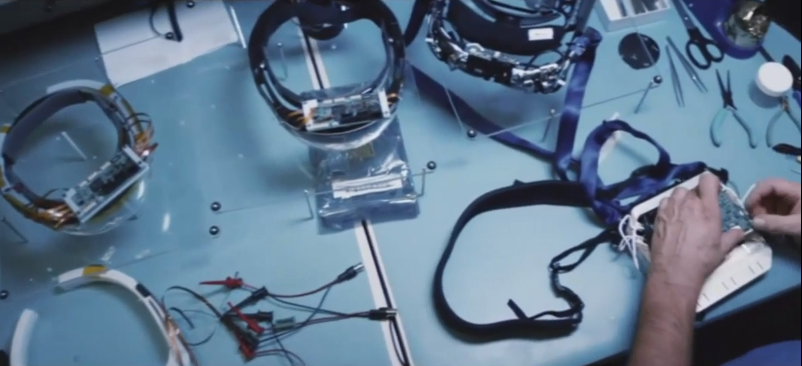
"I say this in the nicest way possible: Using Microsoft HoloLens kinda stinks. In its current form, it feels like someone is tightening your head into a vice. The model being shown today on Microsoft's Redmond, Washington, campus isn't what you saw onstage, but a development kit. The demos begin by lowering a tethered, relatively small, rectangular computer over your head, which hangs around your neck by sling."

"You can literally feel the heat coming off the computer's fans, which face upward. It feels like you're wearing a computer around your neck, because you are."

There doesn't seem to be full hand tracking (as suggested by the demo on stage). Instead it uses something they call AirTap which uses gaze for pointing and hand only for clicking:

"By looking at any of them and using "AirTap" (hold up your hand in front of your eyes, tap with your pointer finger), I could select any contact to call."

"While the effects of interaction were impressive, the actual interaction was less so. Rather than picking up a sheep with my hand by literally just grabbing it with my actual hand, my only means of interaction were voice (pickaxe! redstone torch! etc.) and the aforementioned "AirTap."

Overall impression is kinda mixed (especially compared to how well were received even very crude Oculus Rift early prototypes):

"HoloLens is clearly very early, and kinda sucks right now. It's uncomfortable. It's cumbersome. It looks and feels like a piece of hardware that's far from final."

"Is it bad? No. Lord no. Stop it. It's very impressive, but it's a brand new entry in a market that basically doesn't exist yet."

---------------

http://www.engadget.com/2015/01/21/microsoft-hololens-hands-...

---------------

Given Engadget description of the actual device, here is a screenshot from Microsoft promotional video that probably captured it:

https://pbs.twimg.com/media/B76axLVIUAA4egZ.png:large

https://www.youtube.com/watch?v=IPmAwvmOXKM&t=12m21s

---------------

Another journalist impressions (Andy McNamara from Game Informer):

"Important first impression. In the videos I thought it filled your entire field of view, but it's more like a screen floating in space."

"I'd say it's like a 16x9-ish monitor floating about 7 to 8 inches just in front of your face."

https://twitter.com/GI_AndyMc/status/558039828328357888

---------------

Gizmodo report was more enthusiastic, especially about ability of display to hide real view, though noted "tiny" field-of-view:

"It's one of the most amazing and tantalizing experiences I've ever had with a piece of technology."

"It's not like the Oculus Rift, where you're totally immersed in a virtual world practically anywhere you look. The current Hololens field of view is TINY! I wasn't even impressed at first. All that weight for this? But that's when I noticed that I wasn't just looking at some ghostly transparent representation of Mars superimposed on my vision. I was standing in a room filled with objects. Posters covering the walls. And yet somehow—without blocking my vision—the Hololens was making those objects almost totally invisible."

http://gizmodo.com/project-hololens-hands-on-incredible-amaz...

---------------

Verge folks also liked it:

"... you look down at the coffee table and there's a castle sitting right on the damn thing. It's not shimmery, but it's not quite real, either. It's just sitting there, perfectly flat on the table, reacting in space to your head movements. It's nearly as lifelike as the actual table, and there's no lag at all. The castle is there. It's simply magic."

http://www.theverge.com/2015/1/21/7868251/microsoft-hololens...
Re: Hands-On with Microsoft's New Holographic Goggles

#230
post #142

Earlier quoted context omitted.

With the camera, it's easy to understand how they make the objects feel solid - they just overlay it over the video feed. How would that work on the glasses, I have no idea. Does it have LCD shutters that block incoming light where they want to add a "solid" object?

If you pause at 9 seconds in and check out the rig they're using to film the feed where the virtual objects are visible, it looks as though they are using the same lenses that are on the goggles to display the virtual objects in front of what the camera is recording. So I would bet that what we are seeing in the video is exactly what the user is seeing and not something added on the fly by other means.

Nope. Those lenses are above the camera's main lenses. Whatever those circles do, they are not generating the images for the video. Plus, only one would be needed for that - the camera has only one "eye".
Post reply on HN