[flagged]
There's a fundamental category error at play here: exploit chains like this one and the one behind FORCEDENTRY[1] cost millions, if not tens of millions, of dollars to discover and weaponize, even before operationalization. The people finding and building these chains are doing so as part of nation-state intelligence operations; they go well beyond what any reasonable civilian threat model contains. Put another way:…
Operation Triangulation: What you get when attack iPhones of researchers
111–120 of 433 posts
Re: Operation Triangulation: What you get when attack iPhones of researchers
#112Earlier quoted context omitted.
It can be defended against. The detail is that the only way to harden those defenses is to toss it out in the world and let folks poke holes in it. This was an extremely complex exploit. It was complex because of all of the defenses put in place by Apple and others. It required State level resources to pull it off. We also don't know what, if any, external skullduggery was involved in the exploit. Did someone penetra…
>It was complex because of all of the defenses put in place by Apple and others. I don't know jack about hardware but it would seem obvious that when one designs a chip, you make sure it does not have 'unknown hardware registers' or unknown anything when you get it back from the manufacture. This makes everything written on this page worthless... >Prevent anyone except you from using your devices and accessing your i…
Either Apple or Arm has employees that know what these registers do. They are likely used for debugging and/or testing.
A lot of those registers can do very interesting things, since e.g. fault-injection is an important part of testing. A security-minded implementation will allow these to either be fused off or disabled very early in the boot process. The latter is probably more common, and any disconnect between the hardware and software side can cause this step to get missed.
Re: Operation Triangulation: What you get when attack iPhones of researchers
#113Earlier quoted context omitted.
There's a fundamental category error at play here: exploit chains like this one and the one behind FORCEDENTRY[1] cost millions, if not tens of millions, of dollars to discover and weaponize, even before operationalization. The people finding and building these chains are doing so as part of nation-state intelligence operations; they go well beyond what any reasonable civilian threat model contains. Put another way:…
There haven’t really been all that many hardware exploits for us to judge Apple on this, have there?
(Hopefully what I said wasn't interpreted as a value judgement about hardware security specifically -- the only point I was trying to make is that ICs spend significant resources discovering exploits on all of these platforms.)
Re: Operation Triangulation: What you get when attack iPhones of researchers
#114[flagged]
Re: Operation Triangulation: What you get when attack iPhones of researchers
#115Knowing more about the exfiltration component where it sends data to a remote server would be helpful. According to the article it’s sending large audio microphone recordings. I assume a company like Kapersky would explicit deny all outgoing network connections and then approve one by one.
Re: Operation Triangulation: What you get when attack iPhones of researchers
#116Earlier quoted context omitted.
It can be defended against. The detail is that the only way to harden those defenses is to toss it out in the world and let folks poke holes in it. This was an extremely complex exploit. It was complex because of all of the defenses put in place by Apple and others. It required State level resources to pull it off. We also don't know what, if any, external skullduggery was involved in the exploit. Did someone penetra…
>It was complex because of all of the defenses put in place by Apple and others. I don't know jack about hardware but it would seem obvious that when one designs a chip, you make sure it does not have 'unknown hardware registers' or unknown anything when you get it back from the manufacture. This makes everything written on this page worthless... >Prevent anyone except you from using your devices and accessing your i…
Could have stopped writing right there.
Re: Operation Triangulation: What you get when attack iPhones of researchers
#117It’s quite unfortunate that Apple doesn’t allow users to uninstall iMessage, it seems to be the infection vector for advanced threats like this, NSO group, etc. Presumably it’s to avoid the support burden, but they could gate it behind having Lockdown Mode enabled for a week or something to shake out the vast majority of mistaken activations.
Re: Operation Triangulation: What you get when attack iPhones of researchers
#118>The resulting shellcode, in turn, went on to once again exploit CVE-2023-32434 and CVE-2023-38606 to finally achieve the root access required to install the last spyware payload. Why isn't Apple detecting the spyware\malware payload? If only Apps approved by Apple are allowed on an iPhone, detection should be trivial. And why has no one bothered to ask Apple or ARM about this 'unknown hardware'? >If we try to descri…
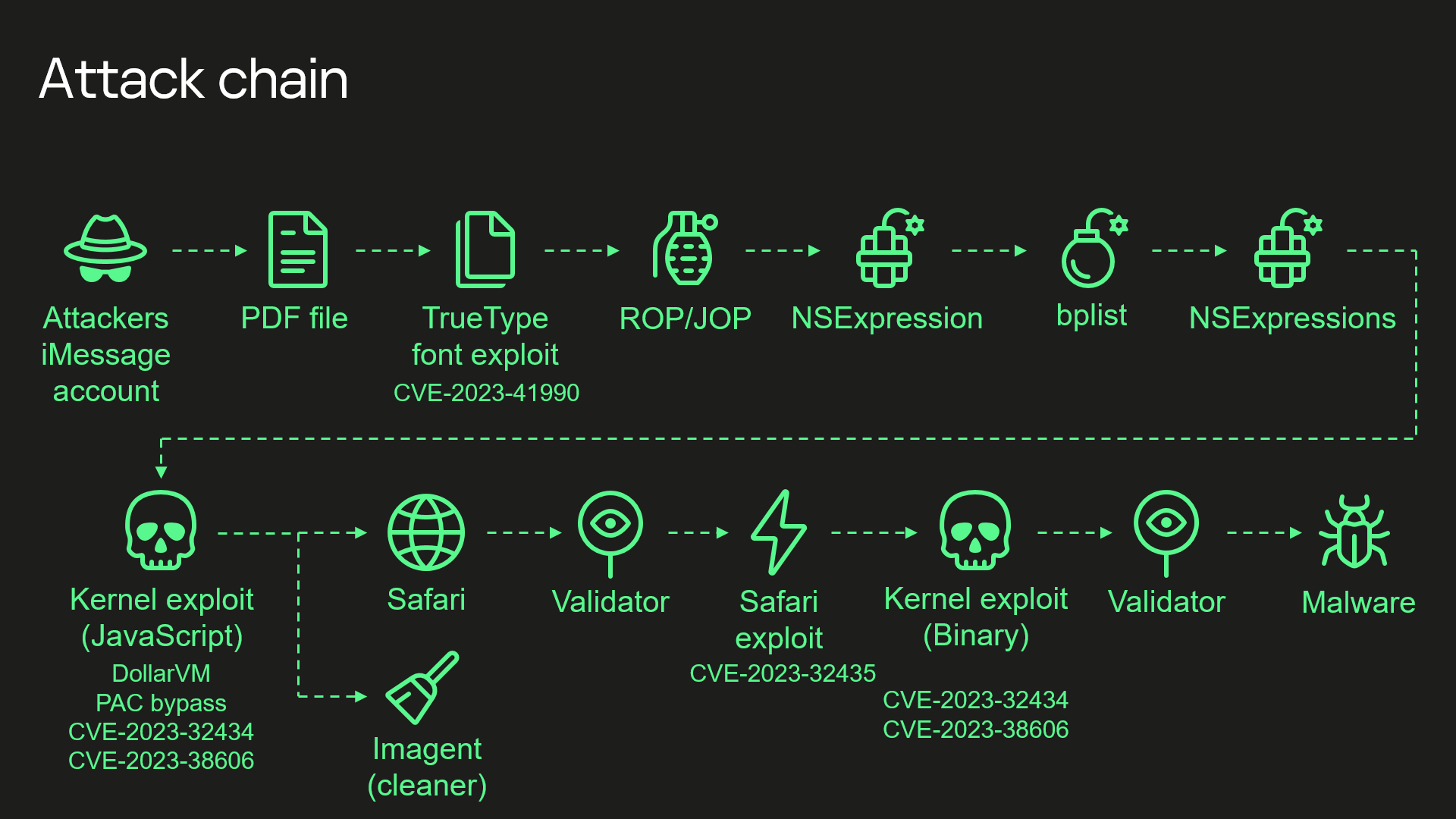
https://cdn.arstechnica.net/wp-content/uploads/2023/12/trian...
As you can see, it starts with a PDF coming into iMessage, and that PDF has a font that is able to exploit ROP gadgets.
Re: Operation Triangulation: What you get when attack iPhones of researchers
#119Earlier quoted context omitted.
To be fair, that was just Kaspersky taking a jab at Apple, after being absolutely gutted by hackers because of their own poor security posture.
I don’t really see anything wrong with their security posture here.
Re: Operation Triangulation: What you get when attack iPhones of researchers
#120Earlier quoted context omitted.
There's a fundamental category error at play here: exploit chains like this one and the one behind FORCEDENTRY[1] cost millions, if not tens of millions, of dollars to discover and weaponize, even before operationalization. The people finding and building these chains are doing so as part of nation-state intelligence operations; they go well beyond what any reasonable civilian threat model contains. Put another way:…
Your “threat model analysis” takes for granted that a “civilian” is a billion times less important than a “nation-state”. It makes no sense to waste any time analyzing anything after such a conclusion. Therefore, something is wrong here.
99.99% of the world lives in threat model 1; our goal as security minded people is to protect these people. These people want general purpose networked computers in their pockets.
0.01% of the world lives in threat model 2; our goal is also to protect these people. But these people don't get protected while also having general purpose networked computers in their pockets.
Both groups are civilians, and both deserve security. But they also have different demands; if Apple forced Lockdown Mode's usability restrictions onto a billion people tomorrow, a large percentage of them would switch to materially less secure hardware and software vendors.