This is a surprisingly comprehensive and well-written article, worth reading. For example, the authors note that the majority of Australia's lithium ore is refined to metal in China, although there's a push for local Australian refining. For more details on the current state of lithium battery production globally, this is good: https://www.nature.com/articles/s41467-022-31850-y (Jul 2022) "Tracing the origin of lithi…
How Australia became the world’s greatest lithium supplier
101–110 of 165 posts
Re: How Australia became the world’s greatest lithium supplier
#102Earlier quoted context omitted.
SAE is using terms differently, abusing, re-defining terms that have been in use for a century. This mixed use of the same word for different things can be extremely dangerous.
Not as dangerous as the free pass LFP batteries have been getting despite trapped energy, thermal runaway and very high heat fires that are extremely hard to control and extinguish. There needs to be far, far more oversight of the battery industry.
Re: How Australia became the world’s greatest lithium supplier
#103Earlier quoted context omitted.
The alternative is gas. 100x more energy dense than lithium and it hasn't been great for the environment to say the least.
Chile is already being ruined. Pay close attention to the lithium triangle as it expands and the state the planet is left in after being mined https://www.euronews.com/green/2022/02/01/south-america-s-li... Why is lithium extraction bad for the environment? Any type of resource extraction is harmful to the planet. This is because removing these raw materials can result in soil degradation, water shortages, biodiversi…
By copper mining. Lithium is unnoticeable in comparison.
Re: How Australia became the world’s greatest lithium supplier
#104I wish Australia the best of luck in escaping the resource curse, by moving up the value chain. Relative to China. I'd like this post to be more sarcastic than it is, really, I would.
> resource curse The service sector makes up 62% of the Australian economy.
I'm sure they need services, and not just raw materials they can turn into products and sell to everyone, rather than Australia in particular. But you'll service them with services.
Australian services, to be clear. Very in-demand trade good. Much like raw lithium, and batteries, that way. Everyone wants Australian services.
Re: How Australia became the world’s greatest lithium supplier
#105Earlier quoted context omitted.
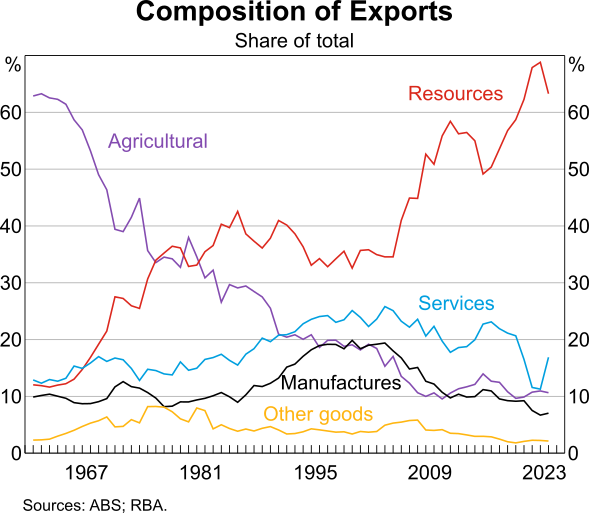
Australia’s service sector makes up ~20% of exports - the resource curse is related to import/export, not internal measures. Total exports 2019-20: 383G$ goods, 92.3G$ services https://www.dfat.gov.au/publications/trade-and-investment/tr...
Wikipedia has an articel on the Resource Curse: https://en.wikipedia.org/wiki/Resource_curse It is about having "less economic growth, less democracy, or worse development outcomes than countries with fewer natural resources". Australia is an advanced services based economy. No one would consider them as an example of a country under a "resource curse" By your measure, Japan also has a resource curse because services…
Re: How Australia became the world’s greatest lithium supplier
#106Earlier quoted context omitted.
> Cars used to be made of steel and were very recyclable. More recently they are mostly made of plastics and alloys that are not easily recyclable. 50/50, actually.
There is still some steel in the core load bearing areas of modern vehicle but they are predominantly alloys. I'd say around 60% alloys, 35% plastics and 5% steel would be an average
https://transportgeography.org/contents/chapter4/transportat...
Ferrous metals 65%.
Re: How Australia became the world’s greatest lithium supplier
#107Earlier quoted context omitted.
Lung cancer rates are higher near major roads due to air pollution from cars. Fossil fuel cars basically means every highway is a superfund site. We just don't talk about it. Given the choice between toxic waste at a mine and toxic waste in millions of homes, I'll take the mine.
How much of that pollution is coming out of the tail pipe vs. off of the brake pads and tires?
A while back I saw a video on youtube of someone mining road dust for platinum of all things.
Evs will be a likely improvement for the health of those near roads.
Re: How Australia became the world’s greatest lithium supplier
#108Earlier quoted context omitted.
Lung cancer rates are higher near major roads due to air pollution from cars. Fossil fuel cars basically means every highway is a superfund site. We just don't talk about it. Given the choice between toxic waste at a mine and toxic waste in millions of homes, I'll take the mine.
How much of that pollution is coming out of the tail pipe vs. off of the brake pads and tires?
Tire scrub and brake pads produce larger particles that wash into stormwater drains and poison downstream aquatic life.
Re: How Australia became the world’s greatest lithium supplier
#109Earlier quoted context omitted.
Australia’s service sector makes up ~20% of exports - the resource curse is related to import/export, not internal measures. Total exports 2019-20: 383G$ goods, 92.3G$ services https://www.dfat.gov.au/publications/trade-and-investment/tr...
Wikipedia has an articel on the Resource Curse: https://en.wikipedia.org/wiki/Resource_curse It is about having "less economic growth, less democracy, or worse development outcomes than countries with fewer natural resources". Australia is an advanced services based economy. No one would consider them as an example of a country under a "resource curse" By your measure, Japan also has a resource curse because services…
Whether that graph says anything about Australia and the resource curse is graduate level analysis - I don’t have any opinion either way.
I felt your reply was a strawman, or putting words in my mouth? I only pointed out a figure with no implication of analysis, because your figure of internal services was completely irrelevant. Note even countries with the resource curse still internally have cafes, and concerts, and mining support crews.
PS: NZ probably isn’t doing much better. Service exports seem lowish, and half of our service exports is tourism: https://oec.world/en/profile/country/nzl#trade-services
[1] https://www.rba.gov.au/education/resources/explainers/trends...
Re: How Australia became the world’s greatest lithium supplier
#110Earlier quoted context omitted.
Not as dangerous as the free pass LFP batteries have been getting despite trapped energy, thermal runaway and very high heat fires that are extremely hard to control and extinguish. There needs to be far, far more oversight of the battery industry.
Where in that link were LFP batteries mentioned? One of the advantages of LFP over nickel-manganese-cobalt chemistries is lower heat evolution when punctured or ruptured. Do you have other evidence for your claim of very high heat fires from LFP batteries?