Live data from Hacker News

Why isn’t new technology making us more productive?

nytimes.com

491–500 of 603 posts

Re: Why isn’t new technology making us more productive?

#491
post #445

Earlier quoted context omitted.

Flights were five times more expensive in the period you refer to [1]. I would bet that the number of fliers increased almost proportionally. A significant part of this cost reduction is efficiency gains, with better, lighter airplanes that consume less fuel. Airplanes are also safer today. To call all that "no appreciable movement" is unfair. [1] https://www.fastcompany.com/3022215/what-it-was-really-like-...

Noted, FYI: https://news.ycombinator.com/item?id=31500807

You wrote above:

> Gordon's point is that the best commercial-grade service ... didn't move much in the seventy-eight years* from 1936--2014. It's been nearly another decade and that story's largely the same.

The fact that total passenger miles has been largely flat since 2000 (is that even accurate? [1]) has no bearing on that claim. Furthermore, the number of passengers has basically tripled in the last 20 years alone [2], at the cost of some comfort certainly, but this also must count as efficiency gains. I mean, if we ignore an order of magnitude reduction in cost and increase in number of passengers, yeah, I guess the industry is the same since the Wright Brothers.

[1] https://www.statista.com/statistics/185744/us-passenger-mile... [2] https://www.statista.com/statistics/564717/airline-industry-...
Re: Why isn’t new technology making us more productive?

#492

Earlier quoted context omitted.

> If you missed a turn, god help you. People had lots and lots of paper maps. Every gas station had a rack of them. You'd probably have had a good spiral-bound one of your entire region in your car. Wrong turn? Just check the map and save God's help for later.

> Just check the map Ah yes, “just” check the map. When I was a kid if my Mom made a wrong turn on a way to a doctor’s appointment a few counties over (I got sick a lot as a kid) I’d have to reach under my seat and figure out which of the multiple paper map books corresponded to where we were. Until GPS I had no visual sense of “where we were” when we were out of my town (I don’t understand the “relying on GPS makes…

Ok. So you were a child and not good at reading a road map of an area near your home to locate a physician that you visited frequently. The vast majority of society managed to navigate using paper maps for centuries with little fanfare.

GPS maps are an improvement not a major innovation, which is the main point. They are more convenient and require less skill, but they are functionally a paper map with a dot on it that changes based on your location.

Finding a gas station in an unfamiliar area, however, is definitely improved by a GPS map. So, you can now run the fuel tank down a little further before filling it up. Nice, but again not revolutionary in my opinion.

Re: Why isn’t new technology making us more productive?

#493
post #487

Earlier quoted context omitted.

What a horribly myopic take, it completely changes the "outcomes". I am way more productive and happy: - I save more money so I have more to spend towards productive uses. - I don't die as often, living is productive. - I listen to podcasts, diverse videos (just listening) or music, learning more during my drive. - I call friends and family, enhancing connections and communicating more. - The car drives for me, leavi…

Virtually everything you mentioned has nothing to do with the point that was so eloquently stated by the above poster.

> The main point though is that you don't accomplish more

And I pointed out ~10 ways I do accomplish more because of it, refuting exactly the point.

The rest of the comment cites a ridiculous one-off, narrow social science study with a few vague pathic appeals to the quaint simplicity of the before-fore-times.

I think you both want to zoom way-way out to 10-guy "like, what does accomplish even really mean? Isn't simplicity, like, the real accomplishment?" and I'm all for a simple life well lived, but that's pretty much re-defining the entire discussion to be about something else. And no one is getting rid of cars or phones at this point, I'd love to see that argument.

You write to me on an internet-connected device, on a forum on the web, from likely a laptop or phone built within the last 5 years. That same phone you likely use all day, every day for hours a day. And you'll argue it's somehow a sinister regression? So... why are you here? A laptop, the internet (and modern healthcare that saves lives, modern cars that save lives, etc) doesn't exist without "complexity". It's such a ridiculous attempt to de-rail an interesting and specific debate.

It's also such a uniquely HN-specific type of person that pines for olden days while distinctly relying on modern technology all day every day, so weird. The same types will laud the Framework Laptop - yet talk about reducing complexity and supply chain reliance.

Re: Why isn’t new technology making us more productive?

#494
post #370

Earlier quoted context omitted.

Right, but how many things are actually central to document processing?

> actually central to document processing? ahh, the no true scotsman style of logical fallacy. Document processing is not strict nor defined. The features listed in the parent comment are all very useful, and if the floppy disk document processor of 30 years ago could do it, the people there would also find it useful.

Yes they would find it useful, but in terms of productivity what's it worth? For the things that aren't collaboration, it's probably single digits. Real-time collaboration is worth a lot for certain documents, but also you could have managed that on a 486 if you had a modem.

Re: Why isn’t new technology making us more productive?

#495
post #421

Earlier quoted context omitted.

With regards to books, this is such a weird take - high quality, well curated books had (and have) such a density of good information, that a stack of paper had all the information you could possibly look on a given for in a concise, reliable manner. For example, when I tried picking up electronics as a curious high-schooler, I managed to pick up a clearance sale copy of The Art of Electronics - it had all the inform…

> I'd be hard-pressed to find such an accurate and comprehensive reference on that topic anywhere on the internet You can find The Art of Electronics on the internet... And you can put it on an old tablet with dozens of other reference books.

However, you can’t read it without electricity to charge the battery and an internet connection. The device you read it on distracts you with notifications, emails, and other communications. You cannot easily scribe notes in the margins or easily flip between two pages that have related information. The device you read it on costs $1000 and must be replaced by every few years due to operating system obsolescence. You cannot read the book in bright outside sunlight on the device. The site that you purchased the book from goes out of business or the link to the book is broken or the site is down preventing access to the book. You drop the device and it breaks, while dropping the book is typically not an issue.

Re: Why isn’t new technology making us more productive?

#496
post #438

Earlier quoted context omitted.

> The software we use is 1000 times more complex than it was 20 years ago, leading to performance that really have not improved a lot, and a lot of functional stagnation. Many applications are slower to start today than they were 10 years ago, because back then they were binaries and today they are Electron apps. Also known as Wirth's law: https://en.wikipedia.org/wiki/Wirth%27s_law Sometimes it worries me. If we had…

I am doing mostly Ruby and code in Atom, or Sublime before that. I don't have noticeable starting times for my editor. Long ago I started coding in gedit. Since then the language got only faster, I need less code because more major libs do more of my work. Also my computer is like 8 years old, my laptop until recently was over 10 years old and my current one about 3 or 4 (T420 and T480s) Ruby is not native, but we'll…

> I am doing mostly Ruby and code in Atom, or Sublime before that. I don't have noticeable starting times for my editor.

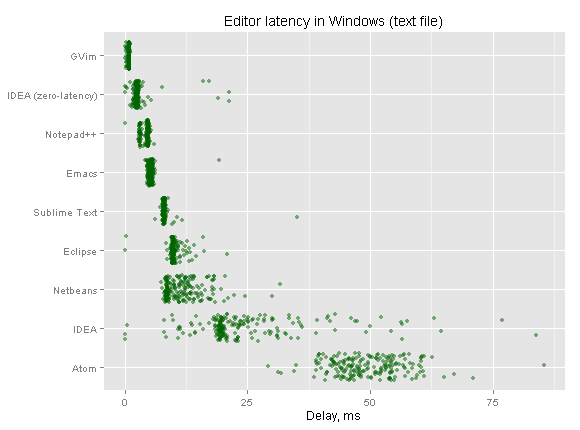
That's interesting, because there have been articles that indicate that Atom has not only comparatively worse startup times (which may or may not matter to people), but also really bad typing latency: https://pavelfatin.com/typing-with-pleasure/

In particular, this image gets the point across well: https://pavelfatin.com/images/typing/editor-latency-windows-...

> Ruby is not native, but we'll portable. My point is this 'boring' work style is here, people just choose to not use it.

This is a good point, though! As far as I know, plenty of people still use Ruby (typically on Rails), or also other "batteries included" solutions like Python and Django pretty successfully.

That said, most of these languages have pretty severe limitations in regards to their performance and resource usage: https://jaxenter.com/energy-efficient-programming-languages-...

Some lovely benchmarks seem to confirm that, in relatively real world conditions: https://www.techempower.com/benchmarks/

Admittedly, that doesn't matter for all projects, but why couldn't we have the ease of use of Python with the performance of Rust and the developer experience of Rails/Django?

Re: Why isn’t new technology making us more productive?

#498
post #471

Earlier quoted context omitted.

There's a weird disconnect with computers. The software we use is 1000 times more complex than it was 20 years ago, leading to performance that really have not improved a lot, and a lot of functional stagnation. Many applications are slower to start today than they were 10 years ago, because back then they were binaries and today they are Electron apps. Your average web based word processor with cloud storage perform…

Recently I opened a Full HD video in a web browser, connected my laptop to a TV using an HDMI cable, moved the browser window over to the TV screen, and watched the video. And it just worked, with sound and all. I didn't have to download or configure anything, neither on the computer nor on the TV. That would have been utterly unbelievable 20 years ago, bordering on magic (especially the no-download/no-configuration…

I'm pretty sure XP let you hot plug displays?

You could simply open windows media player and stream video 20 years ago. The resolution would have been the main impressive thing, along with how much money you spent on that high speed internet connection. But far from utterly unbelievable. I'm not sure anyone would have cared which program you used.

Re: Why isn’t new technology making us more productive?

#499
post #250

Earlier quoted context omitted.

bogus! I was there, and let me tell you, I get so much more done each day, it's shocking: - cellphones, the internet and GPS saves insane amounts of time coordinating RL events. I'm never gonna get back the 1000+ hours I spent with paper maps trying to find places, playing "phone tag" coordinating activities, etc. Kids these days, they just have no idea. - remote work & learning = 2+ hours PER DAY. I used to pay $500…

I am not convinced by this lengthy rebuttal, in fact it just solidified OP's point. OP/Thiel's point: It's not that we haven't made any progress, but rather the progress since the cold war has been disappointing . I'm a bit ambivalent about Globalisation and whether that can be considered progress. We globalized several times (Early trade routes, 14th century, British empire and then again in post-modern era).

thiel gave us a payments company, a shitty hedge fund and a government contractor doing consulting work. not to be reductionist, but his complaining doesn't register for me at all. for god's sake he tries to get people to quit Stanford to start businesses that necessarily can only coast on previous achievements, instead of doing science.

Re: Why isn’t new technology making us more productive?

#500
As always I think this problem is down to some people being producers and some people being consumers. We all produce and consume, but individuals do so in differing ratios.

I think it's especially something that happens as we age, too. I've noticed I've become more of a consumer as I get older, I work on fewer personal projects and spend less time thinking of things to build compared to consuming the work of others.

Post reply on HN