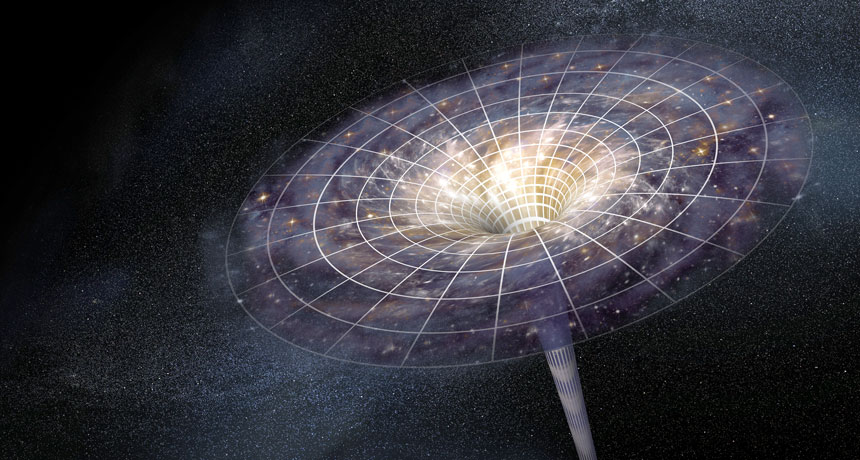
Regarding Q2, spacetime curvature is the grid itself. Think of it as "space" in the simple term where objects including black hole travel through. Black hole's gravity warps the surrounding spacetime. Think of it as the "space" is stretched out by the black hole's gravity.
Regarding time, there's no universal global coordinate for time in General Relativity. Time is based on each observer's time coordinate. When time stops inside a black hole, it means time appears to stop in an outside observer's time coordinate.
This is because the spacetime curvature inside a black hole has been stretched so much that the stretched curvature approaching infinite long. See the pulled down funnel [1]. An object traveling in no faster than light speed in the infinitely long curvature takes forever and its time appears frozen to an outside observer.
But it's an illusion to the outside observer. The observer is seeing the light imprint emitted from the object, not the real object itself. See the diagram below.
BH > P
BH is the black hole singularity and o is the falling object toward BH. EH is the event horizon. P is the observer. The dots are the light photons emitted from the object along the way. The photons are traveling away from o and BH toward P. When the photons reach P, P can measure o's movement and time.
Imagine the object o has a blinking light beacon at its tail, blinking every second by its clock, i.e. on for half of a second and off for half of a second. You can see the light every second and measure the object's time.
Since the speed of the light is constant, the photon traveling away from BH will take longer and longer to move across the stretched out space, as shown by the spaced out dots between EH and P. As o approaching EH, P will see the blinking light slows down because the photons take longer to move across the stretched space. P would conclude that o's time is slowing down. Passed EH, the photon is not coming out because the space is stretched longer than it can cover in its constant speed. At EH, the photon can still come out but at a very slow pace because the space is stretched matching the speed of light. The beacon is not blinking because the light stream been stretched to infinitely long. Object o appears frozen as its time has stopped by P's measurement of the blinking rate. But what P sees is the long stream of photons stretched out when o approaching EH. The object o has long gone in its forever falling across the infinitely stretched spacetime. Only its light imprint before EH is being observed as frozen.
[1] https://www.sciencenews.org/wp-content/uploads/2017/05/05121...