Live data from Hacker News

Why can’t I go faster than the speed of light?

gravityandlevity.wordpress.com

111–120 of 234 posts

Re: Why can’t I go faster than the speed of light?

#111
post #97

My favorite general relativity paradox: A runner is running with a 20m pole at a sufficient velocity so that a stationary observer sees the pole having length 10m. The runner runs through a barn which is 10m long. And two people outside shut the doors simultaneously so that the runner is completely enclosed in the barn for a moment. But from the runner's perspective, the barn has length 5m long. What does she see hap…

At these high speeds and tiny distances, very little would probably be noticeable to a human observer. If any matter collided it would be a catastrophic release of energy evaporating the human.

But I think over longer distances there would be a time delay for the light of the explosion to reach the individual, so they would probably the light of a visually warped pole colliding with visually warped barn doors very briefly before disappearing into an explosion.

Re: Why can’t I go faster than the speed of light?

#112

Earlier quoted context omitted.

I'm pretty sure this doesn't work out because you have to slow down. So thinking about it, if you are traveling at that speed because of your inertial reference frame it is equivalent that everyone else around you is moving at (or near) the speed of light and they are moving slowly through time. This is the classic twin paradox and there is a resolution to it, which is that you can't instantaneously turn around.[0] O…

It does work out, in fact you could go arbitrarily far in space (and, mandatory, in external time) if you had infinite energy to spend. The acceleration and deceleration phase is almost negligible. Edit: the faster you go, the slower your own (inertial) time passes. That means the external time passes faster, and the factor grows to infinity the closer you get to C. In fact, subjectively there is no speed limit. As y…

But in your inertial reference frame the people on Earth are moving at (near) the speed of light. So they are the ones that should be staying young. Or similarly the planet you are traveling to is actually speeding towards you and you are staying still. This is why the twin paradox is a paradox, because of the reference frames.

Re: Why can’t I go faster than the speed of light?

#113

Q1. Does the future already exist? I realize this might be purely philosophical, but if I leave Earth, and fly through space near c kph, and return home a few hours later to find everyone aged 50 years... are they the "same" people, or are they a future-instance of the people left? To clarify, theoretically I could leave earth, and return home in exactly 1 hour (from my ref frame), and basically make people whatever…

Regarding Q2, spacetime curvature is the grid itself. Think of it as "space" in the simple term where objects including black hole travel through. Black hole's gravity warps the surrounding spacetime. Think of it as the "space" is stretched out by the black hole's gravity.

Regarding time, there's no universal global coordinate for time in General Relativity. Time is based on each observer's time coordinate. When time stops inside a black hole, it means time appears to stop in an outside observer's time coordinate.

This is because the spacetime curvature inside a black hole has been stretched so much that the stretched curvature approaching infinite long. See the pulled down funnel [1]. An object traveling in no faster than light speed in the infinitely long curvature takes forever and its time appears frozen to an outside observer.

But it's an illusion to the outside observer. The observer is seeing the light imprint emitted from the object, not the real object itself. See the diagram below.

    BH     > P
BH is the black hole singularity and o is the falling object toward BH. EH is the event horizon. P is the observer. The dots are the light photons emitted from the object along the way. The photons are traveling away from o and BH toward P. When the photons reach P, P can measure o's movement and time.

Imagine the object o has a blinking light beacon at its tail, blinking every second by its clock, i.e. on for half of a second and off for half of a second. You can see the light every second and measure the object's time.

Since the speed of the light is constant, the photon traveling away from BH will take longer and longer to move across the stretched out space, as shown by the spaced out dots between EH and P. As o approaching EH, P will see the blinking light slows down because the photons take longer to move across the stretched space. P would conclude that o's time is slowing down. Passed EH, the photon is not coming out because the space is stretched longer than it can cover in its constant speed. At EH, the photon can still come out but at a very slow pace because the space is stretched matching the speed of light. The beacon is not blinking because the light stream been stretched to infinitely long. Object o appears frozen as its time has stopped by P's measurement of the blinking rate. But what P sees is the long stream of photons stretched out when o approaching EH. The object o has long gone in its forever falling across the infinitely stretched spacetime. Only its light imprint before EH is being observed as frozen.

[1] https://www.sciencenews.org/wp-content/uploads/2017/05/05121...
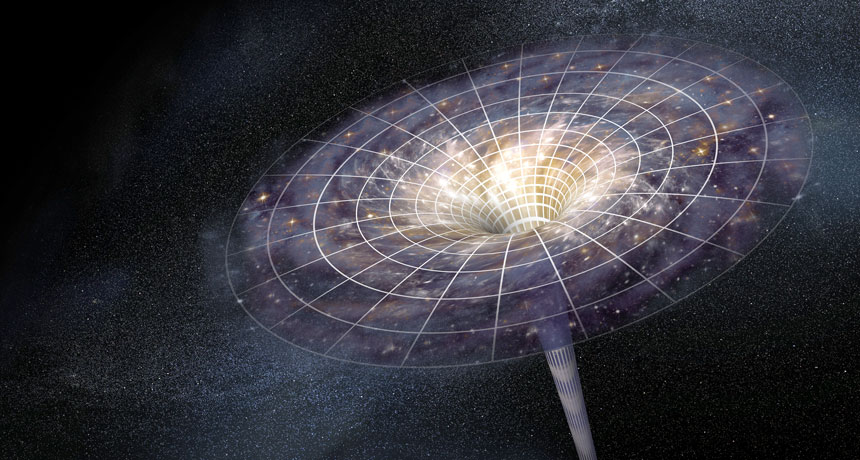
Re: Why can’t I go faster than the speed of light?

#114
post #23

I think a lot of people assume that this means you couldn't go more than a few (~100) light-years in your lifetime... But this is not actually correct. Counter-intuitively you can theorically go any number of light-years (essentially) in your lifetime, as long as you are able to approach the speed of light because when you do so the distance is dilated and hence you're covering far more ground within your reference f…

Also, it doesn’t take too much acceleration to make that trip. Comfortable earthlike 1g (~ 10m/s/s) is enough to build up a decent speed in a very reasonable time. Energy is the issue though.

Re: Why can’t I go faster than the speed of light?

#115

Earlier quoted context omitted.

> So if a photon is emitted from the sun, it's passing earth immediately? Then why does sunlight need 7 or 8 minutes to get to earth? From the photon's perspective, it passes earth immediately. From our perspective, it takes 7 or 8 minutes. > And let's say, i travel one light-year at the speed of light, that should be instantaneous, right? The odometer would show 1 light-year, my watch would should 0 seconds and some…

> > If I travelled at one percent of speed of light, same distance, i suppose 100 years would elapse for me, how much would elapse on earth? > I don't know how to do the math, but a very, very long time would have passed on earth. Eh, at .01c, not so much: https://www.omnicalculator.com/physics/time-dilation?c=USD&v... (=100.005y, not even two days extra)

Yeah, all interesting things only begin at roughly 0.5c and go crazy at 0.9c. Google images on “lorentz factor” to get the quick idea.

https://www.google.ru/search?q=lorentz+factor&tbm=isch

Re: Why can’t I go faster than the speed of light?

#116
post #72

Earlier quoted context omitted.

If you were watching their lives out the window of your spaceship you’d see them in fast forward vv. they’d see you in slow motion. Everything is relative. The main ”paradox” found by experimention is that the speed of light is a constant, regardless of your velocity. The only way this could be true, if you do a thought experiment, is if time was dialating for you. As for the physical and mathematical “why is this ha…

> If you were watching their lives out the window of your spaceship you’d see them in fast forward vv. they’d see you in slow motion. Everything is relative. Both observers, looking at one another, would see the other moving near c. Neither would know who was ‘actually’ moving. Yet, you assume there would not be a symmetry in their respective views of the other’s passage of time. Explain why. In simpler terms, a twin…

It’s still a hard topic related to the rotational “symmetry”.

https://m.youtube.com/watch?v=cPEwkMHRjZU (7 minutes)

It doesn’t answer your question directly, but the tricky part of a twin paradox is not that the earth twin observes his brother in a slow motion (the space twin also does that, thus a paradox). It’s because a space twin actually changes direction by acceleration at some point B, and at that time he skips over a big part of earth’s timeline. The video above only addresses why it’s NOT the earth twin who changes direction by acceleration, which you’re reasonably questioning. The universe somehow knows who is really “steering” and what remains more or less inertial. The pendulum example at the end may give a hint on why.

Edit: also, the space twin doesn’t have to experience any additional acceleration from the “engines” - looping around some gravity well would work too. E.g. an entire trip could be that the space twin goes to the orbit around the earth, gets slung away by a quickly passing blackhole, loops around a distant blackhole and returns, all in a complete free fall.

Re: Why can’t I go faster than the speed of light?

#117

Q1. Does the future already exist? I realize this might be purely philosophical, but if I leave Earth, and fly through space near c kph, and return home a few hours later to find everyone aged 50 years... are they the "same" people, or are they a future-instance of the people left? To clarify, theoretically I could leave earth, and return home in exactly 1 hour (from my ref frame), and basically make people whatever…

Q1.

> basically make people whatever age I want by varying my speed.

No more so than making the Earth change shape by moving your physical location.

> Since the same 1 hour passes for me no matter the age for them I chose, it seems like I'm selecting an already existent future from a stack, not fast-forwarding the present I left.

Yeah these are more philosophical questions rather than a testable hypothesis. It’s an interesting way of viewing the world, but if you’re talking about a future “existing” scientifically and materially in concert with the present, then you’d need to devise an experiment to be able to enter or interact with that future beyond just waiting for that future to exist.

Otherwise time travel isn’t even necessary for this thought experiment. You could say the morning already exists and fall asleep and wake up and boom it’s morning time. But in reality all of the ticks of time happened between when you fell asleep and when you woke up, you just weren’t able to observe all of them at the same speed as someone who stayed awake all night.

Re: Why can’t I go faster than the speed of light?

#118
post #97

My favorite general relativity paradox: A runner is running with a 20m pole at a sufficient velocity so that a stationary observer sees the pole having length 10m. The runner runs through a barn which is 10m long. And two people outside shut the doors simultaneously so that the runner is completely enclosed in the barn for a moment. But from the runner's perspective, the barn has length 5m long. What does she see hap…

Since the two doors are not in the same location in space, there is no absolute "simultaneously".

What one frame of reference sees as a simultaneous closure of the doors looks like non-simultaneous closure of the doors in another frame of reference.

Simultaneity means that two events coincide in time and space.

Different time and/or space means: not simultaneous!

Re: Why can’t I go faster than the speed of light?

#119

Earlier quoted context omitted.

I know this is true, but I never got my head around this, maybe someone can help. So if a photon is emitted from the sun, it's passing earth immediately? Then why does sunlight need 7 or 8 minutes to get to earth? And let's say, i travel one light-year at the speed of light, that should be instantaneous, right? The odometer would show 1 light-year, my watch would should 0 seconds and some decimals. How much would I h…

> And let's say, i travel one light-year at the speed of light, that should be instantaneous, right? Time slows down for the faster moving particles. And by time slowing down we mean all the particles in your body equally all start to move slower and more sluggishly in sync. This is because it takes more energy to accelerate a particle as it approaches the speed of light. So if you had a pendulum clock moving almost…

This is a superb description.

Re: Why can’t I go faster than the speed of light?

#120
The beginning is the best line, that no one really knows "why" and what I have said to even other physicists who don't really understand it. A lot of the counterintuitive consequences of the paradox of the moving charges detailed here are a fact of nature but we don't really know why it must be that way. For example, in a modern particle physics starting point for qed, we force the equations to be lorentz invariant from the start but that is a starting assumption. But that's it, there's no real deeper answer to "why" beyond it being a experimentally observable fact, and the only resolution of these observations is that lorentz transformation and thus things like time dilation and length contraction must happen.

Small relativity related tidbit: I hate when people say the phrase "the faster you go, time slows down for you." This is a problem because it implies that the moving observer notices their own time dilation which is reverse of the case. Of course, every non-accelerating observer is in their own rest frame, so it doesn't make sense to say "time slows down for you," because you are your own reference and there is no other frame to base your measurements on (I mean that was the whole point of relativity, there is no universal rest frame). Instead, when you measure the rate of change for other reference frames moving relative to you, their clocks move slower when measured by your clock. So the actual phrase should be something like "the faster others go, the slower their time appears to you."

Post reply on HN