Live data from Hacker News

Pointless work meetings 'really a form of therapy'

bbc.com

21–30 of 222 posts

Re: Pointless work meetings 'really a form of therapy'

#21

One of my employers actively discouraged meetings and phone calls. They wanted everything done through Slack and email. It felt great at first. Having a wide-open calendar and knowing that random managers can’t pull you into a waste of time meeting seems like a dream come true. However, we quickly learned that removing meetings doesn’t removed the need for communication. Instead of scheduled meetings, our Slack chann…

I've found that, with the exception of daily stand-ups, all meetings must have a bullet point agenda and notes should be sent out for each meeting with risks, action items, issues and ownership of those items. If both of those things are lacking, I doubt how useful the meeting will be or was.

Not only do those things make meetings more productive, they increase the overhead to calling a meeting.

We don't often celebrate making things harder to do, but adding friction to something that's happening too often can help bring it back into balance. That's especially true for things with large "multipliers". An unscripted meeting might take one hour for the person calling it, but eat 10 hours of other people's time (plus interrupt them). Adding an hour of prep and summary for the caller lowers that ratio a bit so everyone has a more similar view of the meeting.

That's rarely grounds to make things harder with no benefit, but meeting prep has very solid benefits. Even in terms of time wasted, a clear agenda keeps meetings from dragging on, and routing minutes/summary after the fact avoids repeating discussions or inviting people who only need to listen.
Re: Pointless work meetings 'really a form of therapy'

#22

There's some truth to this, but holy smokes, another meeting is not the cure. There is value in "venting" at work. A few years ago I built a software tool that pings people at the end of the week asking how their week went. Some of the quietest people in the company had the most to say when they were behind a screen. In fact, some people literally called it therapeutic. It turns out that writing things down can serve…

Perhaps you are being overly dismissive of the "extroverts" needs in the situations you are describing...

Some might just "complain", but others feel safer being vocal in a group of people.

You mention understanding that some of the quietest people have the most to say behind a screen, well, I imagine there is a non-insignificant group of people who feel much safer talking it out within a group where there isn't a written record and they can judge the crowd's reaction immediately.

I wouldn't consider myself anywhere close to an extrovert and I would consider myself more candid in spoken communications at work, even when my whole team is present.

Just my 2 cents.

Re: Pointless work meetings 'really a form of therapy'

#23

One of my employers actively discouraged meetings and phone calls. They wanted everything done through Slack and email. It felt great at first. Having a wide-open calendar and knowing that random managers can’t pull you into a waste of time meeting seems like a dream come true. However, we quickly learned that removing meetings doesn’t removed the need for communication. Instead of scheduled meetings, our Slack chann…

> the asynchronous “always on, always connected” style

Nit: I've always heard this called synchronous, since in this style work is performed immediately, rather than queued up to wait for execution at a scheduled time.

Re: Pointless work meetings 'really a form of therapy'

#24

One of my employers actively discouraged meetings and phone calls. They wanted everything done through Slack and email. It felt great at first. Having a wide-open calendar and knowing that random managers can’t pull you into a waste of time meeting seems like a dream come true. However, we quickly learned that removing meetings doesn’t removed the need for communication. Instead of scheduled meetings, our Slack chann…

I've found that, with the exception of daily stand-ups, all meetings must have a bullet point agenda and notes should be sent out for each meeting with risks, action items, issues and ownership of those items. If both of those things are lacking, I doubt how useful the meeting will be or was.

John Cleese taught us that in the 70's https://en.wikipedia.org/wiki/Meetings,_Bloody_Meetings

Re: Pointless work meetings 'really a form of therapy'

#25

There's some truth to this, but holy smokes, another meeting is not the cure. There is value in "venting" at work. A few years ago I built a software tool that pings people at the end of the week asking how their week went. Some of the quietest people in the company had the most to say when they were behind a screen. In fact, some people literally called it therapeutic. It turns out that writing things down can serve…

I've been on teams for the last two years that use the Sprint Retrospective as a venting venue. Then the Scrum Master processes that into meaningful items that require resolution. Sometimes, the resolution is agreed within the same meeting (e.g. 'we have an internal communication problem' - discuss a bit - 'we can try $this next sprint'), sometimes it falls to an outside dependency (e.g. 'The Business doesn't trust u…

Retrospectives are a common place for this, and I think a fairly healthy one. They're limited in a way that meetings aren't, and they're already structured to take informal comments and process them into useful actions. I've seen too many meetings that amounted to "complaining about external blockers", and unlike retros there's almost never a useful followup.

I've never seen "managers aren't permitted", but I suppose it depends on the level of manager - as long as everyone present got their hands relatively dirty on the project, things seem to go well.

Re: Pointless work meetings 'really a form of therapy'

#26
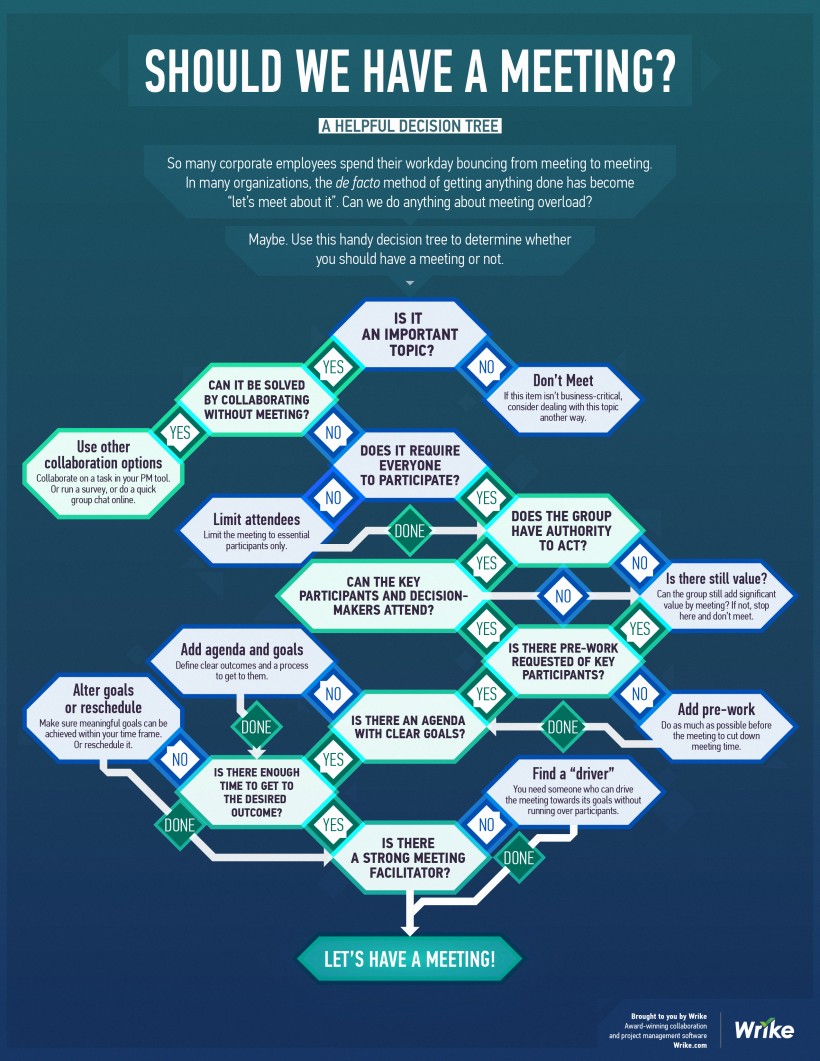
I thought Wrike had a pretty good infographic on deciding whether or not to have a meeting: https://d3tvpxjako9ywy.cloudfront.net/blog/content/uploads/2...

Basically you should have a meeting if:

* It can't be solved by collaborating outside a meeting

* Everyone is needed to participate

* The group has authority to act

* There is a clear agenda and goals

* Someone can be the facilitator

I have found that if a meeting has all those elements than a lot can get done very quickly, rather than having ideas bounce around email or slack for weeks!

Re: Pointless work meetings 'really a form of therapy'

#27
post #4
post #2

WTF? Venting might be arguably beneficial in some cases, but in many companies employees don't get to vent in a meeting. Rather, they have to endure demands, complaints and display of status from management - which is the opposite of therapy. https://en.wikipedia.org/wiki/Learned_helplessness One of the reasons of pointless meeting is to keep busy and appear busy - see https://en.wikipedia.org/wiki/Bullshit_Jobs

The article is, in part, suggesting that it's exactly those kind of status-conscious people who benefit from 'meeting therapy': "Academics from the University of Malmo in Sweden say meetings provide an outlet for people at work to show off their status or to express frustration." But yep, that might not be ideal for a participant who would prefer to be making progress on something else. I've seen a bunch of tech comp…

"outlet for people at work" hints that benefits everybody, or the majority.

"outlet for management" sounds quite different.

Re: Pointless work meetings 'really a form of therapy'

#28
This sounds accurate to my now recently-ex company. The number of meetings have soared, to the point where they probably spend 2-3 days per two week "sprint" (it's really more of a hobbled walk) in project meetings. Not just the absurd number of project managers (currently 1 PM to every 2 programmers, I believe), but the whole team. And what's weird is that when you're in the office, it doesn't feel out of place, but if you're actually trying to be productive it's a horror-show. I had a 3 hour meeting a few weeks back, and then another meeting directly after it which was a summary of the previous meeting.

Add to that the fact that 90% of the company are incapable of being on time to those meetings, and you can probably guess as to one of the reasons I'm moving on to another company. The meetings are usually also at short notice and the person who requests it will universally be late to their own meeting.

I see excessive meetings and calls as a failure of written communication skills. The people I see organising the most meetings are also those who are least adept at understanding writing, and the worst at communicating via it themselves. There's definitely an art to being a good written communicator, and maybe there should be more emphasis placed on it when recruiting in tech roles.

Re: Pointless work meetings 'really a form of therapy'

#29
post #6

The problem I experience with meetings is that often times the information presented is only tangentially related to you. I hate it when I’m in a meeting and it ends up a conversation between two people. It’s stressful if you have an expectation to get something done but also an expectation to sit in a meeting you realize really doesn’t pertain to you.

Once upon a time, this was the point of circulating 'minutes' or a summary after meetings.

Outside of some special cases (e.g. the Federal Reserve), they're specifically meant to reflect conclusions, not the full course of discussion. Back-and-forth that reaches an answer isn't needed, and a debate that ends unresolved would just read as a summary of the positions. That way, you can invite the people who need to speak in a meeting, while anyone who just needs to be informed about the result can catch up from a shorter, async source.

It seems like easy video recording and calling have been one reason for the decline - minutes were handy if someone couldn't make the meeting, but now they can dial in or watch it afterwards. That's great for not having to create a summary, but I think it loses much of the value of a concise, written record of what happened.

Re: Pointless work meetings 'really a form of therapy'

#30

One of my employers actively discouraged meetings and phone calls. They wanted everything done through Slack and email. It felt great at first. Having a wide-open calendar and knowing that random managers can’t pull you into a waste of time meeting seems like a dream come true. However, we quickly learned that removing meetings doesn’t removed the need for communication. Instead of scheduled meetings, our Slack chann…

Why doesn't slack implement scheduled and time-limited "meetings" chats?
Post reply on HN