Live data from Hacker News

We Need to Dream Bigger Than Bike Lanes

citylab.com

151–160 of 561 posts

Re: We Need to Dream Bigger Than Bike Lanes

#151

Rarely I take bike lanes, they are less fast and irregular The road should be used by bikes in my opinion (lower infrastructure/maintenance cost, and the separation between road and bike lanes is actually how I broke my right clavicle), and bikes should have priority against individual cars (not urgency and shared transports of course)

This will never work except for the tiny percentage of people who are extremely confident riding with cars. You're never going to get grandmas and grandpas and 8-year-olds comfortably riding in car traffic on regular roads. I don't understand why people keep suggesting this when bikes generally already can use the road, and this is clearly a failure as far as getting more people biking. Meanwhile, basically everywher…

A "simple" change could affect the way cars and bikes interact on the roads.

It's always the cars fault.

If the law were to change to favour the smallest, lest protected vehicle at all times then those driving cars would take much greater care when driving around them.

Re: We Need to Dream Bigger Than Bike Lanes

#152
post #144

I cycle 24km to work across the city each way on an ebike. It’s the fastest mode of transport available to me, even limited to 25km/h. The bike takes an hour, the bus 90 minutes because of its indirect route, and the car about the same with morning gridlock. You could do it in 35 minutes with no traffic. When I take the bus I arrive to work tired and groggy. When I cycle I arrive energised. I don’t drive because park…

24km? What's your bike's range? Over here ebikes are just about limited to 25-30km on full charge. Do you charge it at work?

Re: We Need to Dream Bigger Than Bike Lanes

#153

Earlier quoted context omitted.

Families is not a counterpoint. I have had three kids in my bike. Now my kids ride their own bikes but we meet parents with all their kids in their bikes every day. There are homes for the elderly around here that put two elders in a bike to get them out for a ride. You didn't mention shopping, but I did put all my shopping in that same bike I had my kids in. Guess what the biggest obstacle to my kids getting around…

Most families in the developed world are having one to two kids. I rode a bike with a toddler in a toddler seat on the back until I was 8 months pregnant. You can also get little "cars" to tow behind your bike to hold two kids. I always hated cars. My kids never felt like a barrier to going far free. My marriage did. After the divorce, my kids and I eventually went car free. They are adults. They still live with me.…

> I rode a bike with a toddler in a toddler seat on the back until I was 8 months pregnant. You can also get little "cars" to tow behind your bike to hold two kids.

As adults, I can understand the appeal of being car free, but I can't help but be struck by how dangerous it seems to commute on a bike pregnant with a toddler onboard.

I'm imagining biking down Market St, 8 months pregnant, with a toddler seat and two kids in tow. That's a lot of faith that nobody's going to open a car door at the wrong time or pull out into traffic without looking. I know fit dudes in their 20s that have had accidents and been seriously injured. I've never thought of myself as particularly risk adverse, but wow that seems risky.

Re: We Need to Dream Bigger Than Bike Lanes

#154

Earlier quoted context omitted.

> A mom with three young kids in tow Ha! Go see how they do it in Europe. Bike trailers, extra seats in the front & back, built in cargo decks, longer bikes; there are lots of fancy ways to load a lot of kids & cargo onto your bike. And don't forget that kids can ride their own bikes too! My kid was riding a bike with me to daycare at 3-4 years old. Your thinking is too car-centric!

Europe does not have some magical equation for drastically reducing car use. The number of cars per capita in the EU is only about one third lower than the United States. That's nothing to sneeze at, but it certainly means that the sizable majority of Europeans are still car-centric. And even then that's mostly a function of lower incomes (vis-a-vis the US). The high-income European states of Luxembourg, Switzerland,…

This is probably a function of distances between living space and work. Beyond 10 km the car catches up and starts to get ahead in total travel time. Public transport is meant to close this gap but there's not enough for people, much less bicycles, especially long distance. So it gets crowded. The car is universal until you run out of parking space.

Re: We Need to Dream Bigger Than Bike Lanes

#155
post #3

I live in Christchurch, NZ. After a massive earthquake in 2011, I had high hopes that we might redesign the city for the next 100 years instead of the previous 50 (i.e. for people, not cars). Instead the city council built a few bike lanes and even then people lost their goddamn minds. "You're taking away parking space!" "All these bike lanes are slowing traffic" "No one wants to bike into the city" Meanwhile, cyclis…

The biggest counterpoint here is what about families? A mom with three young kids in tow pretty much needs a car to get around. Or elderly people? I can't really take my 90-year old grandma out to dinner if it requires her to bike her way to the restaurant. Thinking about non-car based transportation methods is great. But the reality is that large segments of society are always going to need some sort of car-based op…

There was a time before cars. People didn't just entrap their kids and mother at home. We've just made it unworkable due to redesigning things for cars.

Cars only work with kids due to most people having smaller families these days. I actually think the car limitations is a reason family sizes have shrunk. Start imagining moving ten kids around.

Re: We Need to Dream Bigger Than Bike Lanes

#156

I really think the concept of bike boulevards is one that needs more attention than bike lanes. Take a network of side roads and make them inconvenient for large vehicle through-traffic via bollards and other obstacles. https://en.wikipedia.org/wiki/Bicycle_boulevard The result is a quiet, safe setting for 'micro-mobility' bicycles and scooters with decreased bike-car interaction. You don't even need bike lanes, beca…

Bike+bus collision danger can be largely mitigated with protected bike lanes and intersections.

Also in practice, the extent to which buses can go faster than bikes is limited. There's a route I take to the local Ubahn Station, and in practice biking is about as fast as the bus, assuming the same starting time. Obviously the bus has a higher top speed, but it also has to stop every couple blocks, which eliminates its advantage.

For BRT, probably a different story, but if it has a completely separate lane infrastructure, you can just have the same for bikes.

Re: We Need to Dream Bigger Than Bike Lanes

#157

Earlier quoted context omitted.

Ask the Dutch. How do they do it? Or do you assume they do not have young kids or grandmas? Why is it that whenever people talk about designing cities for pedestrians and bikes, someone on hackernews thinks it means eliminating all cars entirely forever. For a forum ostensibly designed for entrepreneurs, it shows a tremendous lack of imagination. Answer: * Public transportation inside cities such as buses and trams *…

The difference is that Holland is entirely flat, has an average high of 71 in the summer, and rarely if ever gets icy. The Dutch experience simply doesn't translate to most of America because of the terrain and climate. Elderly people people will die if you make them walk in the Florida summer. 7 year old children lack the leg-strength to bike up California hills. Both groups are likely to slip and crack their heads…

Our kid rode up mountains once we got her a 21 speed.

Re: We Need to Dream Bigger Than Bike Lanes

#158

Earlier quoted context omitted.

The biggest counterpoint here is what about families? A mom with three young kids in tow pretty much needs a car to get around. Or elderly people? I can't really take my 90-year old grandma out to dinner if it requires her to bike her way to the restaurant. Thinking about non-car based transportation methods is great. But the reality is that large segments of society are always going to need some sort of car-based op…

Ask the Dutch. How do they do it? Or do you assume they do not have young kids or grandmas? Why is it that whenever people talk about designing cities for pedestrians and bikes, someone on hackernews thinks it means eliminating all cars entirely forever. For a forum ostensibly designed for entrepreneurs, it shows a tremendous lack of imagination. Answer: * Public transportation inside cities such as buses and trams *…

> Ask the Dutch. How do they do it? Or do you assume they do not have young kids or grandmas?

They do it the dutch way.

Things you wouldn't do anywhere else, like leaving babies in their strollers in the streets outside shops when they go shopping.

Denmark is really a big village.

Source: my girlfriend family is Danish and I had saw them last time 4 days ago.

> * Trains to rural areas

It's more easily said than done.

Rural areas are also resistant to things that would make the area less rural, like high speed train.

Look at the fights happening in northern Italy against the TAV (the Italian version of the TGV)

> * Park-and-ride garages for people to drive in, and park next to transportation hubs

Many cities in old Europe cannot do that. Think about the central areas of Paris, Rome, Milan, Madrid.

And those that could are reluctant to do it, because it would immediately lower the value of the buildings around.

Imagine you bought a house for 100 and its value drops to 70 because they made a giant parking lot just below your window.

> * Underground parking garages at the edges of pedestrian zones, or even underneath them, coming up directly above them

In most cities in old Europe digging is very costly and sometimes impossible (most Italian cities for example)

> * Ubiquitous bike storage and bike attachments such that yes,

That would steal space to pedestrian transit

> a mom with 3 young kids can tow them from a single bike - moms in Amsterdam and Berlin do it all the time.

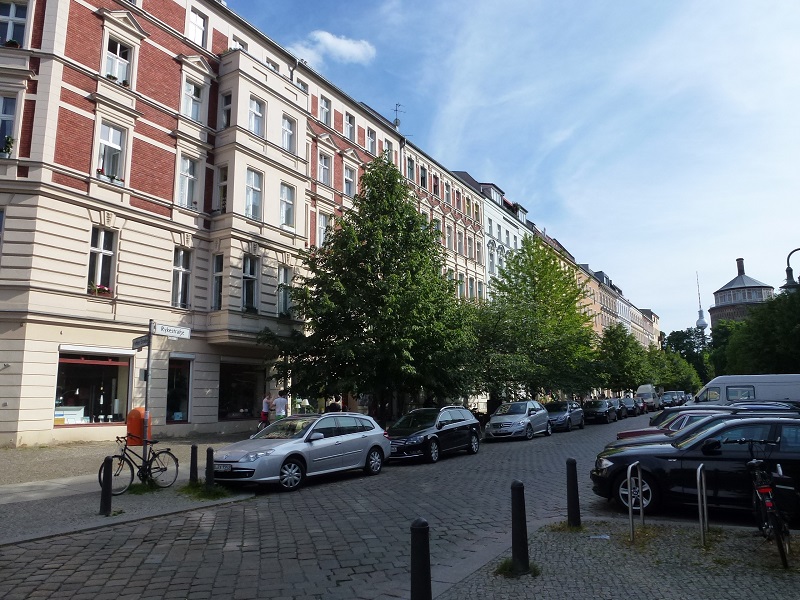
Compare the average street in Berlin[1] or Amsterdam[2] with those of Milan[3]

You will immediately notice a few things: in Milan trams railways are in the middle of the street, they are very slippery and dangerous for bikers; Berlin sidewalks are much larger on average; much of the transport in Amsterdam happens along canals, where cars are usually not allowed.

Things are in a certain way not because people are simply stupid or ignorant, but because the surrounding environment poses a lot of limits.

[1] https://lets-travel-more.com/wp-content/uploads/2019/01/Ryke...

[2] https://i2.wp.com/www.amsterdamredlightdistricttour.com/wp-c...

[3] https://live.staticflickr.com/205/495030650_6d7bf355b8_b.jpg
Re: We Need to Dream Bigger Than Bike Lanes

#159

I really think the concept of bike boulevards is one that needs more attention than bike lanes. Take a network of side roads and make them inconvenient for large vehicle through-traffic via bollards and other obstacles. https://en.wikipedia.org/wiki/Bicycle_boulevard The result is a quiet, safe setting for 'micro-mobility' bicycles and scooters with decreased bike-car interaction. You don't even need bike lanes, beca…

I don't think this would solve much. In the UK at least, side roads are plenty safe enough for bikes. The issue is the big roads that people want to actually cycle on (because they are the fastest route).

Yeah, here in Munich the side roads are generally safe for bikes because they're narrow, much narrower than side roads in the US. But that by itself wouldn't make for a ton of biking if we didn't also have many protected bike lanes on arterial roads, as well as off-street walk/bike paths.

Re: We Need to Dream Bigger Than Bike Lanes

#160

Earlier quoted context omitted.

Most families in the developed world are having one to two kids. I rode a bike with a toddler in a toddler seat on the back until I was 8 months pregnant. You can also get little "cars" to tow behind your bike to hold two kids. I always hated cars. My kids never felt like a barrier to going far free. My marriage did. After the divorce, my kids and I eventually went car free. They are adults. They still live with me.…

> I rode a bike with a toddler in a toddler seat on the back until I was 8 months pregnant. You can also get little "cars" to tow behind your bike to hold two kids. As adults, I can understand the appeal of being car free, but I can't help but be struck by how dangerous it seems to commute on a bike pregnant with a toddler onboard. I'm imagining biking down Market St, 8 months pregnant, with a toddler seat and two ki…

I was in Germany. This means the landscape was pedestrian friendly, bicycle friendly and I wasn't going terribly far.

When I was six months pregnant, I took my two year old to the ER via bike because his dad had our only vehicle. The kid needed stitches, having done a bit of climbing of the furniture and busted his chin open on the wood floor -- a rather all too common injury for children that age. I was told that the stitches he needed were really rather mild for such an injury. They had absolutely seen far worse.

The most dangerous place my toddler spent time was our home, where he persistently climbed the door frames and yelled for me to come catch him before he fell. He never did learn to climb down. He just counted on his young, energetic and very attentive mother to always safely catch him. (And I always did, so he was never cured of this expectation.)

I desperately wished I could find some way to remove our door frames. It would have brought my stress levels down about a thousand percent.

Post reply on HN