Live data from Hacker News

We Need to Dream Bigger Than Bike Lanes

citylab.com

131–140 of 561 posts

Re: We Need to Dream Bigger Than Bike Lanes

#131
post #70

Earlier quoted context omitted.

Evaporation can cool things to below ambient air temperature. It's why we sweat.

The point is at air temps >39c, increasing airflow around you increases apparent temperature. The more wind you experience (or the faster you ride your bike) in those conditions, the more work your body needs to do for maintaining homeostasis via sweating. You will certainly not perceive a >39c wind as a 'cooling' wind in any conditions, and the faster that wind is the hotter it will feel.

This depends strongly on humidity.

Re: We Need to Dream Bigger Than Bike Lanes

#132

I'm curious as to what planet you'd have to be living on to think that if we have billions of dollars to spare on huge transport infrastructure projects that aren't cars, that it should go to bikes and not public transport + walkability. I'm guessing it's a special magic planet with startlingly good weather year-round, without disabled people, where everyone gets to age into spry Euro-oldsters. Not wanting to kick of…

I've been living in Amsterdam for a few years now, and with the bike lanes it feels like disabled people are SUPER included.

You can see a lot of people in the bike lanes with mobility problems, in their electric wheelchairs, scooters, etc. Completely impossible in my car oriented city, specially because these people often cannot afford a car in their situation. It's so nice to see an old lady going in her electric vehicle in the bike line.

Re: We Need to Dream Bigger Than Bike Lanes

#133
post #72

Earlier quoted context omitted.

> Now imagine how many bikes you could fit on a two lane road vs how many cars No need to imagine: http://lh3.ggpht.com/_9F9_RUESS2E/S7tbclwxiPI/AAAAAAAACmw/uI...

I feel the picture is misleading. First, the angle for cars results in a closer, more zoomed in picture than for the bus and bike. Second, it assumes 1 occupant per car, but a full bus. More likely, each car will probably average more than 1 occupant, and buses will probably be less than half full, if not 25%.

I’d be interested in seeing an equivalent side-by-side image based on occupancy data. For instance, cars in the US average only 1.7 people per vehicle:

https://m.wisegeek.com/what-is-the-average-vehicle-occupancy...

Re: We Need to Dream Bigger Than Bike Lanes

#134

This article paints the interstate highway system as some sort of evil incarnation without even giving so much as a breath to the idea that the Interstate highway system is one of the largest and most successful civil works projects of all time. The Romans had their aquaducts. The Americans have their highways. Prior to the Interstate system, it would take as much as two months to travel coast to coast. Eisenhower wa…

“They’re not a solution for most people” — I encourage you to come visit the Netherlands. You’ll see a society where bikes are regularly used by “most people.” Wealthy, middle class, poor — nearly everybody rides the same cheap black bike. And not just in the cities, but throughout the entire country.

Sit in a cafe near a busy street in Utrecht, Amsterdam, Groningen, The Hague or Leiden, and you’ll see all walks of life riding a bike. It’s a lovely, human thing.

Re: We Need to Dream Bigger Than Bike Lanes

#135

Earlier quoted context omitted.

The biggest counterpoint here is what about families? A mom with three young kids in tow pretty much needs a car to get around. Or elderly people? I can't really take my 90-year old grandma out to dinner if it requires her to bike her way to the restaurant. Thinking about non-car based transportation methods is great. But the reality is that large segments of society are always going to need some sort of car-based op…

Ask the Dutch. How do they do it? Or do you assume they do not have young kids or grandmas? Why is it that whenever people talk about designing cities for pedestrians and bikes, someone on hackernews thinks it means eliminating all cars entirely forever. For a forum ostensibly designed for entrepreneurs, it shows a tremendous lack of imagination. Answer: * Public transportation inside cities such as buses and trams *…

The difference is that Holland is entirely flat, has an average high of 71 in the summer, and rarely if ever gets icy.

The Dutch experience simply doesn't translate to most of America because of the terrain and climate. Elderly people people will die if you make them walk in the Florida summer. 7 year old children lack the leg-strength to bike up California hills. Both groups are likely to slip and crack their heads open in the icy Boston winter.

Re: We Need to Dream Bigger Than Bike Lanes

#136
post #62

I'm curious as to what planet you'd have to be living on to think that if we have billions of dollars to spare on huge transport infrastructure projects that aren't cars, that it should go to bikes and not public transport + walkability. I'm guessing it's a special magic planet with startlingly good weather year-round, without disabled people, where everyone gets to age into spry Euro-oldsters. Not wanting to kick of…

I don't mind the weather in Copenhagen where the amount of people who bikes every day exceeds the amount of people who take public transportation every day by around 50% (1). Weather in Copenhagen is rarely very cold or very warm. But Copenhagen weather is not "startlingly good all year-round". It rains quite often and temperatures are often close to zero or sub zero. And it's windy all the time. It even snows a few…

I don't speak danish, but according to that graph your claim is not supported

BTW how many people use a bike is a useless metric, how far they travel and for how much time is more important.

Copenhagen is not a good example, it's very small, very flat and public transport is very expensive and it doesn't have to handle the same number of commuters many other cities have to. For example in Milan everyday a million people come to work from cities around it, in Rome it grows up to a staggering 1.5 millions.

Bike is not favourite because it's better, but because politics made it preferable (less expensive)

Things are changing, Copenhagen had it's first subway only in 2002, decades later other major cities and people will start using it more and more, because the city has invested a lot of money on it and can't handle people not using it or, as it is now, prices have to be very high, which kinda defeat the purpose of a public transport.

Subway it's a good rival for bikes, because they use different paths.

If you increment surface transport in cities with a large number of bikers, they start to compete for road space and it create tensions that need to be resolved.

Bikes in Copenhagen and many other small/medium northern city are the effect of inertia (historically they usesd bikes because it's what they always used), much as the ridiculous number of cars in cities like Rome.

As reference, the Copenhagen subway is run by ATM, the public transport company of Milan (Italy), where prices are an half even though the city is much bigger city, but there are public bikes as well, bike lanes everywhere and lots of car sharing companies.

But the best feature of Milan is still walkability + public transport (subway it's much better than buses and very good on average) because much of the population cannot ride a bike for more than a few kms at a time.
Re: We Need to Dream Bigger Than Bike Lanes

#137

Earlier quoted context omitted.

I live and travel around Europe. Seeing parents riding with their very young kids is not too common a sight and every major city I've been to has traffic problems, because a whole lot of people do want to use cars and do value their convenience. Whether that's a bad thing or not is another discussion but don't try to present Europeans as some sort of superhumans.

I only have experience with Berlin, Hamburg, Munich, and Amsterdam; but if you sit outside of a daycare in those cities in the morning you can see the multitude of people who ride their bikes to drop off their 1, 2, and sometimes 3 kids at daycare. Those cities do cycling right and it shows. So I would disagree with you. The traffic problems are caused by having cities that are only setup to make cars convenient and…

While we love our bycicles in Europe, if you go down to the southern countries you won't see much of them taking kids around either with trailers or kid seats.

Re: We Need to Dream Bigger Than Bike Lanes

#138

I'm curious as to what planet you'd have to be living on to think that if we have billions of dollars to spare on huge transport infrastructure projects that aren't cars, that it should go to bikes and not public transport + walkability. I'm guessing it's a special magic planet with startlingly good weather year-round, without disabled people, where everyone gets to age into spry Euro-oldsters. Not wanting to kick of…

> billions of dollars to spare on huge transport infrastructure projects that aren't cars

Cycling infrastructure is almost ludicrously cheap. You can build pretty good bike infrastructure for a decent-sized city with O(€100m). A single metro line normally costs O(€1bn). The reason that bike infrastructure doesn't get built isn't cost - it's political. Car users don't like having lanes and parking spaces taken away from them.

> startlingly good weather year-round

Not _everywhere_ has weather suitable for cycling. However, a lot of places do have suitable weather and yet no infrastructure. That leaves plenty of room for improvement. Many cities could be suitable for cycling with some effort - e.g. clearing snow from bike lanes (see Copenhagen) or adding shade.

> disabled people

Cycling infrastructure is actually great for many disabled people. It makes safe space available for specially-adapted bicycles and mobility scooters.[1]

> spry Euro-oldsters

As far as I know, there's not much of an inherent genetic difference between the Dutch and the rest of the world. Perhaps having an active lifestyle is what _causes_ you to age into a 'spry Euro-oldster' - and is something everyone should aspire to.

[1] https://www.theguardian.com/cities/2018/jan/02/cambridge-dis...

Re: We Need to Dream Bigger Than Bike Lanes

#139

I really think the concept of bike boulevards is one that needs more attention than bike lanes. Take a network of side roads and make them inconvenient for large vehicle through-traffic via bollards and other obstacles. https://en.wikipedia.org/wiki/Bicycle_boulevard The result is a quiet, safe setting for 'micro-mobility' bicycles and scooters with decreased bike-car interaction. You don't even need bike lanes, beca…

I don't think this would solve much. In the UK at least, side roads are plenty safe enough for bikes. The issue is the big roads that people want to actually cycle on (because they are the fastest route).

Re: We Need to Dream Bigger Than Bike Lanes

#140
post #72

Earlier quoted context omitted.

> Now imagine how many bikes you could fit on a two lane road vs how many cars No need to imagine: http://lh3.ggpht.com/_9F9_RUESS2E/S7tbclwxiPI/AAAAAAAACmw/uI...

I feel the picture is misleading. First, the angle for cars results in a closer, more zoomed in picture than for the bus and bike. Second, it assumes 1 occupant per car, but a full bus. More likely, each car will probably average more than 1 occupant, and buses will probably be less than half full, if not 25%.

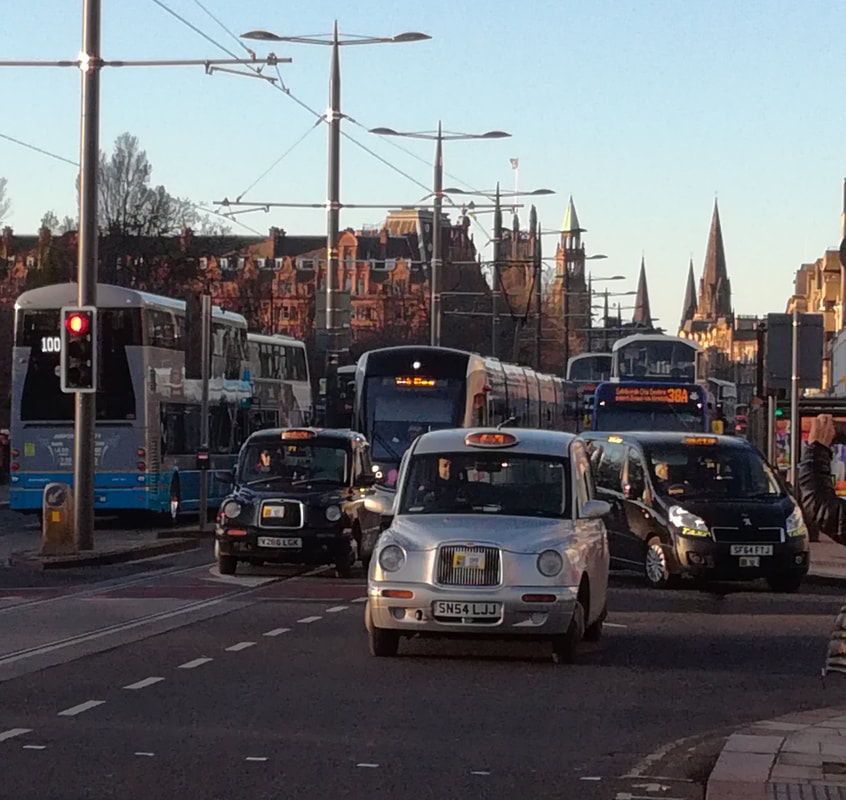
Yeah I wish I could find a better picture bit this gives a sense of Edinburgh centre.

https://www.nfpplanning.com/uploads/2/4/0/5/24056719/taxi-tr...

Queues of buses, and during the day they will often only have one or two passenger.

Plus car drivers are advised to give a bike the same room as a car, so on mixed use roads a bike effectively takes up the same space as a car.

Post reply on HN