Live data from Hacker News

Quake II RTX: Re-Engineering a Classic with Ray Tracing Effects on Vulkan

nvidia.com

151–160 of 169 posts

Re: Quake II RTX: Re-Engineering a Classic with Ray Tracing Effects on Vulkan

#151
post #49

Wow that's a big difference. It reminds me of what it was like to first see 3dfx OpenGL mode in Quake II when I got a Voodoo graphics card.

Not Glide mode? ;)

There is a 3DFX Mesa/Sage port

http://dk.toastednet.org/Q2DOS/

No Glide though, so it won't run under emulation it needs an actual 3dFX card.

Re: Quake II RTX: Re-Engineering a Classic with Ray Tracing Effects on Vulkan

#152

> id Software’s Quake II launched in 1997, bringing gamers a new single-player campaign, a long-awaited, addictive multiplayer mode that we played for years on pitifully-slow 56K modems, and a jaw-dropping engine As for me Quake 2 was kind of a disappointment after Duke Nukem 3D. Only Half-Life brought back the depth Duke Nukem 3D had. E.g. seeing something like a ventilation cover and not being able to break it and…

Honestly Quake 2's biggest feature was going open source. When I was porting Quake 2 to MS-DOS, I have to admit that it's the most I ever played of it. It really fell into Carmak's view that stories have no place in gaming. It's a shame Valve found a much bigger market than games, but it leaves the mantle for others to pick up.

Quake 2 is one of the most difficult FPS games to play competitively. I played the game for 10 years, 1998 - 2008. I can tell you're looking at the game from a different perspective (I'm assuming you're referring to its singleplayer), however - its multiplayer component was nothing short of amazing. Game actually takes a huge physical toll on the player due to complex controls (strafe jumps, circle jumps, doublejumps, circle-strafes, occasional rocket / grenade jump), and the movement aspect combined with aim and general awareness made it one of the best games I had honor to play.

Re: Quake II RTX: Re-Engineering a Classic with Ray Tracing Effects on Vulkan

#153
post #134

Earlier quoted context omitted.

As someone passionate about hl1, I dont like Black mesa. Yes it looks nice, but gameplay wise it seems lacking to me. It feels very slow to move, bhopping has been nerfed to death. It feels more like a reboot than a remaster

From what I remember of Black Mesa, it felt more like Half-Life 2, control wise, than Half-Life. So for people who played Half-Life 2 first, Black Mesa probably feels more natural.

This is unsurprising, since they're both on the Source engine.

Re: Quake II RTX: Re-Engineering a Classic with Ray Tracing Effects on Vulkan

#154
post #122

The original textures were done by Adrian Carmack. I think he's a genius as much as John. He was capable of making a difficult theme really work: a mix between dark future and fantasy. Specially fantasy with guns is terribly difficult and I don't recall having seen a game that succeeded in making that mix as well as the Quake series.

Maybe this isn't what you're talking about, but Bungie's game Destiny is a pretty great example of medieval fantasy transposed several thousand years into the future.

there's a ton of great art happening in games these days. and a lot of it comes down to a few factors, there are some excellent concept art outsourcing houses (check out opusartz for one) the tools and artists trained in them are EXTREMELY capable in recreating whatever style, and the technology available for real time can basically do a fantastic job at baking down extremely high poly high res assets to whatever the final system requires.

this is not to diminish artists working today. (I'm one of them!)

Adrian Carmack though, comes from a whole other breed of creators who had to be both artistically brilliant as well as technically resourceful enough to create art within EXTREMELY tight constraints.

the menagerie for doom, which he is responsible for are still a masterwork in readability, efficiency of design, and communication of purpose in many ways (the textures in that game very easily still hold up today)

I work with a ton of amazingly talented artist, and still, it's rare that I see both artistic, illustrative, and technical talent all in one person. (helps that teams are enormous and so those skills can be spread amongst multiple people)

Re: Quake II RTX: Re-Engineering a Classic with Ray Tracing Effects on Vulkan

#155

> id Software’s Quake II launched in 1997, bringing gamers a new single-player campaign, a long-awaited, addictive multiplayer mode that we played for years on pitifully-slow 56K modems, and a jaw-dropping engine As for me Quake 2 was kind of a disappointment after Duke Nukem 3D. Only Half-Life brought back the depth Duke Nukem 3D had. E.g. seeing something like a ventilation cover and not being able to break it and…

Honestly Quake 2's biggest feature was going open source. When I was porting Quake 2 to MS-DOS, I have to admit that it's the most I ever played of it. It really fell into Carmak's view that stories have no place in gaming. It's a shame Valve found a much bigger market than games, but it leaves the mantle for others to pick up.

> stories have no place in gaming

What does this mean? Being told and participating in a story has always been by far the primary thing I play a game for. Interactive visual fiction experience inducing compassion and involvement bundled with moderate challenge, a degree of freedom and realism (that's why I don't like rail-nailed heavily scripted games) is what I want of a game. The visual part should be reasonable (mostly needed for the atmosphere) and controls should be convenient. In my opinion Half-Life and Fallout (all the parts) were the best games I ever played. The story unveiling and the sense of helping people in the imaginary world heroically (something that is a way too hard and dangerous for an average Joe to do in the real life where you can't save&load) and exploration are the things that make a game addictive for me.

Re: Quake II RTX: Re-Engineering a Classic with Ray Tracing Effects on Vulkan

#156
post #131

Earlier quoted context omitted.

But it's not down to polygons or details in the environment - the simple architecture still looks realistic with the addition of realistic lighting. In the quest for realism, modern games have so many details, dirt and grit everywhere [1]. Perhaps going forward artists can let the lighting do more work and still represent realistic clean environments. I loved this blocky room in Half Life 1 for the dramatic (prebaked…

A whole lot of the benefit is the added "normal and roughness maps for added surface detail." If they hadn't done the hard work of basically retexturing every single surface, it wouldn't look half as good. Without depth, ray-tracing looks incredibly flat, like this: http://builder.openhmd.net/blender-hmd-viewport-temp/_images...

How hard would it be to automatically derive such maps from textures? After all, they are already drawn to visually imply that with shading, so wouldn't it be possible to e.g. train a model to extract that information, just as our eye does?

Re: Quake II RTX: Re-Engineering a Classic with Ray Tracing Effects on Vulkan

#157

> id Software’s Quake II launched in 1997, bringing gamers a new single-player campaign, a long-awaited, addictive multiplayer mode that we played for years on pitifully-slow 56K modems, and a jaw-dropping engine As for me Quake 2 was kind of a disappointment after Duke Nukem 3D. Only Half-Life brought back the depth Duke Nukem 3D had. E.g. seeing something like a ventilation cover and not being able to break it and…

Honestly Quake 2's biggest feature was going open source. When I was porting Quake 2 to MS-DOS, I have to admit that it's the most I ever played of it. It really fell into Carmak's view that stories have no place in gaming. It's a shame Valve found a much bigger market than games, but it leaves the mantle for others to pick up.

But it wasn't the first id game to go open source.

Re: Quake II RTX: Re-Engineering a Classic with Ray Tracing Effects on Vulkan

#158
post #21

This is great to see. Quake and Doom were all about elaborate fake 3d and elaborate fake raytracing to run fast and look amazing on slow hardware. As technology improved, first we got a real 3d engine and now we finally have a real raytracing engine.

>Quake and Doom were all about elaborate fake 3d A nitpick: DooM (1 and 2), just as well as Duke Nukem 3D were indeed "2.5D" elaborate fakery of 3D. One of examples of the ruse: a level was basically a (floor, ceiling) height map, and there could be no two overlapping rooms one above the other. On the other hand, Quake (1) was an early pioneer [1] of real, actual 3D, including an OpenGL backend and all that. That's o…

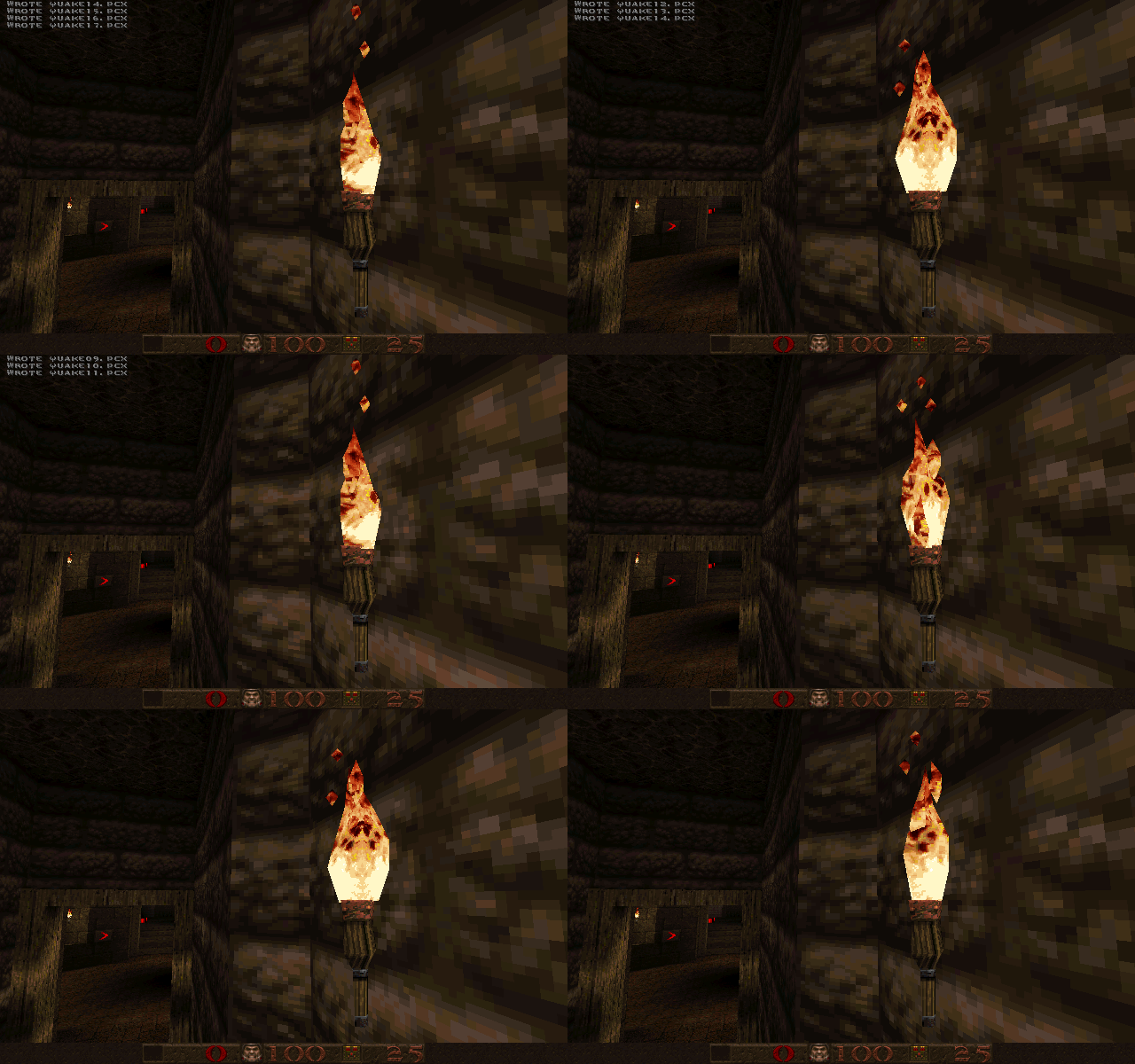
One interesting thing about Quake is that not only it was 3D, but it was excessively 3D in many ways. For example, they have rendered all flames as 3D models, even though sprites and/or procedurally generated 2D flame (as used in e.g. Unreal two years later) would look much better given the very low poly counts.

https://media.moddb.com/images/members/1/240/239733/qv1.gif

Curiously, explosions were still sprite + particles. But I can't remember anything else outside of UI that was using a sprite.

Q2 took it even further - it has 3D models for explosions, and even puffs of smoke when bullets hit walls (these were simple particle effects in Q1). IIRC the only thing that was a sprite was the BFG10K plasma ball?

Back then, I just found it strange. In retrospect, I wonder if it was an attempt to associate some kind of "uncompromising real 3D" branding with id engines. It's interesting that Q3 - which was the first engine id released after they got serious competitors in that space (Unreal, Source) - switched back to sprites for fire, smoke and explosions. And Unreal especially made it a point that it wasn't just 3D, but it was shiny:

https://www.youtube.com/watch?v=zqdeyseQAP4

Re: Quake II RTX: Re-Engineering a Classic with Ray Tracing Effects on Vulkan

#159
post #86

Earlier quoted context omitted.

My P200MMX with a Voodoo 2 managed it just fine.

It was more that Voodoo than the MMX. I tried playing some MMX "accelerated" games and it was a lo-fi slideshow. I think the MMX era was the start of Intel's tradition of hyped up graphics related press releases followed by a total lack of execution.

MMX was useless for games. MMX is Integer math only, good for DSP, things like audio filters, or making a softmodem out of your sound card. Unsuitable for accelerating 3D games. Whats worse MMX has no dedicated registers, and instead reuses/shares FPU ones, this means you cant use MMX and FPU (all 3D code pre Direct3D 7 Hardware T&L) at the same time.

All comes down to Microsoft and Intel coming up with a concept of purely software peripherals around 1997. Intel released things like MMX, AC'97, Communications and Networking Riser (CNR), and audio/modem riser (AMR) standards, all in an effort to push hardware vendors out of the market by handling those roles in software by the CPU. More work for CPU = more demand for fast CPUs = more profit.

Funnily enough AMDs 1998 3DNow! did actually add floating point support to MMX and was useful for 3D acceleration until hardware T&L came along 2 years later.

Intel Paid few dev houses to release make believe MMX enhancements, like POD (1997)

https://www.mobygames.com/images/covers/l/51358-pod-windows-...

1/6 of box covered with Intel MMX advertising while game used it only for some sound effects. Intel repeated this trick in 99 while introducing Pentium 3 with SSE. Intel commissioned Rage Software to build a demo piece showcasing P3 during Comdex Fall. It worked .. by cheating with graphic details ;-) Quoting hardware.fr "But looking closely at the demo, we notice - as you can see on the screenshots - that the SSE version is less detailed than the non-SSE version (see the ground). Intel would you try to roll the journalists in the flour?". Of course Anandtech used this never released publicly cheating demo pretending to be a game in all of their Pentium 3 tests for over a year.

https://www.vogons.org/viewtopic.php?f=46&t=65247&start=20#p...
Re: Quake II RTX: Re-Engineering a Classic with Ray Tracing Effects on Vulkan

#160
post #49

Wow that's a big difference. It reminds me of what it was like to first see 3dfx OpenGL mode in Quake II when I got a Voodoo graphics card.

now compare it to https://www.youtube.com/watch?v=0uurJ-zjhok and try saying "big difference" with a straight face again
Post reply on HN