Live data from Hacker News

GDPR will pop the adtech bubble

blogs.harvard.edu

161–170 of 454 posts

Re: GDPR will pop the adtech bubble

#161
post #135

Completely oblivious and ignorant here: If a company has no official office in Europe, how does this affect them? All advertisement and business focus is say only in the US, is it business as usual? What if an EU citizen decides to sign up? Are US companies forced to deny customers not par of say an IP block (half assed method I know, but just speaking in general)?

If you dont have money, materials, or employees flowing through Europe there is very little they could do to you even if you actively flaunted the law. They could always block access to your site, or even try to sanction your business but unless they are willing to invade your country to physically stop you they don't have very many options. There is always the chance that your own government will enforce EU rulings…

If another company with facilities in the EU then buys the noncompliant company, could they enforce a judgement on the parent company?

If a noncompliant company is going through due diligence prior to being acquired, they be legally obligated to disclose that judgement? Even if they didn't, how hard would it be for an associate at a law firm to check public records about the company?
Re: GDPR will pop the adtech bubble

#162

Earlier quoted context omitted.

If true, it makes a very amusing reversal from the usual story. Rather than peddling their wares to suckers, the placers of the ads have themselves been suckered into buying a product that doesn't work as advertised!

The rumor is that both the Cruz campaign and the Trump campaign found Cambridge Analytics' products to not work as advertised.

The SNP had an introduction to them, and the delegate reported back exactly that: not trustworthy and not a good idea to work with.

Re: GDPR will pop the adtech bubble

#163
post #102

One surprising side effect of this might be that the hordes of machine learners and data scientists who used to work for adtech might go to healthcare/bioinformatics where we might get new breakthroughs.

There's a lot more stuff to do with ML and make money than ad targeting

Adtech is the highest paid application of ML.

Re: GDPR will pop the adtech bubble

#164

Earlier quoted context omitted.

Serious question: What are the odds of someone offical even noticing that you are in violation of GDPR? It's not like they'll enforce GDPR and collect $7.89 in fines from small businesses.

A good question. But that’s not how these things work. The law has to be self enforced or it’s useless - since as you say, how will small to medium businesses ever be caught violating? Megacorps comply because of mega fines. Small business comply because their owners or future buyers are a larger Corp who fears that their sub-subsidiary might be in violation, causing a future mega fine. So small businesses who care a…

All it takes is one disgruntled employee

Re: GDPR will pop the adtech bubble

#165
post #102

One surprising side effect of this might be that the hordes of machine learners and data scientists who used to work for adtech might go to healthcare/bioinformatics where we might get new breakthroughs.

There's a lot more stuff to do with ML and make money than ad targeting

Maybe that’s true, but if the ML ad targeting industry disappears, several of those currently employed ML workers have little to no reason to exist.

Re: GDPR will pop the adtech bubble

#166

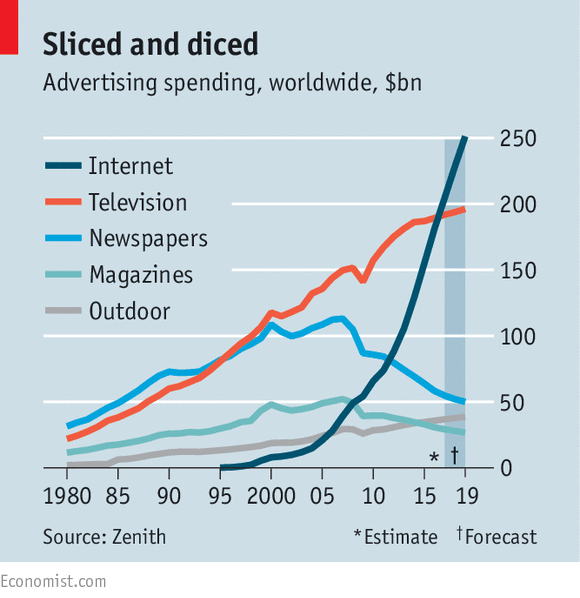
Oddly, I think the article underestimates the size of the change coming. I think one side affect of the surge of IT into advertising, is that it has become easier to measure exactly how well advertising works. By and large, it doesn't, very well. I am reminded of this, from Paul Graham, about his time at Yahoo: http://www.paulgraham.com/yahoo.html "...The reason Yahoo didn't care about a technique that extracted the…

underestimates or overestimates? There is advertising that doesn't require tracking. Simple brand-awareness-building and content-based advertising is pretty profitable without requiring tracking. For a website, the lack of personally-targeted ads may be offset by increasing the number of ad slots. I wonder if there is an estimate on how much value tracking adds.

There is no reason to expect that ad spending will drop in total, because ads never worked very well in any medium, but they worked well enough that it's worth investing in them. The portion of ad spending in TV has not changed significantly the past decades, what has happened is spending has shifted from newspapers to online. but the overall the volume keeps increasing in all media

[1] https://cdn.static-economist.com/sites/default/files/images/...

Re: GDPR will pop the adtech bubble

#167

Earlier quoted context omitted.

They can know how many people, as long as they don't store personal information. Keeping a counter doesn't require consent.

Keeping a reliable counter of meaningful interactions is hard without personal data to correlate unique users.

Ok, so it’s hard. Nobody is entitled to that being easy in the way that they are to privacy.

Re: GDPR will pop the adtech bubble

#168
post #31

Earlier quoted context omitted.

The ICO does not consider IP addresses personal data since more than one person could use a computer in a household.

That seems like a weak argument though. Two humans can also have same name and zipcode. They can also have same personal number and bank account number if they are in different countries. Without tracking and correlation, most information on its own is useless.

This reads like you are intentionally trying to misunderstand. GDPR has two categories of user information: direct identifiers and indirect identifiers.

Direct identifiers are pieces of data that allow to target a person, or a very small group of persons from a single data point. Indirect identifiers are anything that you could use to build a marketing cohort.

Combining a few indirect identifiers allows to target very specific groups of people. Or, using the very examples you quoted:

- The tuple (bank account number, country) is enough to target an individual.

- The tuple (full name, zip code) is enough to target a very small group of individuals. By adding just one more element you can identify individuals.[ß]

Each one of the four data points counts as user information under GDPR. Doesn't matter whether they are direct or indirect.

Disclosure: I wear the DPO hat at Smarkets. As a gambling company we are legally required to know quite a lot about our customers.

ß: For the nitpicking armchair lawyers: unless you happen to have a gated community for John Smiths.

Re: GDPR will pop the adtech bubble

#169

Earlier quoted context omitted.

> By and large, it doesn't, very well. I know Twitter isn't known for being the best at advertising, but it was made exceptionally clear to me that online advertising is a massive bunch of lies when I did my GDPR Twitter data export and it included me in a bunch of incorrect, non-sensical and contradictory ad targeting groups. Twitter claims I: * Own a cat, dog and other animal (I don't) * Have between $100k- $999k l…

For the frugal/high spender conflict, I can kind of see how that might happen. I try to buy quality goods because cheap stuff doesn't last. That means spending more up front to spend less in the long run. So frugal, but also maybe high spender? My mom always says: if you're poor, you can't afford to buy cheap.

I guess the 'spoiler' is that I'm fortunate enough to certainly not be a frugal spender. Yet another data point they have about me that they sell, but is completely incorrect.

Re: GDPR will pop the adtech bubble

#170

Earlier quoted context omitted.

So if I don't think that Walmart should be able to record me with security cameras while I'm in the store I should have the right to demand that they ask me to sign a waiver before entering the store? Shouldn't it be Walmart's right to do what they want on their property, and my right to decide not to visit Walmart if I don't agree with that. Isn't the converse an infringement of Walmart's rights?

I'm not 100% sure, but I believe the cameras at Walmart are for security only. I don't believe Walmart is using facial-recognition technology to identify visitors, track their behaviors (which aisles they visit, how long they look at specific products, etc.) and then using it to other retailers for them to then target those visitors with ads.

OK, it's the petrol station part of the supermarket, but

"Tesco is set to install hi-tech screens that scan customers' faces in petrol stations so that advertisements can be tailored to suit them, it has been reported.

The retailer will introduce the OptimEyes screen, developed by Lord Sugar's Amscreen, to all 450 of its UK petrol stations, in a five-year deal, according to The Grocer.

The screen, positioned at the till, scans the eyes of customers to determine age and gender, and then runs tailored advertisements."

https://www.theguardian.com/business/2013/nov/03/privacy-tes...

Post reply on HN