Live data from Hacker News

Unbounded High Dynamic Range Photography Using a Modulo Camera

media.mit.edu

41–50 of 98 posts

Re: Unbounded High Dynamic Range Photography Using a Modulo Camera

#41

> No more will photographers or even ordinary people have to fumble with aperture size and exposure length. This is a "computer scientists" understanding of photography, and this phrase alone can even be seen as "dangerous" by photographers. There's more to aperture size and exposure length than "how much light reaches the sensor", like focus, depth of field, motion blur and bokeh, to name a few, that is not aknowled…

> This is a "computer scientists" understanding of photography, and this phrase alone can even be seen as "dangerous" by photographers.

The actual headline of the article is actually more informative and less misleading than the subhead:

"Unbounded High Dynamic Range Photography Using a Modulo Camera"

In photographer's terms, they're referring to ending blown highlights (caused by filling the wells in a sensel) not saturated images (caused by exaggerating color data).

There's a school of photography that basically lives and dies by over-saturating images (e.g. http://kenrockwell.com ) and they'd likely have a cow over the headline, but understand and be totally onboard for the actual goal.

Depending on how quickly the well can reset and how many times resets can be counted this will either be better or worse than simply improving existing approaches. The state of the art in full frame sensors is just under 15-bits of dynamic range. So to equal it an 8-bit sensor would need to be able to count resets at least 128 times AND be able to do this in 1/8000 of a second, at the same sensel density and efficiency! Don't hold your breath.

http://www.dxomark.com/Cameras/Nikon/D810

(I'd also suggest that trends towards using multiple sensors to assemble high resolution images will easily blow this away since they can use high- and low- sensitivity sensors to synthesize more dynamic range and resolution. Also see recent Olympus patents to capture polarization data at the same time.)

BTW: assuming they can do this stuff, they presumably can read the sensor pretty darn fast — so they should be able to eliminate image "tearing" in digital video and the need for mechanical shutters altogether. That's probably a bigger issue than dynamic range.

I suspect that clearing a well in < 1/10,000,000 of a second (which would only lose 10% of the photon detection time during a 1/8000s exposure) is going to be tough. Assuming 25% of the sensel real estate needs to be sacrificed to the modulo circuitry, that's a loss of 32.5% of photon data which is about the same loss as for pellicle mirrors (as seen in Sony's pretty unsuccessful SLT cameras) for a feature that won't be much use in many situations.
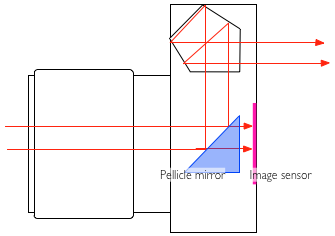
Re: Unbounded High Dynamic Range Photography Using a Modulo Camera

#42

Earlier quoted context omitted.

Exactly. This is huge, and I was wondering why people didn't do it already. Or, for example, why don't cameras currently take multiple snapshots of the sensor? For example, if I'm exposing for 2 seconds, read the sensor at 0.1 sec (for the very bright lights) and again at 2 seconds, for the darker parts. That way, I can make an HDR image without having to take another photo. Is reading the sensor destructive to the d…

Readout of a CCD is destructive. There are types of sensors that have non-destructive readout (Charge Injection Devices being one example: https://www.cis.rit.edu/research/CID/a_cid_is.htm ).

Okay, but can’t I take 8 raw images and merge them into one image with 8 times higher dynamic range?

Re: Unbounded High Dynamic Range Photography Using a Modulo Camera

#45
post #20
post #11

Earlier quoted context omitted.

Sure, photographs will still control aperture and exposure time — this just removes a constraint at one end: if you want shallow depth of field and motion blur, you could use this method (and get extra bits) rather than an ND filter.

That's just really a completely misguided statement. No mater how much you fumble with aperture and shutter speed there's simply no way to expand the camera sensor dynamic range without taking multiple exposures. Besides I have never seen "ordinary people" fumble with aperture size and exposure length so that's a solved problem. Sometimes it gives "wrong" results, like exposing for the highlights rather than the shad…

Sure you can - you expose for the highlights and then you push the shadows in post with a crazy exponential curve. I do it all the time on digital. People used to do it via print manipulation too (filter grading, split printing, dodging and burning), except back then you exposed for the shadows and controlled the highlights (since you were capturing a negative, not a positive).

What would normally have been indistinguishable blacks are pushed into the midtones and you get a flat, grainy image. It just looks like garbage because noise gets out of hand and you lose all your color depth, but there's more dynamic range there in the sense of there being more stops of light crammed onto the final image.

There is a physical limit of the camera or the film where you cannot actually squeeze any more accuracy out of the ADC, but standard conditions are nowhere near that limit.

Re: Unbounded High Dynamic Range Photography Using a Modulo Camera

#46
post #42

Earlier quoted context omitted.

Readout of a CCD is destructive. There are types of sensors that have non-destructive readout (Charge Injection Devices being one example: https://www.cis.rit.edu/research/CID/a_cid_is.htm ).

Okay, but can’t I take 8 raw images and merge them into one image with 8 times higher dynamic range?

Yes, but if I understand correctly, unless those images occur at the same time (or really, really close) you run into issues involving subject and camera motion.

Re: Unbounded High Dynamic Range Photography Using a Modulo Camera

#47
post #42

Earlier quoted context omitted.

Readout of a CCD is destructive. There are types of sensors that have non-destructive readout (Charge Injection Devices being one example: https://www.cis.rit.edu/research/CID/a_cid_is.htm ).

Okay, but can’t I take 8 raw images and merge them into one image with 8 times higher dynamic range?

Yes, that's what modern cameras with the built in feature do. (although I'm not sure about 8 times) The article talks about this feature.

Re: Unbounded High Dynamic Range Photography Using a Modulo Camera

#48
post #42

Earlier quoted context omitted.

Readout of a CCD is destructive. There are types of sensors that have non-destructive readout (Charge Injection Devices being one example: https://www.cis.rit.edu/research/CID/a_cid_is.htm ).

Okay, but can’t I take 8 raw images and merge them into one image with 8 times higher dynamic range?

Of course - that's the current standard way to produce HDR photos. The advantage here is being able to do it all in a single image, which prevents mismatches between images due to subject or photographer movement.

Re: Unbounded High Dynamic Range Photography Using a Modulo Camera

#49
post #38
post #16

I had an idea similar to this that solved the oversaturation issue. Use 2 cameras. Have them at right angles to the shutter point, separated a few inches. At the T junction where the camera pointing would cross with the shutter area, put a prism there. The prism would give each camera 1/2 of the available photons. Now use any standard HDR processing technique.

Interestingly enough that's how Technicolor used to work. Three separate exposures from a single lens, split off by pellicle mirrors. The downside is that like any pellicle you are dividing your light between multiple exposures, meaning you some mixture of a longer exposure, a faster lens, or more lighting. Technicolor required special high-intensity arc lighting. Also, the pellicles must be kept spotless because dus…

Admittedly, my understanding of traditional optics is very limited. I happened upon it in a dream whilst trying to figure out how to handle dynamic scenes while using SLAM.

I was thinking of a prism (new word: pellicle mirror) like this one :

http://static1.squarespace.com/static/54ca877ce4b014ea90e14b...

Except I don't need the deconvolutional prism. I can handle that in software easily with a X or Y matrix flip. And I assume we are using the same CCD module for both areas; given that, I can sum the contrast between the pixels and calculate the min and max, as well as can calculate the HDR image from both sources.

Calibration would be easy to handle, using a checkerboard to link the CCDs to each other (assume aligning errors will happen).

I also see no reason why the pellicles wouldn't be kept clean. The same goes for the CCDs as well. I'd embed them in a dark acrylic box and try to seal them as best as can be.

Re: Unbounded High Dynamic Range Photography Using a Modulo Camera

#50
post #49
post #38

Earlier quoted context omitted.

Interestingly enough that's how Technicolor used to work. Three separate exposures from a single lens, split off by pellicle mirrors. The downside is that like any pellicle you are dividing your light between multiple exposures, meaning you some mixture of a longer exposure, a faster lens, or more lighting. Technicolor required special high-intensity arc lighting. Also, the pellicles must be kept spotless because dus…

Admittedly, my understanding of traditional optics is very limited. I happened upon it in a dream whilst trying to figure out how to handle dynamic scenes while using SLAM. I was thinking of a prism (new word: pellicle mirror) like this one : http://static1.squarespace.com/static/54ca877ce4b014ea90e14b... Except I don't need the deconvolutional prism. I can handle that in software easily with a X or Y matrix flip. An…

The acrylic box blocks all your light (dark is bad), and now you have to keep THAT clean instead. Any surface in your optical path needs to be kept clean, but especially those that are between the center of the optical system and the sensor. Dust on the front element doesn't matter too much, dust on the rear element matters a lot and pellicle mirrors are even worse since they're closer to the focal plane. Scratches from cleaning are real bad too.

As long as your lens system is sealed it's not a problem. But many systems are interchangeable-lens, and when the lens is removed then dust can float in. Or some lenses generate a "vacuum" effect as they focus in and out.

Sensors often incorporate an ultrasonic motor which vibrates it and throws dust off. Or some sensors are mounted on shake tables to reduce blur from operator motion - you can do a similar thing there too. At the end of the day you just have to be careful though.

Like I said, totally possible optically, and yes, very simple to process. The downsides are that when you split the beams each sensor only gets half the light intensity, which means you need to get more light into the optical system in the first place, and you need 2 sensors, which are by far the single most expensive component in the whole camera.

You can actually do something similar with Magic Lantern, a hacked-up open-source firmware for Canon cameras. They scan alternate rows of the sensor at different sensitivities, and use the low-sensitivity row as the most-significant-bits of dynamic range for the high-sensitivity image. You lose a bunch of vertical resolution, but hey, you don't need 2 sensors.

Post reply on HN