Live data from Hacker News

Unbounded High Dynamic Range Photography Using a Modulo Camera

media.mit.edu

11–20 of 98 posts

Re: Unbounded High Dynamic Range Photography Using a Modulo Camera

#11

> No more will photographers or even ordinary people have to fumble with aperture size and exposure length. This is a "computer scientists" understanding of photography, and this phrase alone can even be seen as "dangerous" by photographers. There's more to aperture size and exposure length than "how much light reaches the sensor", like focus, depth of field, motion blur and bokeh, to name a few, that is not aknowled…

Sure, photographs will still control aperture and exposure time — this just removes a constraint at one end: if you want shallow depth of field and motion blur, you could use this method (and get extra bits) rather than an ND filter.
Re: Unbounded High Dynamic Range Photography Using a Modulo Camera

#12

The title here is terrible because over-saturation is an effect of poor tone mapping, which is inevitable if you want to display an HDR image in a low dynamic range display. An accurate title would be the end of over- exposed images, but why not just keep the original?

Two different senses of the word ‘saturation’. The subtitle of the article (current title here) is unfortunate.

Re: Unbounded High Dynamic Range Photography Using a Modulo Camera

#13
post #11

> No more will photographers or even ordinary people have to fumble with aperture size and exposure length. This is a "computer scientists" understanding of photography, and this phrase alone can even be seen as "dangerous" by photographers. There's more to aperture size and exposure length than "how much light reaches the sensor", like focus, depth of field, motion blur and bokeh, to name a few, that is not aknowled…

Sure, photographs will still control aperture and exposure time — this just removes a constraint at one end: if you want shallow depth of field and motion blur, you could use this method (and get extra bits) rather than an ND filter.

Exactly. This is huge, and I was wondering why people didn't do it already. Or, for example, why don't cameras currently take multiple snapshots of the sensor? For example, if I'm exposing for 2 seconds, read the sensor at 0.1 sec (for the very bright lights) and again at 2 seconds, for the darker parts. That way, I can make an HDR image without having to take another photo.

Is reading the sensor destructive to the data, somehow?

Re: Unbounded High Dynamic Range Photography Using a Modulo Camera

#14
post #3

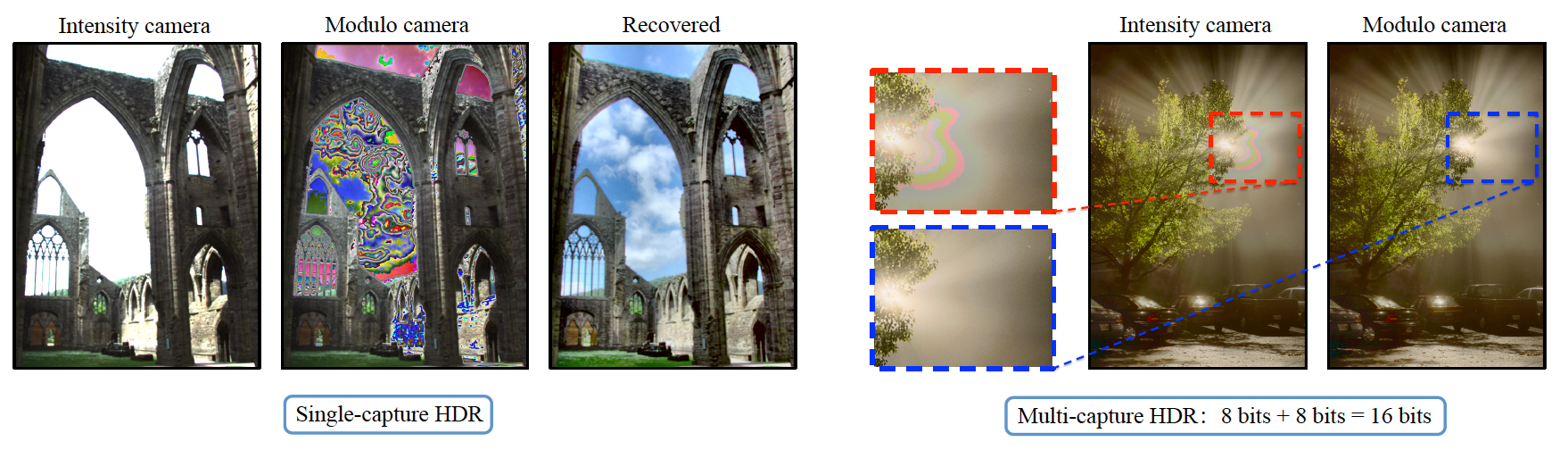
What's with the completely useless thumbnail at the bottom? That said, the technological explanation sounds simple and solid. Why aren't cameras doing that already?

High resolution image here: http://web.media.mit.edu/~hangzhao/images/modulo_teaser.png

Re: Unbounded High Dynamic Range Photography Using a Modulo Camera

#15
post #11

Earlier quoted context omitted.

Sure, photographs will still control aperture and exposure time — this just removes a constraint at one end: if you want shallow depth of field and motion blur, you could use this method (and get extra bits) rather than an ND filter.

Exactly. This is huge, and I was wondering why people didn't do it already. Or, for example, why don't cameras currently take multiple snapshots of the sensor? For example, if I'm exposing for 2 seconds, read the sensor at 0.1 sec (for the very bright lights) and again at 2 seconds, for the darker parts. That way, I can make an HDR image without having to take another photo. Is reading the sensor destructive to the d…

Readout of a CCD is destructive. There are types of sensors that have non-destructive readout (Charge Injection Devices being one example: https://www.cis.rit.edu/research/CID/a_cid_is.htm).

Re: Unbounded High Dynamic Range Photography Using a Modulo Camera

#16
I had an idea similar to this that solved the oversaturation issue.

Use 2 cameras. Have them at right angles to the shutter point, separated a few inches. At the T junction where the camera pointing would cross with the shutter area, put a prism there.

The prism would give each camera 1/2 of the available photons. Now use any standard HDR processing technique.

Re: Unbounded High Dynamic Range Photography Using a Modulo Camera

#18

Earlier quoted context omitted.

Exactly. This is huge, and I was wondering why people didn't do it already. Or, for example, why don't cameras currently take multiple snapshots of the sensor? For example, if I'm exposing for 2 seconds, read the sensor at 0.1 sec (for the very bright lights) and again at 2 seconds, for the darker parts. That way, I can make an HDR image without having to take another photo. Is reading the sensor destructive to the d…

Readout of a CCD is destructive. There are types of sensors that have non-destructive readout (Charge Injection Devices being one example: https://www.cis.rit.edu/research/CID/a_cid_is.htm ).

Very interesting, thank you.

Re: Unbounded High Dynamic Range Photography Using a Modulo Camera

#20
post #11

> No more will photographers or even ordinary people have to fumble with aperture size and exposure length. This is a "computer scientists" understanding of photography, and this phrase alone can even be seen as "dangerous" by photographers. There's more to aperture size and exposure length than "how much light reaches the sensor", like focus, depth of field, motion blur and bokeh, to name a few, that is not aknowled…

Sure, photographs will still control aperture and exposure time — this just removes a constraint at one end: if you want shallow depth of field and motion blur, you could use this method (and get extra bits) rather than an ND filter.

That's just really a completely misguided statement. No mater how much you fumble with aperture and shutter speed there's simply no way to expand the camera sensor dynamic range without taking multiple exposures.

Besides I have never seen "ordinary people" fumble with aperture size and exposure length so that's a solved problem. Sometimes it gives "wrong" results, like exposing for the highlights rather than the shadows, that's what this technology solves.

Post reply on HN