> No more will photographers or even ordinary people have to fumble with aperture size and exposure length. This is a "computer scientists" understanding of photography, and this phrase alone can even be seen as "dangerous" by photographers. There's more to aperture size and exposure length than "how much light reaches the sensor", like focus, depth of field, motion blur and bokeh, to name a few, that is not aknowled…
The actual headline of the article is actually more informative and less misleading than the subhead:
"Unbounded High Dynamic Range Photography Using a Modulo Camera"
In photographer's terms, they're referring to ending blown highlights (caused by filling the wells in a sensel) not saturated images (caused by exaggerating color data).
There's a school of photography that basically lives and dies by over-saturating images (e.g. http://kenrockwell.com ) and they'd likely have a cow over the headline, but understand and be totally onboard for the actual goal.
Depending on how quickly the well can reset and how many times resets can be counted this will either be better or worse than simply improving existing approaches. The state of the art in full frame sensors is just under 15-bits of dynamic range. So to equal it an 8-bit sensor would need to be able to count resets at least 128 times AND be able to do this in 1/8000 of a second, at the same sensel density and efficiency! Don't hold your breath.
http://www.dxomark.com/Cameras/Nikon/D810
(I'd also suggest that trends towards using multiple sensors to assemble high resolution images will easily blow this away since they can use high- and low- sensitivity sensors to synthesize more dynamic range and resolution. Also see recent Olympus patents to capture polarization data at the same time.)
BTW: assuming they can do this stuff, they presumably can read the sensor pretty darn fast — so they should be able to eliminate image "tearing" in digital video and the need for mechanical shutters altogether. That's probably a bigger issue than dynamic range.
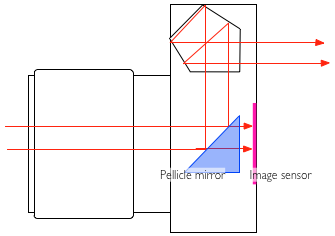
I suspect that clearing a well in < 1/10,000,000 of a second (which would only lose 10% of the photon detection time during a 1/8000s exposure) is going to be tough. Assuming 25% of the sensel real estate needs to be sacrificed to the modulo circuitry, that's a loss of 32.5% of photon data which is about the same loss as for pellicle mirrors (as seen in Sony's pretty unsuccessful SLT cameras) for a feature that won't be much use in many situations.