Live data from Hacker News

I think Anthropic and OpenAI have found product-market fit

simonwillison.net

851–860 of 1001 posts

Re: I think Anthropic and OpenAI have found product-market fit

#851
post #14

> $2,180.16 worth of tokens for $200 “Tokens” don’t have an intrisic cost or value. Saying that I used $2,180.16 worth of tokens is like relying on the salesperson to convince me I’m getting a billion dollars worth of pots and pans for $19.99. I think it’s funny how we are throwing critical thinking out the window when it comes to evaluating biased sources of info.

> “Tokens” don’t have an intrisic cost or value.

i am pretty sure these services know what it truly costs them to serve you tokens, maybe not in realtime but at least periodically.

however, what they charge us is a constant exercise in price discovery. i agree with this sentiment in the sense that we don't have a stable sense of the cost. all of these comparisons are good for the moment, or at most the near future.

i believe that even the "all you can eat" approach with the max plans, regardless of their crazy pricing, is not sustainable only with the power users. if most of us gets this kind of value through our plans, surely it does not incentivise the service providers to continue pushing it. maybe they can regardless just to gain market share, but not forever.
Re: I think Anthropic and OpenAI have found product-market fit

#852
post #223

Earlier quoted context omitted.

Not to mention the API plans are also still in their "lose money, just get the suckers hooked like addicts" phase. Once the reality-based pricing comes into play, it's a coin flip of whether the bulk of the companies fail, or they get to live off government subsidies for a few decades. On the plus side, I'm happy I'll have a nice hay barn when the local half-built AI data center is abandoned.

I believe that API pricing runs at a healthy margin, at least compared to the server and energy costs used to serve the tokens. Recent conversation here on that topic: https://news.ycombinator.com/item?id=47062534#47063134

> There exist a large number of people who are absolutely convinced that LLM providers are all running inference at a loss in order to capture the market and will drive the prices up sky high as soon as everyone is hooked.

> I think this is often a mental excuse for continuing to avoid engaging with this tech, in the hope that it will all go away.

Thanks for that psychological explanation. I was wondering why people were simply ignoring the math that shows that inference at API pricing can be quite profitable, e.g. published here for DeepSeek V3/R1 with 545% profitability: https://github.com/deepseek-ai/open-infra-index/blob/main/20...

Re: I think Anthropic and OpenAI have found product-market fit

#853
money talks, and being a broky from outside the valley/west coast, the "product-market fit" here are the neighbours of the service providers.

the economics simply don't work unless you make six figures, at least to just give it a go blindly. the providers are also still figuring out what they can get away by charging, and they are getting a similar treatment from those under the stack.

the caps and limits are not very transparent, and it is quite difficult to know what is "enough". the current rate does not stay the same and the contract is changed way too often to dedicate for the long term. regardless, the subsidized rates should not be sustainable forever. make hay while the sun shines i suppose.

Re: I think Anthropic and OpenAI have found product-market fit

#854

Product-market fit, but what about customer retention? It is quite trivial to switch from using one model or another. Likewise, in a few years we'll have affordable laptops to run today's frontier models. What's their plan to let us keep subscribing?

Right now the main plan for that appears to be having those enterprise accounts commit for a year at a time.

Re: I think Anthropic and OpenAI have found product-market fit

#855

They've got, ballpark, $5t to $10t to make back in the next 5 years, or the hardware buildouts will start getting written down. This means we're going to need $1t+ per year in spending, per year, on tokens. 200m knowledge workers in the world, 30m developers. We're talking about a world where you need 5% of every knowledge workers salary to go into tokens. 20% if you're a developer. That's a _huge_ shift. Most people…

Here are a few thoughts: - The publicly available information about how inference costs compare to training costs is conflicted. EEs involved in datacenters talk about power usage spikes during training runs as if they were a major factor in the designs, but academic papers discussing cost-optimal scaling confidently treat inference-time compute as a major factor. - On the side of the balance indicating that training…

Why would power spikes from training runs imply training>>inference? The cost of a training run scales with energy, whereas power is energy per unit time. All that tells you is that they're speeding up their training run so it will take less time overall (probably chasing some first-mover advantage, where they're out with a given model before their closest competitors), whereas they obviously can't do that for inference (which is a steady flow of requests over time).

Re: I think Anthropic and OpenAI have found product-market fit

#856

Earlier quoted context omitted.

Yeah, that's the part that just seems to be wildly under-discussed to me. If open source models are ~3-6 months behind SOTA, and ~opus4.6 capabilities are good-enough for product market fit, do the frontier labs have half a decade to catch up on their prior burn? AI cost ballooning faster than companies can afford is becoming a very common topic in my circles right now. The era of "I'll pay infinitely more for margin…

Open source models that you can run locally are much more than 3 to 6 months behind. 6 months was the November inflection for Claude. No open source model is as good as Claude Opus 4.6.

I've been doing my work with OpenCode Go, with Kimi2.6. It is not as good as Claude Opus, but it's good enough to get the job done, and I never run out of tokens.

Re: I think Anthropic and OpenAI have found product-market fit

#857

They've got, ballpark, $5t to $10t to make back in the next 5 years, or the hardware buildouts will start getting written down. This means we're going to need $1t+ per year in spending, per year, on tokens. 200m knowledge workers in the world, 30m developers. We're talking about a world where you need 5% of every knowledge workers salary to go into tokens. 20% if you're a developer. That's a _huge_ shift. Most people…

We're going to reach a point where these companies stop asking for money and start mandating it. They've got a vice grip around the nuts of many governments and loads of companies have gone all in on investing in these slop heaps.

At some point, companies are going to start removing basic features. Governments and essential services are going to make people go through chatbots to get basic service. They're going to require AI to validate stuff that's already automated and working fine. Google search? That'll be all AI (and I guess they're already rolling it out). Dentist appointment? Going to need to do it through some AI app that requires an account and tokens "for a better patient experience". Verifying your ID when buying alcohol? Going to need AI to scan it and take 90 seconds to determine whether it's real. And it'll say you're an 7 year old farm worker in rural Botswana, so you can't get alcohol. And they're going to milk money at every level of this.

Re: I think Anthropic and OpenAI have found product-market fit

#858

I feel like there's a bit of AI psychosis in this particular post. >"These are tools which burn vastly more tokens, but are also quickly becoming daily drivers for the work carried out by extremely well-compensated professionals." >"Somehow this fragment turned into headlines like Uber’s COO says it’s getting harder to justify the money spent on AI tokenmaxxing, because the market for stories about AI failures remain…

Please let's not dilute the meaning of 'AI psychosis'. It is a real phenomenon that involves actual psychosis.

Re: I think Anthropic and OpenAI have found product-market fit

#859

Earlier quoted context omitted.

Ed actually provides sources and goes into an incredible amount of detail as to how he came to his conclusions. The average AI booster just goes "I totally built ten businesses off vibe coding but I can't tell you anything because it's a SECRET!". And the mainstream tech media is so in the pocket of big tech and AI corporations that they might as well just publish their PR emails at this point. Yeah, I'll listen to E…

Ed actually seems to make some really serious errors in his work. Tim Lee called out a particularly egregious one here, though it's one of many: https://x.com/binarybits/status/2050562429709377986 That said, I really mean it when I say that I don't actually think Ed is a good choice for the anti-AI movement. I think an actual opposition is useful, but he ain't it. I really recommend you read the Wired profile if you…

I read the profile and didn't see anything really wrong. Why would PR companies have to believe in their clients? Why does he have to be held to higher moral standards than Sam Altman who’s a total lying snake?

The error you call out is hardly “serious”, as the whole argument is uninteresting. It is a stupid indefensible error but the argument about revenue being 20% or 30% lower than reported isn’t that central to his overall thesis. Stuff that matters is inference cost, profitability, actual training costs.

Re: I think Anthropic and OpenAI have found product-market fit

#860

Earlier quoted context omitted.

What I also find confusing though is that folks seem to ignore trajectory which is maybe the biggest lede to bury. As Simon says, we have had "good enough" coding agents for 6 months, that is a blink of an eye, and at my company my job has now completely changed. It's almost like a dream. And that's just one inflection point. We've had several and there are many more on the horizon. So while I could be convinced that…

There may be additional major leaps forward, and there may not. I kind of struggle to imagine what the next step actually is. Certainly there will be improvements in performance (speed) and cost. But at a point you reach a barrier where the limiting factor is the specificity of the human prompt and our ability to manage all the code we’re generating. Somewhat oversimplifying; writing software and building apps was a…

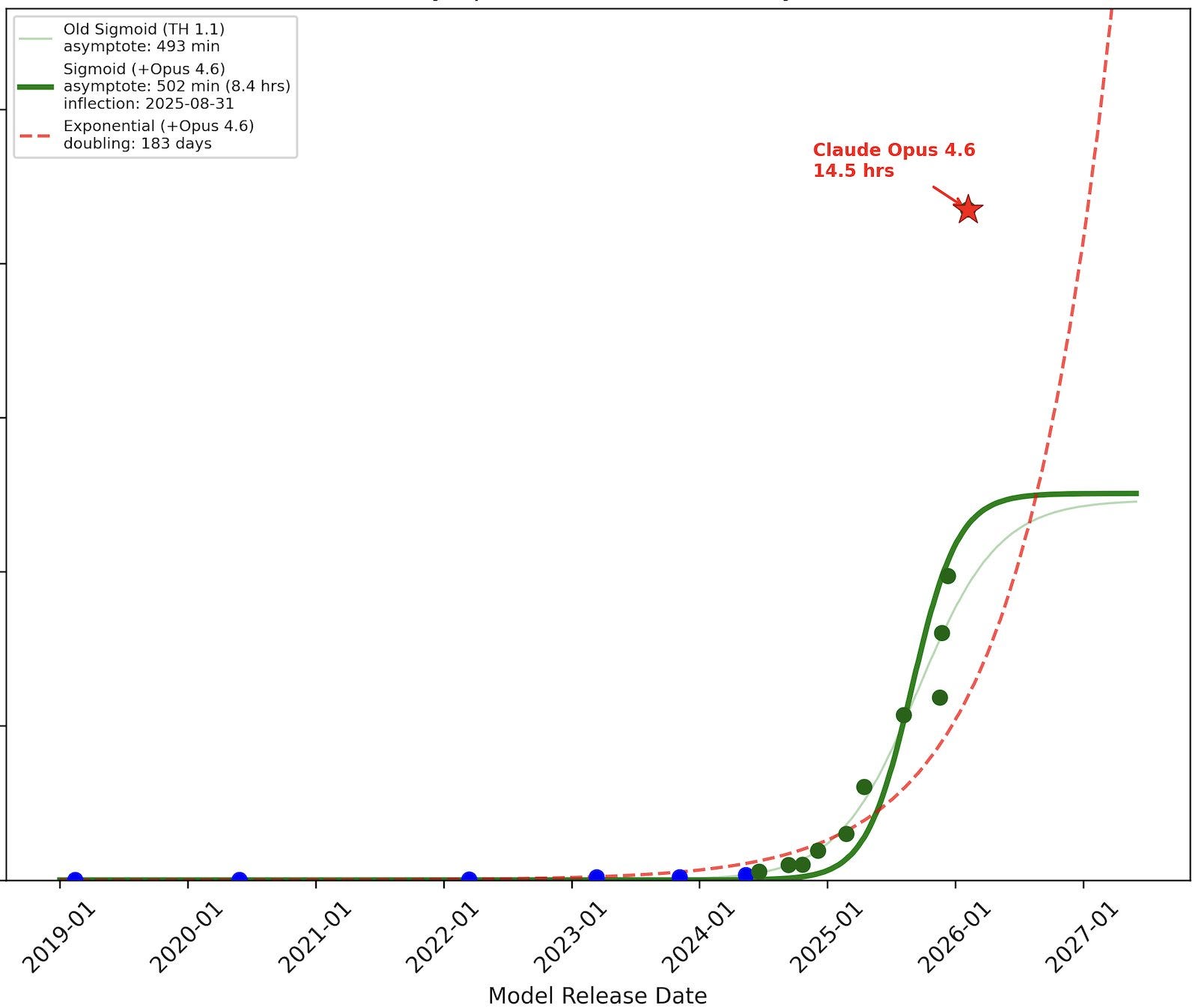
Based on how much money is chasing returns, and how steep the slope is, it's almost certain that we are still not at the end of this sigmoid cycle.

Sure, it might start to slow down, but even then we will likely see a doubling in the next 10-15 years.

https://substackcdn.com/image/fetch/$s_!_ZW2!,f_auto,q_auto:...

Post reply on HN