Live data from Hacker News

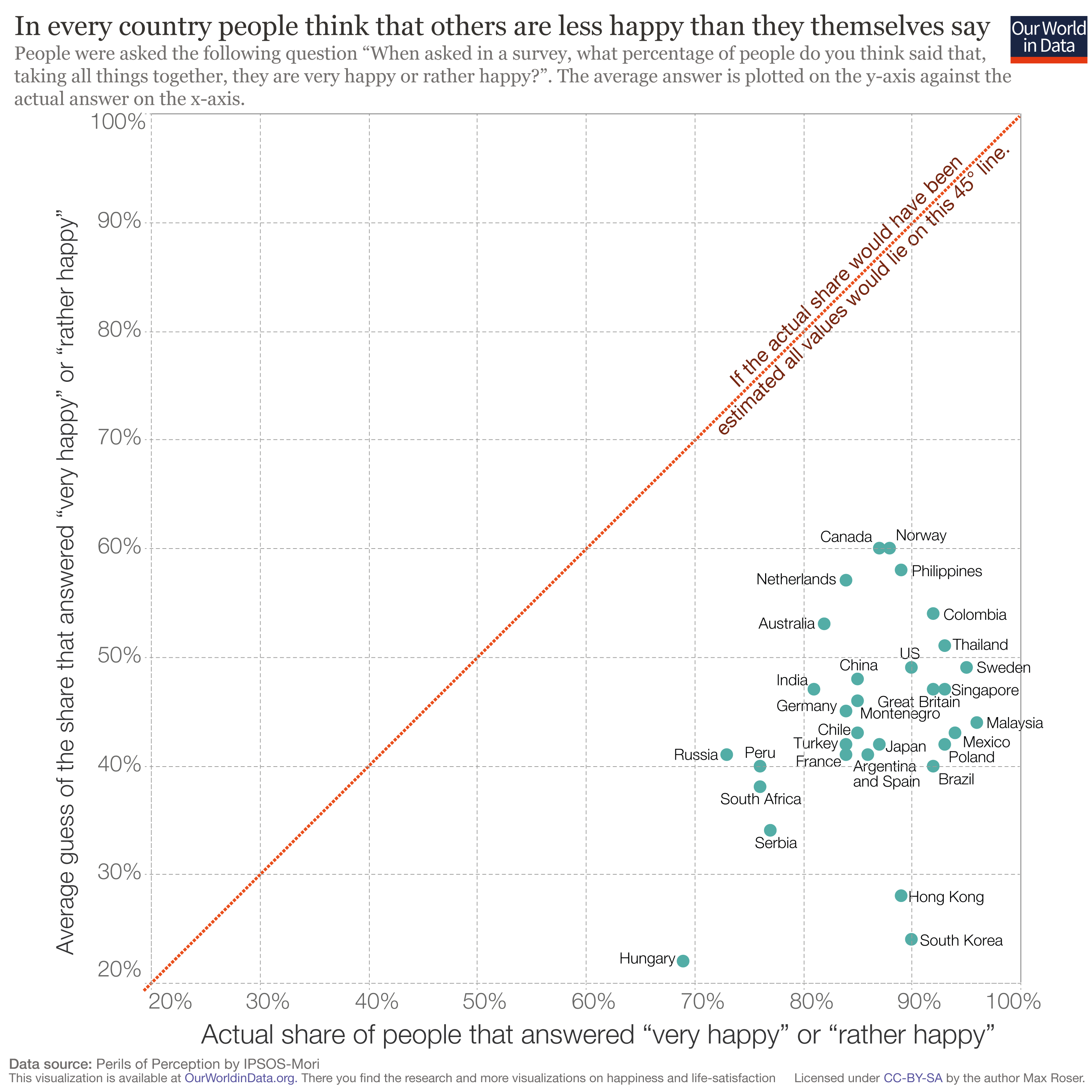
In every country people think others are less happy than they themselves say (2017)

ourworldindata.org

81–90 of 103 posts

Re: In every country people think others are less happy than they themselves say (2017)

#81
post #58

Earlier quoted context omitted.

I've heard this book cited many times, and people saying that the "bad" things we see are just the news cycles and very temporary, and in general we're better off (e.g. "The richest person has the same iPhone as you and uses the same kind of toilet"). Sure, some things are "objectively" better, like lower child mortality and so on. But happiness is so subjective. It's entirely possible that when we were hunter gather…

Go without a toilet, a refrigerator, or clean water for a year and tell me how happy you are… I think this idealization of “hunter gatherer” society is absolutely insane. It’s like arguing the moon is made of cheese. People were likely not happy being hungry, scared, and afraid most of fucking the time.

They could have been equally happy or happier because they did not have this reference or refrigeration or clean water.

For all we know when people start to travel cross continent in minutes, press a button and have instant steak printed, we cannot assume they will be happier than everyone alive today. They will have their own set of issues to weight them down. If nothing, boredom.

Re: In every country people think others are less happy than they themselves say (2017)

#82
post #73
post #64

Earlier quoted context omitted.

Propaganda is about showing just the right data in the right way to make an argument. As such his backstory is perfect for a propaganda piece. > almost every metric That’s exactly the kind of thing that’s both misleading and false. Take global divorce rate, it’s one metric but you can easily turn it into several others if you’re trying to support a given narrative. Average length of marriage, percentage of the global…

Sure you can accuse statisticians like this of picking and choosing metrics and you can choose other metrics to paint a different picture. That's really not the point the book is making though. What the book does is ask ordinary people what they think is happening on metrics do they care about, and are those metrics getting better or worse. So the metrics themselves are part of the story, but it's people's perception…

I don’t think it’s a distorted view to think in terms of the absolute numbers or even in terms of your society rather than just the global rates which makes many of those trends look far worse. The CCP’s genocide isn’t less important simply because they have a huge population and therefore it’s impacting a smaller percentage of their population than many past genocides.

There’s a few positive trends that show up on thousands of different metrics. Economic growth continues, but as much as that impacts poverty in a positive way it also results in an increasing number of deaths on an absolute scale from air pollution, CO2, plastic pollution etc. I am not saying it’s therefore bad, just that talking about things in terms of statistics is on it’s own misleading.

Re: In every country people think others are less happy than they themselves say (2017)

#83
post #64
post #61

Earlier quoted context omitted.

Don't throw around accusations like that willy nilly. It causes "propaganda" to become a trivialized term that everyone can just throw at anyone making any statement they don't agree with after 1 minute of consideration. This book was written by Hans Rosling, a man who was an expert in data analysis and whose mission was to show actual world data to people in fantastic visualizations they could clearly understand. If…

Propaganda is about showing just the right data in the right way to make an argument. As such his backstory is perfect for a propaganda piece. > almost every metric That’s exactly the kind of thing that’s both misleading and false. Take global divorce rate, it’s one metric but you can easily turn it into several others if you’re trying to support a given narrative. Average length of marriage, percentage of the global…

Divorce rate isnt strictly good but or bad though. Some of the increase in divorce is due to increased economic opportunity for women. To put it another way, we could decrease divorce rates by eliminating economic opportunities for women.

Re: In every country people think others are less happy than they themselves say (2017)

#84
post #64

Earlier quoted context omitted.

Propaganda is about showing just the right data in the right way to make an argument. As such his backstory is perfect for a propaganda piece. > almost every metric That’s exactly the kind of thing that’s both misleading and false. Take global divorce rate, it’s one metric but you can easily turn it into several others if you’re trying to support a given narrative. Average length of marriage, percentage of the global…

Divorce rate isnt strictly good but or bad though. Some of the increase in divorce is due to increased economic opportunity for women. To put it another way, we could decrease divorce rates by eliminating economic opportunities for women.

I didn’t mean to single out divorce as a bad thing just that you can create multiple statistics around the same thing. Economic growth itself is an extreme example of this you can find many positive and many negative statistics resulting from the same underlying trend.

Total number of people dying from air pollution is an easy way to make global economic growth look bad. I am not saying it’s inherently a bad thing, just that painting a very rosy picture means being selective about what’s included and how it’s presented. You can downplay anything by using percent of a growing population even if things don’t actually become less horrific for those impacted just because there’s more people.

Re: In every country people think others are less happy than they themselves say (2017)

#85
post #64
post #61

Earlier quoted context omitted.

Don't throw around accusations like that willy nilly. It causes "propaganda" to become a trivialized term that everyone can just throw at anyone making any statement they don't agree with after 1 minute of consideration. This book was written by Hans Rosling, a man who was an expert in data analysis and whose mission was to show actual world data to people in fantastic visualizations they could clearly understand. If…

Propaganda is about showing just the right data in the right way to make an argument. As such his backstory is perfect for a propaganda piece. > almost every metric That’s exactly the kind of thing that’s both misleading and false. Take global divorce rate, it’s one metric but you can easily turn it into several others if you’re trying to support a given narrative. Average length of marriage, percentage of the global…

> Average length of marriage, percentage of the global population married, etc.

Getting/being married is not itself a measure of happiness. Just the ability to get divorced is a huge positive change from the past. It means people don't have to be stuck in bad relationships.

> Average lifespan after cancer diagnosis increasing is good but more people with cancer sounds bad.

More people with detected cancer is good. A larger swath of the population has access to cancer screening and the capability of detecting cancer early is better than it ever was in the past. Just because cancer diagnosis has increased doesn't mean rates of incidence has increased.

Re: In every country people think others are less happy than they themselves say (2017)

#86
post #43
post #39

> Yup, and it shows that most people are happy but still think that most other people are unhappy This (and alike) conclusion is likely wrong. If there is a societal/cultural/political expectation to project happiness, people will say they are happy. Many people wouldn’t say they are unhappy to a stranger. Fun fact, sociologists in Russia asking people nowadays “how do people around you feel? good/bad/worried/etc.” e…

This explanation is so obvious that I consider any study or chart that doesn't scream this at the reader in big red letters to be nothing short of propaganda. The conclusion those "researchers" would like to draw is that the world is better than "the people" think, when the far more plausible interpretation is that the world is so horribly bad that people are scared to even talk about how they feel.

That's a very pessimistic view, that the world is "horribly bad" is subjective, and as it has been said, contradicts objective metrics.

This graph by itself is hard to interpret anyways. Though pessimistic, your interpretation is a valid one, but so is the optimistic "people are happier than you think they are" conclusion.

More neutrally, I think the chart is more about social expectations that have little to do with how bad the environment is. For example, I would expect people who believe in a religion that says that life on earth is horrible and ones goal is to reach heaven to say that they are unhappy even if they are doing fine. That's because no matter how they feel, this is earth and not heaven, and true happiness is unreachable. Anyways, too many possibilities to interpret this without additional data.

Re: In every country people think others are less happy than they themselves say (2017)

#87
post #64

Earlier quoted context omitted.

Propaganda is about showing just the right data in the right way to make an argument. As such his backstory is perfect for a propaganda piece. > almost every metric That’s exactly the kind of thing that’s both misleading and false. Take global divorce rate, it’s one metric but you can easily turn it into several others if you’re trying to support a given narrative. Average length of marriage, percentage of the global…

> Average length of marriage, percentage of the global population married, etc. Getting/being married is not itself a measure of happiness. Just the ability to get divorced is a huge positive change from the past. It means people don't have to be stuck in bad relationships. > Average lifespan after cancer diagnosis increasing is good but more people with cancer sounds bad. More people with detected cancer is good. A…

Screening is a separate question, many drugs extend people’s lives pans with cancer but don’t actually cure it. I would call them a good thing, but they do directly mean a higher percentage of the population has cancer irrespective of detection. Which gets to my point, people with cancer isn’t a statistic that’s universally good or bad but a complex thing.

Re: In every country people think others are less happy than they themselves say (2017)

#88
post #47

Earlier quoted context omitted.

> Compared with every metric in history, we are better. That claim alone should immediately make you doubt the metrics being used. In fact, it's easy to find dozens of metrics for which this isn't true. Housing affordability being a very obvious example. And the average democracy index has been going downwards for 15 consecutive years IIRC. Environmental pollution also most certainly isn't "at the best time in the en…

> You've fallen for propaganda, I'm afraid. That seems shortsighted at best. Theres certainly a case to be made that increased life expectancy, increased consumption of goods and services, access to education and health services, reduction in poverty etc. outweigh those things you cited. Also, those things you cited are all highly political issues and arguably not true so be careful about suggesting people have falle…

> outweigh those things you cited

The comment I responded to claimed that "we are better" according to "every metric". It wasn't about one thing "outweighing" the other.

> Environmental pollution, at least in the West, is down.

Not compared to 500 years ago. The comment I responded to was talking about all of history.

Re: In every country people think others are less happy than they themselves say (2017)

#89
post #86
post #43

Earlier quoted context omitted.

This explanation is so obvious that I consider any study or chart that doesn't scream this at the reader in big red letters to be nothing short of propaganda. The conclusion those "researchers" would like to draw is that the world is better than "the people" think, when the far more plausible interpretation is that the world is so horribly bad that people are scared to even talk about how they feel.

That's a very pessimistic view, that the world is "horribly bad" is subjective, and as it has been said, contradicts objective metrics. This graph by itself is hard to interpret anyways. Though pessimistic, your interpretation is a valid one, but so is the optimistic "people are happier than you think they are" conclusion. More neutrally, I think the chart is more about social expectations that have little to do with…

> that the world is "horribly bad" is subjective, and as it has been said, contradicts objective metrics

The metrics themselves may be objective, but which metrics you apply is very much subjective, and a potent tool for spinning propaganda. You don't even have to lie, you just have to be selective about which facts you present. And the great news is, the world is so incredibly complex that for literally anything you can find some metric that will present it in a positive light (or in a negative light, depending on which message you want to convey).

Re: In every country people think others are less happy than they themselves say (2017)

#90
post #46
post #43

Earlier quoted context omitted.

This explanation is so obvious that I consider any study or chart that doesn't scream this at the reader in big red letters to be nothing short of propaganda. The conclusion those "researchers" would like to draw is that the world is better than "the people" think, when the far more plausible interpretation is that the world is so horribly bad that people are scared to even talk about how they feel.

I found a book a while ago, that made me change my perspective about how I see the world as a whole. This is the book, it's called Factfulness: https://www.goodreads.com/book/show/37850908-factfulness There are a lot of bad things that happen around us (war, hunger, discrimination, etc), but we are at the best time in the entire human history, even with that. Compared with every metric in history, we are better. Even…

> we are at the best time in the entire human history, even with that.

I've heard this ad naseum during my whole life. The word they always forget is "materially". People are on average better off materially than ever before (maybe), but that is far from taking into account what it means to be human and what life is.

One example is that we have better quality beds than ever before in history, but maybe that doesn't matter since people in the past had tougher skin and didn't need better beds.

These "best time in human history" doesn't take into account things such as freedom, purpose in life, dignity and any other factors of life that cannot be measured, because scientists can not deal with things that aren't measurable.

Post reply on HN