Live data from Hacker News

In every country people think others are less happy than they themselves say (2017)

ourworldindata.org

71–80 of 103 posts

Re: In every country people think others are less happy than they themselves say (2017)

#71
post #64

Earlier quoted context omitted.

Propaganda is about showing just the right data in the right way to make an argument. As such his backstory is perfect for a propaganda piece. > almost every metric That’s exactly the kind of thing that’s both misleading and false. Take global divorce rate, it’s one metric but you can easily turn it into several others if you’re trying to support a given narrative. Average length of marriage, percentage of the global…

Don't get uppity about "almost every metric". It's quite possibly true, after all. But then again we're defining the metrics aren't we, with all our recency bias and modern philosophy on life. A high divorce rate is a positive thing if it means people are getting out of bad marriages and living poverty free independent lives. We have a lot of civil law around divorce that makes it expensive and painful, but not Henry…

[deleted]

Re: In every country people think others are less happy than they themselves say (2017)

#72
post #39

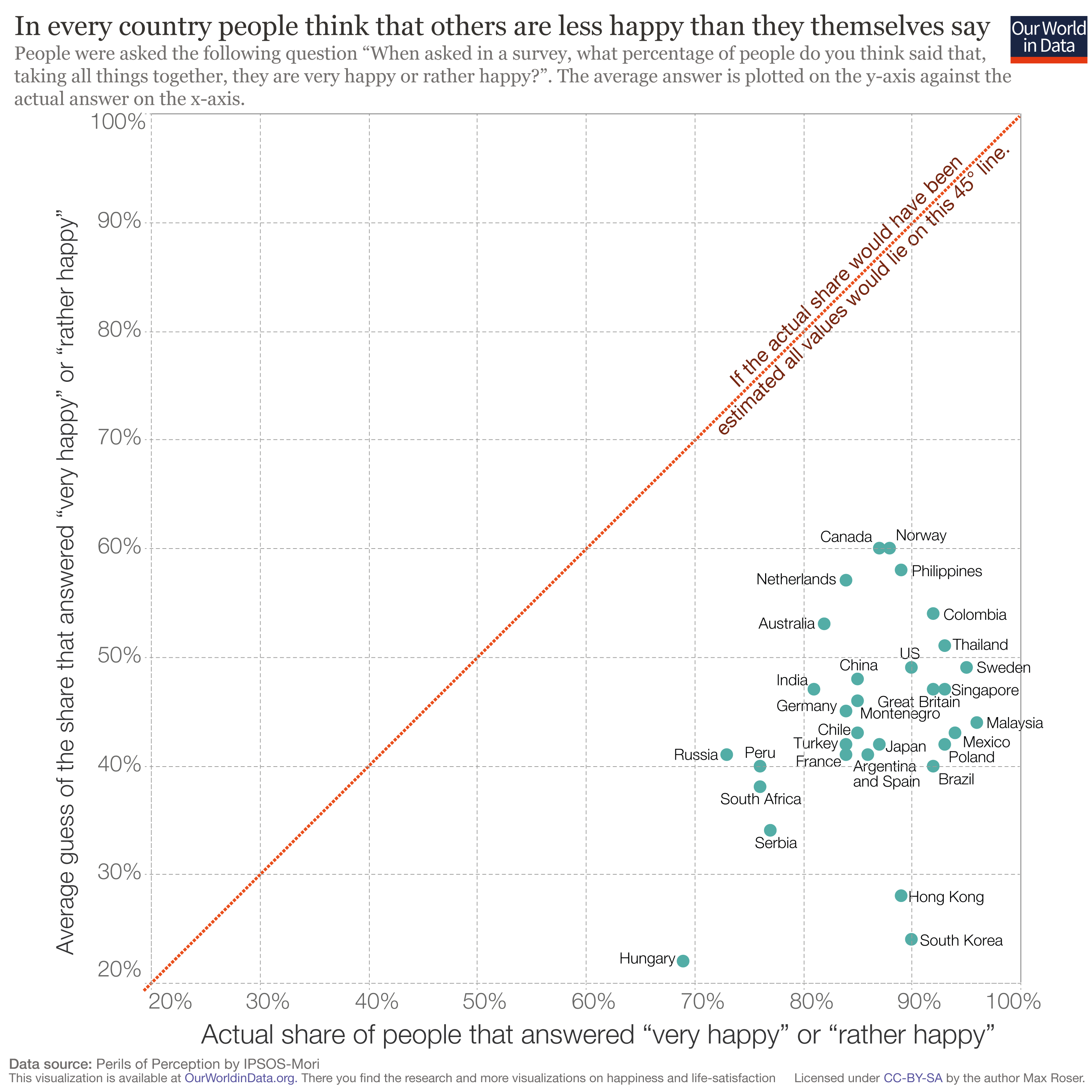
> Yup, and it shows that most people are happy but still think that most other people are unhappy This (and alike) conclusion is likely wrong. If there is a societal/cultural/political expectation to project happiness, people will say they are happy. Many people wouldn’t say they are unhappy to a stranger. Fun fact, sociologists in Russia asking people nowadays “how do people around you feel? good/bad/worried/etc.” e…

It's not strangers approaching random people on the street, it's an anonymous survey in which you have to willingly participate, so I don't think any of these expectations could have significantly affected this statistic.

Re: In every country people think others are less happy than they themselves say (2017)

#73
post #64
post #61

Earlier quoted context omitted.

Don't throw around accusations like that willy nilly. It causes "propaganda" to become a trivialized term that everyone can just throw at anyone making any statement they don't agree with after 1 minute of consideration. This book was written by Hans Rosling, a man who was an expert in data analysis and whose mission was to show actual world data to people in fantastic visualizations they could clearly understand. If…

Propaganda is about showing just the right data in the right way to make an argument. As such his backstory is perfect for a propaganda piece. > almost every metric That’s exactly the kind of thing that’s both misleading and false. Take global divorce rate, it’s one metric but you can easily turn it into several others if you’re trying to support a given narrative. Average length of marriage, percentage of the global…

Sure you can accuse statisticians like this of picking and choosing metrics and you can choose other metrics to paint a different picture. That's really not the point the book is making though.

What the book does is ask ordinary people what they think is happening on metrics do they care about, and are those metrics getting better or worse. So the metrics themselves are part of the story, but it's people's perception of them that's the main point. It turns out that people consistently get this wrong, and think that these things are getting worse when actually they are mostly getting much better.

So this isn't so much about the author painting a picture of the world getting better, though maybe that's part of the argument. It's about ordinary people having an extremely distorted view of progress. Whatever you think about these metrics or other metrics, it's hard to argue that this central thesis of the book about people's view of these metrics is wrong.

Re: In every country people think others are less happy than they themselves say (2017)

#74
post #43
post #39

> Yup, and it shows that most people are happy but still think that most other people are unhappy This (and alike) conclusion is likely wrong. If there is a societal/cultural/political expectation to project happiness, people will say they are happy. Many people wouldn’t say they are unhappy to a stranger. Fun fact, sociologists in Russia asking people nowadays “how do people around you feel? good/bad/worried/etc.” e…

This explanation is so obvious that I consider any study or chart that doesn't scream this at the reader in big red letters to be nothing short of propaganda. The conclusion those "researchers" would like to draw is that the world is better than "the people" think, when the far more plausible interpretation is that the world is so horribly bad that people are scared to even talk about how they feel.

The reverse is true too though. A lot of people love to complain. Small examlle, A ton of workplaces, if you have small talk, people will yammer on how busy they are (they're not).same with anything else. when you look in your heart, you actually find yourself pretty satisfied, that's not that uncommon either.

Re: In every country people think others are less happy than they themselves say (2017)

#75
post #58
post #46

Earlier quoted context omitted.

I found a book a while ago, that made me change my perspective about how I see the world as a whole. This is the book, it's called Factfulness: https://www.goodreads.com/book/show/37850908-factfulness There are a lot of bad things that happen around us (war, hunger, discrimination, etc), but we are at the best time in the entire human history, even with that. Compared with every metric in history, we are better. Even…

I've heard this book cited many times, and people saying that the "bad" things we see are just the news cycles and very temporary, and in general we're better off (e.g. "The richest person has the same iPhone as you and uses the same kind of toilet"). Sure, some things are "objectively" better, like lower child mortality and so on. But happiness is so subjective. It's entirely possible that when we were hunter gather…

Go without a toilet, a refrigerator, or clean water for a year and tell me how happy you are…

I think this idealization of “hunter gatherer” society is absolutely insane. It’s like arguing the moon is made of cheese. People were likely not happy being hungry, scared, and afraid most of fucking the time.

Re: In every country people think others are less happy than they themselves say (2017)

#76
post #47
post #46

Earlier quoted context omitted.

I found a book a while ago, that made me change my perspective about how I see the world as a whole. This is the book, it's called Factfulness: https://www.goodreads.com/book/show/37850908-factfulness There are a lot of bad things that happen around us (war, hunger, discrimination, etc), but we are at the best time in the entire human history, even with that. Compared with every metric in history, we are better. Even…

> Compared with every metric in history, we are better. That claim alone should immediately make you doubt the metrics being used. In fact, it's easy to find dozens of metrics for which this isn't true. Housing affordability being a very obvious example. And the average democracy index has been going downwards for 15 consecutive years IIRC. Environmental pollution also most certainly isn't "at the best time in the en…

Housing affordability is an entirely new concept as a result of a better society. Go back a hundred or two hundred years and housing was not affordable because people didn’t have jobs. They were serfs and slaves.

Re: In every country people think others are less happy than they themselves say (2017)

#77
post #46
post #43

Earlier quoted context omitted.

This explanation is so obvious that I consider any study or chart that doesn't scream this at the reader in big red letters to be nothing short of propaganda. The conclusion those "researchers" would like to draw is that the world is better than "the people" think, when the far more plausible interpretation is that the world is so horribly bad that people are scared to even talk about how they feel.

I found a book a while ago, that made me change my perspective about how I see the world as a whole. This is the book, it's called Factfulness: https://www.goodreads.com/book/show/37850908-factfulness There are a lot of bad things that happen around us (war, hunger, discrimination, etc), but we are at the best time in the entire human history, even with that. Compared with every metric in history, we are better. Even…

> we are at the best time in the entire human history

I constantly see this claim and I have really grown to hate it. It is a simple lie, in three ways, and thirds one is the worst.

Firstly, the statement is only true if you compare human history over hundreds of years. So you comparing modern society to people who haven't discovered soap and hygiene. If that is your benchmark, even USSR looks good if you compare it to 1500's - at least you had real medical system and toilets. Clearly medieval social order in not our benchmark of success, no-one is arguing we should bring back the inquisition, burning witches and bloodletting.

It is not actually true if you compare human experience over last few decades - look at suicide rates and debt burden amongst young people, climate change, etc.

Second reason your claim is terrible, is it conflates social order and technological progress. So when I question social policies, like why did I alone pay more tax in UK in 2015 than the entire corporation of Starbucks, people go - 'things have never been so good, so current social policies should not be questioned.' Well, things get better because technology get's better. Even in USSR technology got better. So if all you knew was living in USSR, you'd be making the same argument, and it would be equally valid/invalid.

Third reason this is terrible, is it fails to take into account inertia. So in Britain we question the way our railways are run, and this argument gets throw around. But majority of railways were built in Victorian Era, under completely different social order. American economy was made great decades ago, when corporate tax rates were like 3x higher, education was free, etc. We are just living off success of the past, it does not mean current social order, which is different, will lead to success.

Re: In every country people think others are less happy than they themselves say (2017)

#78
post #47
post #46

Earlier quoted context omitted.

I found a book a while ago, that made me change my perspective about how I see the world as a whole. This is the book, it's called Factfulness: https://www.goodreads.com/book/show/37850908-factfulness There are a lot of bad things that happen around us (war, hunger, discrimination, etc), but we are at the best time in the entire human history, even with that. Compared with every metric in history, we are better. Even…

> Compared with every metric in history, we are better. That claim alone should immediately make you doubt the metrics being used. In fact, it's easy to find dozens of metrics for which this isn't true. Housing affordability being a very obvious example. And the average democracy index has been going downwards for 15 consecutive years IIRC. Environmental pollution also most certainly isn't "at the best time in the en…

> You've fallen for propaganda, I'm afraid.

That seems shortsighted at best. Theres certainly a case to be made that increased life expectancy, increased consumption of goods and services, access to education and health services, reduction in poverty etc. outweigh those things you cited.

Also, those things you cited are all highly political issues and arguably not true so be careful about suggesting people have fallen prey to propaganda. Environmental pollution, at least in the West, is down. Are you comparing comparable houses when comparing housing prices? In places with similar demand?

Re: In every country people think others are less happy than they themselves say (2017)

#79
post #58

Earlier quoted context omitted.

I've heard this book cited many times, and people saying that the "bad" things we see are just the news cycles and very temporary, and in general we're better off (e.g. "The richest person has the same iPhone as you and uses the same kind of toilet"). Sure, some things are "objectively" better, like lower child mortality and so on. But happiness is so subjective. It's entirely possible that when we were hunter gather…

Go without a toilet, a refrigerator, or clean water for a year and tell me how happy you are… I think this idealization of “hunter gatherer” society is absolutely insane. It’s like arguing the moon is made of cheese. People were likely not happy being hungry, scared, and afraid most of fucking the time.

I'm going to assume that the person that thinks their least happy is one of the following.

A person that had 'happiness' and now is in a less secure position.

A person surrounded by happy people, but doesn't feel that way themselves.

Relative privation does weird things to people.

Re: In every country people think others are less happy than they themselves say (2017)

#80
post #64
post #61

Earlier quoted context omitted.

Don't throw around accusations like that willy nilly. It causes "propaganda" to become a trivialized term that everyone can just throw at anyone making any statement they don't agree with after 1 minute of consideration. This book was written by Hans Rosling, a man who was an expert in data analysis and whose mission was to show actual world data to people in fantastic visualizations they could clearly understand. If…

Propaganda is about showing just the right data in the right way to make an argument. As such his backstory is perfect for a propaganda piece. > almost every metric That’s exactly the kind of thing that’s both misleading and false. Take global divorce rate, it’s one metric but you can easily turn it into several others if you’re trying to support a given narrative. Average length of marriage, percentage of the global…

This book is a quick read. It wouldn't take you long to verify if it was misleading or not. Several people in this thread, myself included, think it isn't. I'm guessing most of us have some background working with data and metrics, so it's not that easy to fool us.

It's $10-12 on ebook or paper. Worth a read, certainly.

Post reply on HN