Live data from Hacker News

Gut epithelial barrier damage caused by dishwasher detergents and rinse aids

jacionline.org

131–140 of 420 posts

Re: Gut epithelial barrier damage caused by dishwasher detergents and rinse aids

#131
post #114

Earlier quoted context omitted.

Theres also liquid or powder detergent, which allows you to use a fitting amount for the dishwasher load.

Liquids have enzymes or bleach. They might have oxiclean instead of bleach but apparently the two best cleaning agents don’t exist in liquid together very well. Powder is better. Pods are just powder.

You can also get dissolvable tablets (basically powder stuck together).
Re: Gut epithelial barrier damage caused by dishwasher detergents and rinse aids

#132
post #81

Earlier quoted context omitted.

I have a new one (a few years old) and yes there's a compartment for salt. My previous one did as well. I'm in Europe (Spain) if that helps. I don't go to any special store to buy them, any old Lidl or other supermarket has it. Where you from where this isn't a thing?

From other comments it's looking like this one of those US/European divide things, with compartments for salt being uncommon on US dishwashers except for a few rare higher-end models/brands that are likely common to both continents (due to low volume in the US not justifying a localized version, I'd guess). I'm middle-aged and in the US and this thread is the first time I've heard of adding salt to a dishwasher.

Seems to be not quite EU/US. At least in Ireland we don't have salt compartments either. Maybe an anglosphere/not division?

Re: Gut epithelial barrier damage caused by dishwasher detergents and rinse aids

#133

Rinse aid is completely unneeded if you properly maintain and use your dishwasher. I never use any, and my dishes are completely spotless. 30 years old dishwasher, super hard water. Specifically, you should: - always fill the salt of the dishwasher's water softener once it's empty. It cannot soften the water if it doesn't get cleaned by the salt. If the water is not softened you will get spots. EDIT: Apparently US fo…

Have never used rinse aid even once.

Re: Gut epithelial barrier damage caused by dishwasher detergents and rinse aids

#134
post #125

Ok, so what do I use as a rinse aid then? I just dug all over amazon and pretty much everything has akoxylated alcohol or some form of polyoxypropylene laureth. And yes, I've purposely let the rinse aid run out just to see what happens. It wasn't pretty... Anyway to make something more "natural"? Some other ingredients I've seen include citric acid, urea, trisodium phosphate. But not sure if just mixing those togethe…

You don't need any rinse aid, period.

Re: Gut epithelial barrier damage caused by dishwasher detergents and rinse aids

#135
post #78

I suffered from chronic diarrhea for years which I attributed to Crohn's disease. This seemed obvious since diarrhea is a very common symptom of Crohn's, but its onset had been several years after I was diagnosed and prior to that I had tended more towards the opposite problem (constipation). I was thus always suspicious that the root cause lay elsewhere. After much experimenting I found that if I ran my dishwasher t…

I worked in an office where I eventually realized I got annoying to bad GI problems whenever I drank the water (won't describe in detail but very atypical and I at first wondered why it only happened when I was in the office), and someone else there once mentioned they had the same problem. I always used the office-services provided glasses to drink out of, and reading this it seems very likely it could have been residue on them

Re: Gut epithelial barrier damage caused by dishwasher detergents and rinse aids

#136
post #11

maybe dont wash them that often

If you're talking about "don't full-on wash them in the dishwasher on the 1 hour wash cycle every time you see a breadcrumb drop on the plate and just rinse in warm soapy water and towel dry" then yeah.

Re: Gut epithelial barrier damage caused by dishwasher detergents and rinse aids

#137
post #6

Earlier quoted context omitted.

Yah, it seemed the same to me. I don't use rinse aid, never have, you don't actually need it, you can just let the dishes air dry for slightly longer. If you have hard water then soften it, rather than use a rinse aid.

It is talking about professional dishwashers like the ones used in restaurants. So if you dine out on a regular basis you're probably getting exposed to this stuff even if you don't use it at home. PS I have no chemical expertise, but the article singles out alcohol ethoxylates as the cause of this damage. And while I don't use rinse aid in my home dishwasher, my Cascade dishwasher pods list "Isotridecanol Ethoxylate…

> At least this gets rinsed off

It does not get rinsed off. The hope is that it drips off the dishes, but some will remain and then dry. Does this ingredient dry? I don't know.

Re: Gut epithelial barrier damage caused by dishwasher detergents and rinse aids

#138
post #83

It’s time to place all chemicals in the “unsafe until proven safe” category.

I don't mean to be trite, but that won't work since everything is chemicals.

You also can't prove anything safe.

Re: Gut epithelial barrier damage caused by dishwasher detergents and rinse aids

#139
Those of you with chronic diarrhea, please look into bile malabsorption. Normally consumed by gut bacteria at the end of your small intestine, it can cause problems when it passes into the lower intestine. Bile sequestration medication, normally used to reduce cholesterol levels, can be used to remediate the symptoms.

IANAD, but it worked for me.

Re: Gut epithelial barrier damage caused by dishwasher detergents and rinse aids

#140
post #95
post #66

Earlier quoted context omitted.

Anything that ends in “sulfate” on the ingredients label. Or anything that is labeled “detergent” or “rinse aid.”

How did you get "sulfate" out of "ethoxylate alcohol". You probably confused them with ethoxysulfates, which are a related but different class of chemicals. https://en.wikipedia.org/wiki/Ethoxylation

EA and EAS are extremely similar in the studied context, both in their use as surfactants in the tested products and their effect on the human body.

The harm done by EAS was previously established by these same researchers and referenced in the paper: "Our recent studies have demonstrated that exposure to anionic surfactants in laundry detergents impairs the epithelial barrier functions in human skin and bronchial epithelial cells even at very high dilutions."

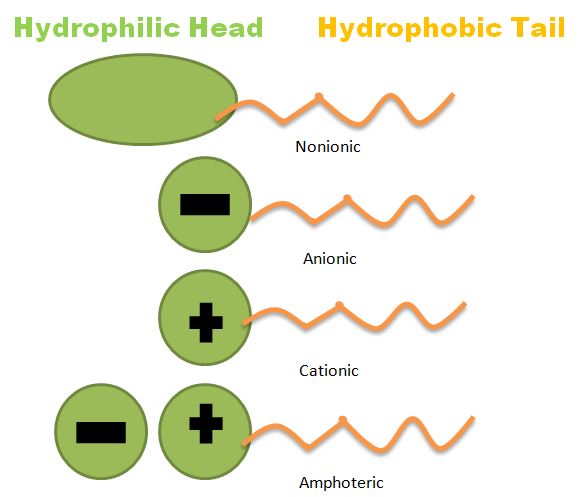
"Anionic surfactants" AKA sulfates, sulfonates, phosphates.

The EA are nonionic, by comparison, but do the same damage to the gut or any other part of the epithelium.

https://www.ipcol.com/wp-content/uploads/SURFACTANT-TYPES.jp...

Post reply on HN