anyone else notice this page is 12MB because the two thumbnails images are 6MB each
The old suburban office park is the new American ghost town
311–320 of 371 posts
Re: The old suburban office park is the new American ghost town
#312Earlier quoted context omitted.
> On top of that, the DC metro area is becoming very public transit oriented. Most employers consider good access via public transit an important feature when looking for office space. While at the same time the Metro is going to hell.
I disagree. With the new funds coming in, improvements are being done on the metro constantly, they seem to be rebuilding tracks every weekend. On top of that, the new 7000 series train cars are a BIG step up from the old ones. I had a chance to ride in one the other day, and it addressed many of he problems of the older cars. Once the roll out of the 7000-series cars is complete and they take the old cars offline, t…
Got kicked off two trains yesterday for doors that would not close and just bout missed my MARC train. I rather walk the 2 miles to Union Station than ride the METRO.
Re: The old suburban office park is the new American ghost town
#313Earlier quoted context omitted.
>They just can't afford to raise a family as easily as their parents and grandparents could, so many choose not to, not because they legitimately have no interest but because they don't see the numbers adding up. That's the conventional wisdom, but I don't buy it. Raising a family was always tough - when I was young my parents scrimped and saved in a way that I've never seen among millennials. Everybody did, and it w…
> That's the conventional wisdom, but I don't buy it. Raising a family was always tough. I'm not saying it wasn't tough, but housing prices were much lower relative to incomes in the 50s and 60s, even in a place like San Francisco. Several of my relatives own million dollar homes there, and none of them are college educated or had spectacular careers or anything. Their only advantage is they were part of previous gen…
relative to housing costs, they enjoyed incomes that today would be in the range of a $300k+ base salary.
Do you have a source for that? I can believe it in certain cities (like SF), but then again, SF wasn't as desirable a place to live either (SF population was dropping in the 60's and 70's).
Re: The old suburban office park is the new American ghost town
#314Earlier quoted context omitted.
I've heard that my entire life. "The city is coming back". "Its not like ten years ago when the cities were dead" I'm in my 40s. Same message for the last four decades. Think about that, four times in a row, the city has always been dead a decade ago but now its returned, no really, this time its true. I'm told by elders that sloganeering about urban renewal and return began around 1955, about 5 years after the burbs…
Since 2010, population growth has either restarted in many cities that lost inhabitants for decades, or has accelerated for cities that never stopped growing. New York, Boston, San Francisco, Seattle, D.C., Minneapolis, Miami, Philadelphia, Denver, and Chicago have all experienced this phenomenon, not to mention others, I'm sure. It's a huge trend.
City populations can grow without an actual trend of increasing desire to live in the city. It's the percentage that matters, not the absolute number.
Re: The old suburban office park is the new American ghost town
#315Earlier quoted context omitted.
>Most of them thought spending their life in a car was great -- certainly way better than having to take the bus or the train. It was a sign of success. You're overstating that quite a bit. Sure, driving for twenty minutes beats taking public transportation. But sitting in stop and go traffic for a couple hours every day is awful and people always realized it.
How much stop and go traffic was there in the 50s?
That's about when it started getting bad. The term "Sig Alert", for an unplanned lane closure, originated in LA in 1955. It takes its name from Loyd C. "Sig" Sigmon, who created a radio-based notification system for the California Highway Patrol:
Sigmon developed a specialized radio receiver and reel-to-reel tape recorder. When the receiver picked up a particular tone, it would record the subsequent bulletin. The device cost about $600. The LAPD's chief, William H. Parker, was interested, though skeptical, warning the inventor, "We're going to name this damn thing Sigalert." More practically, he refused to use it unless the receivers were made available to all Los Angeles radio stations — it could not be a KMPC monopoly.
https://en.wikipedia.org/wiki/Sig_Alert#The_origin_of_the_Si...
Re: The old suburban office park is the new American ghost town
#316Earlier quoted context omitted.
One common occurrence where I live is that county and cities are buying up the old office parks and even strip malls to convert them into government buildings. Most are ideally located as well as being offered up for sale cheaply. Seen even a few charitable organizations buy up parts of a strip mall for the cheap space by square foot. Besides the age a lot of REITs cashed out awhile ago and I am not sure the market i…
Unfortunately for some zoning prevents you from living in those spaces. A friend of mine tried to get a zone variance to turn an office building into essentially a multifamily dwelling and the city turned him down flat. They suggested he could buy the property, tear down the building, get it rezoned, and then build dwellings there. But not go in and convert a perfectly usable space into a livable space. Sigh.
Even without zoning it's not entirely straightforward, although at least possible. Houston has no formal zoning, but there are building/safety codes, so you can't just live in part of a warehouse as-is. You have to redo the whole thing to be up to residential code.
Re: The old suburban office park is the new American ghost town
#317Earlier quoted context omitted.
I've heard that my entire life. "The city is coming back". "Its not like ten years ago when the cities were dead" I'm in my 40s. Same message for the last four decades. Think about that, four times in a row, the city has always been dead a decade ago but now its returned, no really, this time its true. I'm told by elders that sloganeering about urban renewal and return began around 1955, about 5 years after the burbs…
Since 2010, population growth has either restarted in many cities that lost inhabitants for decades, or has accelerated for cities that never stopped growing. New York, Boston, San Francisco, Seattle, D.C., Minneapolis, Miami, Philadelphia, Denver, and Chicago have all experienced this phenomenon, not to mention others, I'm sure. It's a huge trend.
Some cities are growing a bit, but far more people, proportionally, are heading to the suburbs, which is where all the fastest-growing places in the US are.
For example, between 2000 and 2014, SF added about 75,000 residents. In that same period, Irvine, CA added about 150,000 residents, and one quadrant of the Dallas suburbs, Collin County, TX (the northern suburbs) added about 400,000 residents. All of NYC put together in the same period added 500,000 residents, slightly beating out this one part of suburban Dallas.
I personally like living in dense urban areas, but for there to be a sea change in that direction on the scale of overall American trends, people need to be moving into cities in much larger numbers. Here's a modest goal that would represent an undeniable change, even if still only for a small minority of the population: over the next 10 years, 2-3% more Americans live in dense urban areas than currently. That's ~6-9 million more people in dense urban areas. As far as I can tell, we're nowhere near being on track for that to happen.
Re: The old suburban office park is the new American ghost town
#318Earlier quoted context omitted.
> On top of that, the DC metro area is becoming very public transit oriented. Most employers consider good access via public transit an important feature when looking for office space. While at the same time the Metro is going to hell.
I disagree. With the new funds coming in, improvements are being done on the metro constantly, they seem to be rebuilding tracks every weekend. On top of that, the new 7000 series train cars are a BIG step up from the old ones. I had a chance to ride in one the other day, and it addressed many of he problems of the older cars. Once the roll out of the 7000-series cars is complete and they take the old cars offline, t…
WMATA is improving in some spots but there are still A LOT of problems with the metro as it stands. There are regularly major delays, they still haven't fixed the automated control since the fatal accident in 2009, there have been more reports of smoke in the tunnels since the fatal incident this year, and they're having to deal with a a bunch of financial irregularities.
I hope things improve but as of right now it doesn't look like they've turned the corner.
Re: The old suburban office park is the new American ghost town
#319The building featured here seems like a false example of blight, since it's in an area that's seeing major redevelopment. The same is true of the mall alongside it, which has been reckoned as a 'dead mall' in other articles, but only because it's being rebuilt into a urban neighborhood:
https://b256ec319b64095c3d1d-e19f06f73efdb5028989d1916204cd7...
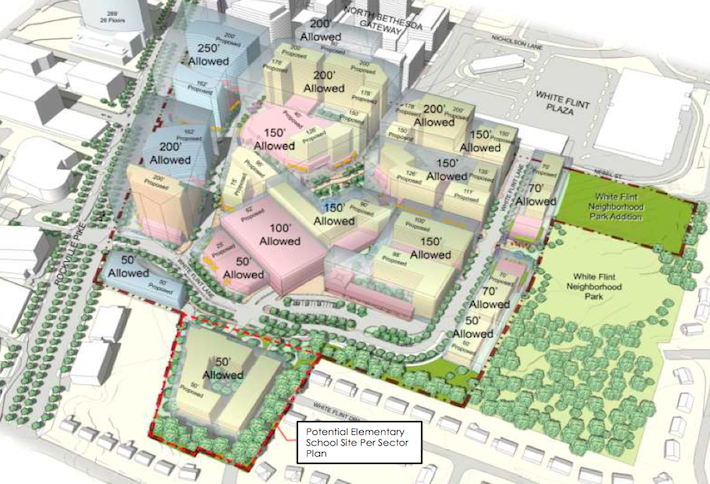
I would guess that the owners of the office buildings in question here are warehousing it until the area becomes more desirable.
Re: The old suburban office park is the new American ghost town
#320Earlier quoted context omitted.
Taking your description literally, there is no legal way under any reasonable zoning code that a zoning department could issue a variance to allow a prohibited residential use on a property zoned and currently occupied by an office building. The variance is a mechanism for relieving a hardship that runs with the land by allowing limited non-conformity (e.g. setbacks on a non-conforming lot or the continuation of a pr…
Agreed. I spent two years getting a piece of property split in an unusual way. It was totally legal, just weird enough that it encountered friction at every imaginable level. Everyone at the city, county level, even attorneys that should have understood reacted with "whoa, wait a minute" at each stage. At the end it was worth it, a nice return for the time spent. But not easy, and certainly not clearly understood.
Care to elaborate?