Live data from Hacker News

Preferences for Trains vs. Buses

citylab.com

41–50 of 60 posts

Re: Preferences for Trains vs. Buses

#41

Part of the preference for trains is that the sunk investment in right-of-way is a strong disincentive to move or discontinue service. This allows people to feel confident that they can depend on the service to stay there, and invest in the areas around these transit corridors. Anecdote: I lived in Seattle for 10 years without a car. (A city with surprisingly high transit ridership considering the lack of any sort of…

Depends on the city though. Bus routes in London haven't changed for a long time. The buses I used 30 years ago all have basically the same routes. There are probably routes that are over 80 years old. But buses could never be grade separated in London. There's just not enough room.

Re: Preferences for Trains vs. Buses

#43

Earlier quoted context omitted.

I've had to wait in a train for over 30 minutes due to another train passing by. I guess it depends where you're at.

Sounds like Amtrak, lower priority than freight and using ancient tracks.

Or England at a busy station.

It's not a common occurance, but it happens often enough that people who use trains regularly can remember a time it happened to them.

(I tend to like trains, but I use buses and coaches more often because price and convenience.)

Re: Preferences for Trains vs. Buses

#44
post #18
post #13

Earlier quoted context omitted.

Boses have traffic. People don't like traffic. Trains don't have traffic.

Trains also sometimes have lounge cars, dining cars and theaters. Buses confine you to a cramped seat and if you're lucky there's a tiny bathroom on board.

In England some coaches (long distance buses) have tables (seat four people); power sockets and WIFI. They might have a fridge with cold bottled water.

Some buses have WIFI.

Re: Preferences for Trains vs. Buses

#45
post #26
post #5

Most train systems I've taken don't have to stop at stop lights, but the buses I've ridden, even with a dedicated lane, still stop at the lights. This means twice as many stops and starts. Big negative in my mind. But then again, maybe this is another small improvement which could be made.

The stop lights for a train are scheduled such that the train doesn't need to stop if it is keeping to the schedule. This works on both smaller and larger lines. The stop lights for a bus are scheduled in line with the general car population, so it's pretty hard for the bus to keep to its schedule. There's a lot of work goes into timing traffic lights (for cars), how much of that thought process involves keeping the…

I think perhaps what the parent comment meant was more that trains aren't inhibited by normal traffic lights; upon approaching a crossing with a road, the train is immediately given the right-of-way — i.e., the lights activate, the gates close, the cars stop and allow the train to pass.

True, there is a separate signal for the train, though it's more if the train(s) ahead of it are keeping to schedule than the train itself. (Rush-hour trains here are regularly delayed due to the train ahead of the one I tend to ride being so delayed.)

Re: Preferences for Trains vs. Buses

#46
post #20

Can only speak from the experience of my own country, but in Ireland This is the inside of a bus: http://www.cityswifty.com/SC241interior1.JPG This is the inside of a train: https://c3.staticflickr.com/3/2831/9337782850_41264e4fd4_b.j... That should say it all as to why people like trains more.

Are those both public transit? Both of those, but particularly the bus, put anything I've seen here in America to shame. (Even private bus transit doesn't look that nice…)

Re: Preferences for Trains vs. Buses

#47

People do in general prefer trains over buses. This article is basically just saying that as you make the buses more train-like by giving them dedicated lanes and more reliability, people start to like buses more. Make them longer (articulated), faster, with dedicated lanes, and basically they start to become like a train with rubber tires. I think that is in fact, confirming people like trains better. Titles do matt…

Yes but in cities like LA which are planned around cars the major arteries are 3 lanes in each direction, so you can put up signs saying $200 fine if you use the bus lane, give buses priority at traffic lights, run articulated buses with pre paid tickets and you have buses that operate pretty much like trams ('light rail') at a fraction of the cost. In most European cities this won't work as streets are too narrow to accommodate seperated traffic so you need a combination of congestion charging with streets restricted to public transport and/or expensive tunnels. Trams make sense if you have sections of tunnel in denser parts of the city and grade seperated sections in outer areas; buses can't run in tunnels. They also reduce pollution at street level. Diesel fumes from buses are a significant problem in dense European cities.

Re: Preferences for Trains vs. Buses

#49
post #20

Can only speak from the experience of my own country, but in Ireland This is the inside of a bus: http://www.cityswifty.com/SC241interior1.JPG This is the inside of a train: https://c3.staticflickr.com/3/2831/9337782850_41264e4fd4_b.j... That should say it all as to why people like trains more.

Are those both public transit? Both of those, but particularly the bus, put anything I've seen here in America to shame. (Even private bus transit doesn't look that nice…)

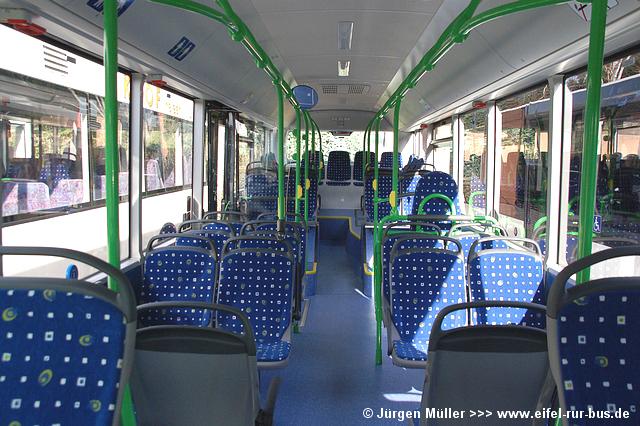
(German here.) Both look pretty standard to me. Although I think buses like that are more common for long-distance. Most buses for public transit I've seen have more space for standing people:

http://www.bahnreiseberichte.de/050-Rottalerland-Thueringen/... http://www.eifel-rur-bus.de/seiten/nachrichten/2007/nachrich...

Re: Preferences for Trains vs. Buses

#50
post #26
post #5

Most train systems I've taken don't have to stop at stop lights, but the buses I've ridden, even with a dedicated lane, still stop at the lights. This means twice as many stops and starts. Big negative in my mind. But then again, maybe this is another small improvement which could be made.

The stop lights for a train are scheduled such that the train doesn't need to stop if it is keeping to the schedule. This works on both smaller and larger lines. The stop lights for a bus are scheduled in line with the general car population, so it's pretty hard for the bus to keep to its schedule. There's a lot of work goes into timing traffic lights (for cars), how much of that thought process involves keeping the…

Where I live, the traffic lights know about approaching trams and buses and turns green early or remains green until they have passed. That doesn't work if the traffic gets too bad, but most of the time it works pretty well.
Post reply on HN