Live data from Hacker News

The Little “Fighter” That Couldn’t: Moral Hazard and the F-35

jqpublicblog.com

181–190 of 233 posts

Re: The Little “Fighter” That Couldn’t: Moral Hazard and the F-35

#181
post #151

Earlier quoted context omitted.

>US's military might has everything to do with the geopolitics that continue to make it rich I'm sceptical that the military might does that much to make the US rich besides providing basic peace. Obviously things would be screwed if WW3 started. The US has got rich mostly by trade and enterprise and producing much of the worlds high value stuff. Spending a huge portion of governments revenues on the military rather…

The US military also effectively subsidizes the national defense of a large portion of the world, much of which we trade with. It's because of our treaty obligation to defend South Korea that, instead of investing in an arms race with North Korea, they can afford to manufacture cell phones and cars and televisions and trade them to us. Likewise for Japan and the NATO members.

> instead of investing in an arms race with North Korea,

NK is so poor they can barely stay alive. I don't believe there could be any sort of meaningful arms race...
Re: The Little “Fighter” That Couldn’t: Moral Hazard and the F-35

#182
post #106

Earlier quoted context omitted.

Why? It's easy to look at rosy predictions but is there any reason to think that this project would have avoided the same systemic problems which have been endemic for the F-35? A quick glance at the Wikipedia page shows several questionable elements of the design, all of which seem to be due to the same problem of requiring one design to fill too many roles.

Actually there is. Boeing's design was forward thinking, e.g. using carbon fiber before anyone else --now common place. They also figured out a way to use the main engine to provide vertical take-off and landing, instead of having a separate engine, which would have made a big difference in cost. I watched an excellent documentary on the whole project long ago, and it was clear that Boeing design was superior, but th…

It wasn't so crystal clear then. I'm assuming the documentary you saw was Nova's "Battle of the X Planes". Recall that a Navy requirements change made Boeing's design overweight, so it never performed any STOVL operations in its full flight configuration. Lockheed Martin had an aircraft with enough margin to do a short takeoff, supersonic dash, and then land vertically, all in the same trim. So the DoD had to choose between Lockheed, which had a plane that had already shown it could fulfill the mission, and Boeing, which proposed to build an aircraft significantly different than it had tested and hadn't had a single flight that demonstrated all capabilities like LA had.

Proven versus unproven. That's the choice that was present.

Re: The Little “Fighter” That Couldn’t: Moral Hazard and the F-35

#183

Earlier quoted context omitted.

Have you considered the gigantic military requirements that are placed on the United States? Placed by whom, exactly? It's not as if the US took on those treaty commitments involuntarily or expecting no benefits in return, and it's not as if the rest of the world would not adapt if the US reduced its military commitments over time. For example, you talk about the US being required by treaty to defend almost all of Eu…

The last time the US followed an isolationist foreign policy, the Europeans got themselves into two world wars in a row. It's true that Europe has a continent-wide mutual defense agreement now. What you didn't mention is that it's called NATO and the US is the backbone of it. That's part of how it works. Otherwise you don't get the combined forces of Europe, you get indifference at best and European war at worst. Loo…

Your information appears to be a generation out of date. The EU in particular have been working on collective defence agreements independent of NATO for quite some time.

While it's true that if current US foreign policy went away overnight it would probably make certain other parts of the world less stable for a while, such rapid change couldn't actually happen as a practical matter of international diplomacy and even basic logistical issues. This isn't a logical reason not to move in a slower and more controlled way towards a more balanced position where power and responsibility are more widely distributed.

It also seems fair to observe that the US has caused a lot of instability in recent years with its aggressive foreign policies. A large part of how the world works may indeed depend on the American military as you say, but it isn't always in a good way.

Re: The Little “Fighter” That Couldn’t: Moral Hazard and the F-35

#184

It's a little surprising that an angry rant by someone without any established expertise is given so much credibility here; I think it just echos popular memes. I don't have any expertise myself, but let me share what I've read from experts providing serious analysis: 1) Every large, complex program has similar technical teething problems. If you look back at the beginnings of today's well-established systems, includ…

Those that know can't share what they know, they must rely on information already made public that by necessity does not tell the whole story. It's frustrating, but it's part of the nature of this work.

Re: The Little “Fighter” That Couldn’t: Moral Hazard and the F-35

#185

Earlier quoted context omitted.

The US military also effectively subsidizes the national defense of a large portion of the world, much of which we trade with. It's because of our treaty obligation to defend South Korea that, instead of investing in an arms race with North Korea, they can afford to manufacture cell phones and cars and televisions and trade them to us. Likewise for Japan and the NATO members.

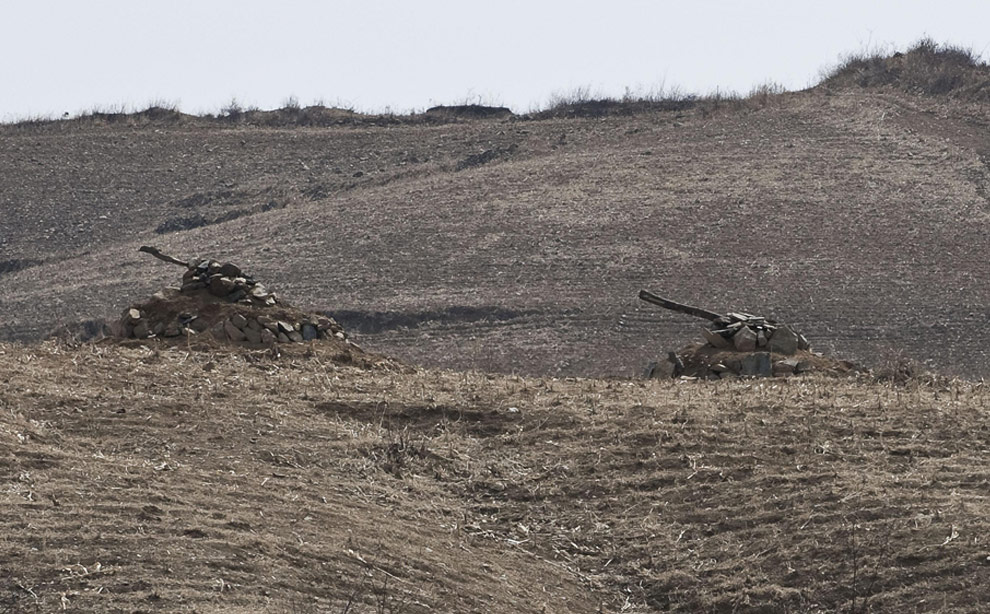
> instead of investing in an arms race with North Korea, NK is so poor they can barely stay alive. I don't believe there could be any sort of meaningful arms race...

Agreed. When they have to assemble fake artillery out of logs + rocks, I think it's safe to say there's no arms race to speak of whatsoever: http://www.nkeconwatch.com/nk-uploads/fake-artillery.jpg

Re: The Little “Fighter” That Couldn’t: Moral Hazard and the F-35

#186

Earlier quoted context omitted.

Have you considered the gigantic military requirements that are placed on the United States? Placed by whom, exactly? It's not as if the US took on those treaty commitments involuntarily or expecting no benefits in return, and it's not as if the rest of the world would not adapt if the US reduced its military commitments over time. For example, you talk about the US being required by treaty to defend almost all of Eu…

> There is exactly one sovereign state on earth that could single-handedly give the combined forces of Europe a serious fight today The point is that we Europeans are so divided we can't even name a Foreign Minister of Europe because the Brits once again needed to prove they're special. Hell, just kick GB out of the European Union and have a MUCH better organized and FVEY-free EU.

I think you are mistaking a small political class within the UK for the population as a whole. The public sentiment in the UK today is heavily anti-EU and the electorate would obviously choose to leave if a vote happened tomorrow.

Whether this would actually be a good idea for either party is a different question, of course. In the short term, it would almost certainly be painful for both sides, but short term politics is not necessarily the priority at this scale.

In any case, it is important not to mistake avoiding a federal system of government for a general policy of xenophobia and isolationism. You can have things like free trade (the original EEC), free movement (Schengen), and shared recognition and defence of fundamental values (ECHR) without the heavy political integration of the EU or the heavy economic integration of the Eurozone. You could have mutual defence agreements similarly.

There are a lot of people in the UK right now who think we and the EU should recognise that our goals are not aligned and go our separate ways amicably, and that we should seek simpler and more narrowly focussed agreements with our European neighbours for mutual benefit, as we would with any other foreign partner.

Re: The Little “Fighter” That Couldn’t: Moral Hazard and the F-35

#187

Earlier quoted context omitted.

Have you considered the gigantic military requirements that are placed on the United States? Placed by whom, exactly? It's not as if the US took on those treaty commitments involuntarily or expecting no benefits in return, and it's not as if the rest of the world would not adapt if the US reduced its military commitments over time. For example, you talk about the US being required by treaty to defend almost all of Eu…

There is a reasonable school of thought that argues the world would be a much safer place if the number of military superpowers in it was zero, and that as the only old-school military superpower remaining, the US is therefore a negative factor on global stability and peaceful relations. So, in other words, you'd prefer a situation similar to the world as it was before World War 1? That world wasn't exactly peaceful…

So, in other words, you'd prefer a situation similar to the world as it was before World War 1?

I didn't say that.

You say that you would prefer a world with no superpowers.

I didn't actually say that either. I'm commenting on one particular theory, not expressing any sort of personal preference.

Such a world has existed, and it's always been rather unstable, with many regional powers jockeying for position, often leading to massive wars.

If you look far enough back through history, that is true.

Then again, periods with a single superpower that became aggressive have probably led to more death and damage than any other periods in modern history except for the World Wars, while two superpowers playing poker gets you the Cuban Missile Crisis.

Given the developments in both international diplomacy and military power since those historical periods, I don't think it is reasonable to assume that a lack of superpowers would necessarily have the same result in the future.

Re: The Little “Fighter” That Couldn’t: Moral Hazard and the F-35

#188

It's duplicitous of me to bring this up given all the other problems with this plane, but since it's a favorite topic of argument here, let's not forget the F-35's software is mostly developed in C++, and had been, in the past, touted as a triumph of C++ over Ada.

At least C and C++ have proven that programming languages do matter. Otherwise I don't think they would've done anybody any good for the last decade.

Re: The Little “Fighter” That Couldn’t: Moral Hazard and the F-35

#189
post #134

Earlier quoted context omitted.

It's much easier to do in C, as no cast is required.

I didn't realize that distinction, so it's good to know. Still, as I originally assumed, I confirmed that gcc with `-Wall -Werror -std=c99` flags won't compile an initialization of a "struct seagull * " with a value of type "struct enemy * ", or passing a mismatch of those types to a function. If those would be the main reasons to use C++, I'd personally rather just use C with extra checks. But to be fair, maybe that…

Yes. In C, conversion between object pointer types requires a cast, but conversion from void pointer to object pointer does not; in C++, both conversions require a cast.

Conversion from void pointer to object pointer would be very a bit annoying to warn about in general, as it's so commonly used in C. And if you always use casts, that also hide other types of error (see, e.g., http://c-faq.com/malloc/mallocnocast.html).

I'm sure there are compilers (and possibly gcc/clang can do it, too...) that will warn you about this stuff without needing you to switch to C++.

Re: The Little “Fighter” That Couldn’t: Moral Hazard and the F-35

#190
post #42
post #19

Earlier quoted context omitted.

The A10's minigun is ineffective at killing modern main-battle tanks, so I wouldn't say it's a raging sucess. In addition, it would certainly be blown up immediately if it came within shooting distance of a tank by any number of man-portable anti-air missiles. What it can do is provide reasonable close air support against Toyota pickups and infantry, but replacement parts for the plane or the molds to create them don…

As far as I can tell from this list[1], five A-10s have ever been shot down, while destroying at least 1500 battle tanks and AFVs[2] [1] http://en.wikipedia.org/wiki/List_of_combat_losses_of_United... [2] http://www.2951clss-gulfwar.com/statistics.htm

Wow. This is the equivalent of three Rudels

http://en.wikipedia.org/wiki/Hans-Ulrich_Rudel

Post reply on HN