Earlier quoted context omitted.
That's why I'm for average speed traffic cams and ruthless, fully automatic ticketing of speeders. When the probabilty of getting caught and punished reaches almost certainity, people start to "factor it in regular behavior calculations". But this is going to be a hard sell for both drivers (who feel entitled to their high speed) and law enforcement (which treats ticketing as a revenue source; widespread deployment o…
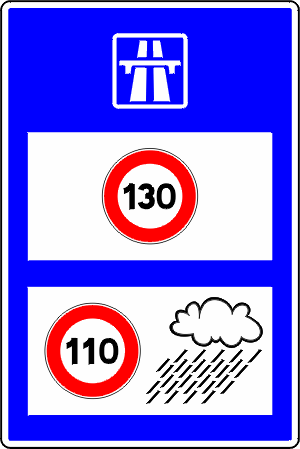
It would be an easy sell if drivers (such as myself) didn't feel convinced that highway speed limits are arbitrary. 100km/h is a very unlikely number for an engineer to calculate as an upper boundary for a road. It wouldn't be a tough sell to lower speed limits on some portions, and raise it on others, even on a time-neutral but safety-positive basis, but yet, the powers that be stick to their arbitrary number.
I haven't seen any actual calculations used for setting speed limits, but I do remember being taught in school (on physics lessons) that if you want maximum road throughput then after factoring in safe distance (which is proportional to square of velocity) you end up with ~50km/h as a sweet spot. Even if some other factors (like fuel efficiency) alter this calculation, 100km/h feels quite plausible to me.
Also I believe that many consider speed limits as arbitrary because most people seem not to care about safe distances anyway.