Funny story - when I first started using Twitter a few years back, I had tweeted about some AI news. Pretty soon after that , I had a new follower that was trying to have a conversation with me - it was retweeting stuff randomly and sending some weird replies to me - it all seemed quite odd. Turned out that it was @cyc_ai - the Twitter handle of the the Cyc AI system, presumably trying hard to emulate a person - but failing unfortunately!
Ambitious Artificial Intelligence Project Operating In Near-Secrecy For 30 Years
31–40 of 46 posts
Re: Ambitious Artificial Intelligence Project Operating In Near-Secrecy For 30 Years
#32I tested OpenCYC three years ago while working for a startup that did semantic tagging & recommendation of text-based content. Essentially, we would take something like: Gov. Rick Perry has said he will no longer wear cowboy boots, which some believe is part of an attempt to soften his gunslinging image as he considers another run for president. And map it to something more machine-readable: "Gov." -> http://dbpedia.…
I am not surprised by your results. However, the system is more robust than your experience would indicate.
OpenCyc is a subset of ResearchCyc, which itself is a subset of (Full)Cyc. OpenCyc is primarily used for mapping between ontologies. It contains 239k concepts from ResearchCyc, but only the basic rules for definitional relationships between them. These relationships include part/whole, disjointness, etc.
You mention DBPedia as being superior for your purpose, but I would counter that the two are complementary. There is a mapping between DBPedia and OpenCyc within the Linking Open Data cloud. In fact, it was one of the first ontologies contributed to the W3C's LOD initiative[1][2].
The concepts in OpenCyc are rigorously organized from most general (e.g. Thing) to more specific (e.g. board game). Each concept may have specific instances (e.g. Yahtzee, Trivial Pursuit, Scrabble, etc.) These primitives all live within a custom Lisp, where they may be reasoned over. DBPedia's structure arises naturally from user activity. It is organized primarily by Wikipedia's category system and includes individual pages.
Unlike Wikipedia, the Cyc project does not aim to contain every instance of a concept. The relationships between concepts are what matter. Once one knows that something belongs to a given Cyc concept, one can leverage the system's knowledge to reason about it.
OpenCyc's reasoning capability is limited by a lack of assertions (facts and rules) -- ResearchCyc's is not. ResearchCyc contains over 5 million assertions not present in OpenCyc. (Things like: water is wet, a dog is a mammal, mammals have hair, etc.) It also contains Natural Language tools not present in OpenCyc: parsers, taggers and more. With these tools, one can go from natural language to a formal logic representation. Or, given a formal representation generate natural language. These capabilities exist today in real world applications[3][4].
[2] http://lod-cloud.net/versions/2007-10-08/lod-cloud.png
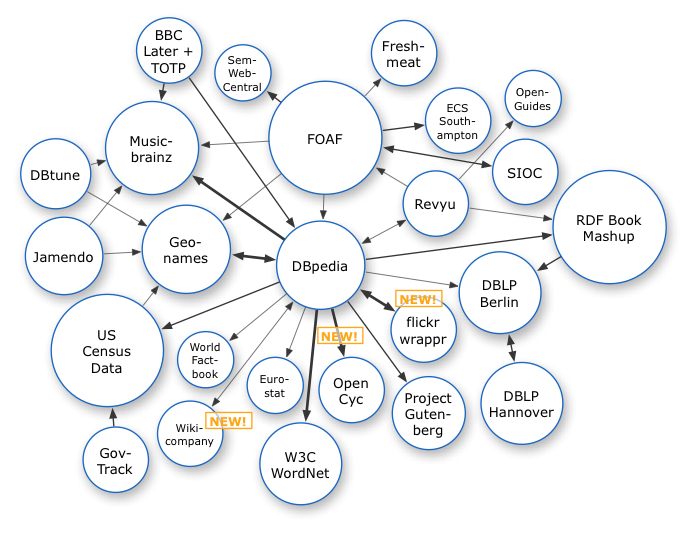
[3] http://videolectures.net/coinplanetdataschool2011_witbrock_c...
Re: Ambitious Artificial Intelligence Project Operating In Near-Secrecy For 30 Years
#33> "It's not done by any means, but it's useful." Is it? How do we know? You've been working on a product "in stealth" for 30 years, shown practically nobody outside your company, and provided us with nothing more than a vaporous description of its capabilities (in Businessinsider, no less). I'm left wondering not only how seriously I should be taking this claim, but also exactly what the claim even is. Artificial int…
At its core, Cyc is a logical system based on nth order predicate calculus. However, it is able to leverage other AI techniques to populate its knowledge base.
Re: Ambitious Artificial Intelligence Project Operating In Near-Secrecy For 30 Years
#34Doug Lenat is, to me, the most confusing case of someone in AI. He programmed a general problem solver (Eurisko) to use (meta^n)-heuristics that solved a major strategy game, coming up wih a creative plan no human thought of, and yielding insights on the field of heuristics and the "Representation Language Language". ... and then "went dark", "officially" working on this tedious, brittle attempt to compile common sen…
Since when people call him "Doug"? :) Eurisko had some amazing accomplishments, but some questioned their authenticity saying Douglas and students help it a bit. Anyway, Douglas Lenat is my all-times idol and I hope this prolonged "stealth mode" was the intermission of something great. Isn't Freebase.com his project as well?
> Isn't Freebase.com his project as well?
No, that was Danny Hillis. Freebase was purchased by Google and became the core of what is now known as the Google Knowledge Graph.
Interestingly, Ramanathan Guha[1] was originally involved in the Cyc project and is now at Google. He was also instrumental in the creation of RDF, the format central to the W3C's Semantic Web and LOD efforts.
Re: Ambitious Artificial Intelligence Project Operating In Near-Secrecy For 30 Years
#35When I read this story the first thing that sprung to mind was Ted Nelson's Project Xanadu, described by Wired magazine as "the longest-running vaporware story in the history of the computer industry". As any entrepreneur will tell you, it is never a good idea to have long-running projects with few public deliverables. Projects like this need new blood, new ideas and continuous user validation in order to remain rele…
Xanadu is an unfair comparison. Cyc is deployed in real world applications[1][2].
[1] http://www.w3.org/2001/sw/sweo/public/UseCases/ClevelandClin...
[2] http://videolectures.net/coinplanetdataschool2011_witbrock_c...
Re: Ambitious Artificial Intelligence Project Operating In Near-Secrecy For 30 Years
#36Earlier quoted context omitted.
Since when people call him "Doug"? :) Eurisko had some amazing accomplishments, but some questioned their authenticity saying Douglas and students help it a bit. Anyway, Douglas Lenat is my all-times idol and I hope this prolonged "stealth mode" was the intermission of something great. Isn't Freebase.com his project as well?
> Isn't Freebase.com his project as well? No, that was Danny Hillis. Freebase was purchased by Google and became the core of what is now known as the Google Knowledge Graph. Interestingly, Ramanathan Guha[1] was originally involved in the Cyc project and is now at Google. He was also instrumental in the creation of RDF, the format central to the W3C's Semantic Web and LOD efforts. [1] http://en.wikipedia.org/wiki/Ram…
I confused OpenCyc with Freebase, which was linking to OpenCyc at least in the past. I know Freebase got acquired, but thanks for the clarification! It's really nice that Google is aggregating a lot of AI power. Combined with the robotics companies they've acquired, too, the direction is clear.
Re: Ambitious Artificial Intelligence Project Operating In Near-Secrecy For 30 Years
#37Earlier quoted context omitted.
> Since when people call him "Doug"? One datapoint: http://archive.wired.com/wired/archive/2.04/cyc-o.html So for more than 20 years.
When I was reading about his work, it was the 80s, early 90s. :)
I'm not sure why I got downvoted, but, really, back at those times, maybe out of great respect, but he was "Douglas". :)
Re: Ambitious Artificial Intelligence Project Operating In Near-Secrecy For 30 Years
#38If you look up their reviews by ex-employees you will find they are extremely negative, talk about lots of workplace bullying, insufficient resources and a vicious upper management that doesn't respect their workers.
Re: Ambitious Artificial Intelligence Project Operating In Near-Secrecy For 30 Years
#39[deleted]
Re: Ambitious Artificial Intelligence Project Operating In Near-Secrecy For 30 Years
#40> "It's not done by any means, but it's useful." Is it? How do we know? You've been working on a product "in stealth" for 30 years, shown practically nobody outside your company, and provided us with nothing more than a vaporous description of its capabilities (in Businessinsider, no less). I'm left wondering not only how seriously I should be taking this claim, but also exactly what the claim even is. Artificial int…
> Enough of this closed source, proprietary, snail's pace AI development. Eh? http://www.cyc.com/platform/opencyc Also: "Cycorp also offers a complete version of Cyc, including many more assertions and additional NL capabilities, under a ResearchCyc license at no cost for research purposes."
I used that during my BSc. Thesis, the non-free version includes data that is of higher precision and more useful for the military use. Which they have been building this for. It was used to answer questions regarding current threats and find out which other threats nobody has thought about could also occur, where, by whom etc. You can research that, if you want. But one thing is true, the information on them is scarce. I think they have had held a talk at Google though, if I remember correctly.
Tl;Dr.: Cyc is military precise, OpenCyc is not. Use case: Terror-Cell and threat identification, Information Gathering, Reconnaissance, Data-Fusion
It never made sense to me that the whole process would be manual. I would've developed an AI that could use their "complicated and cumbersome" forms automatically based on "Speech or Written" Input
There is also: http://www.larkc.eu/ and many other alternatives "Expert Systems". I heard the the military version of http://clipsrules.sourceforge.net/ is pretty good and in use here and there. But I don't know of the current progress and use of such systems. Can someone involved or knowledgeable give us an update on the state-of-art in AI/Expert-Systems used by the mliitary? I like to stalk military technology based developments =)