Earlier quoted context omitted.
I wasn't aware that clicking different things in different orders affected the outcome. I have just been clicking solve every time it comes up and not reading the captions.
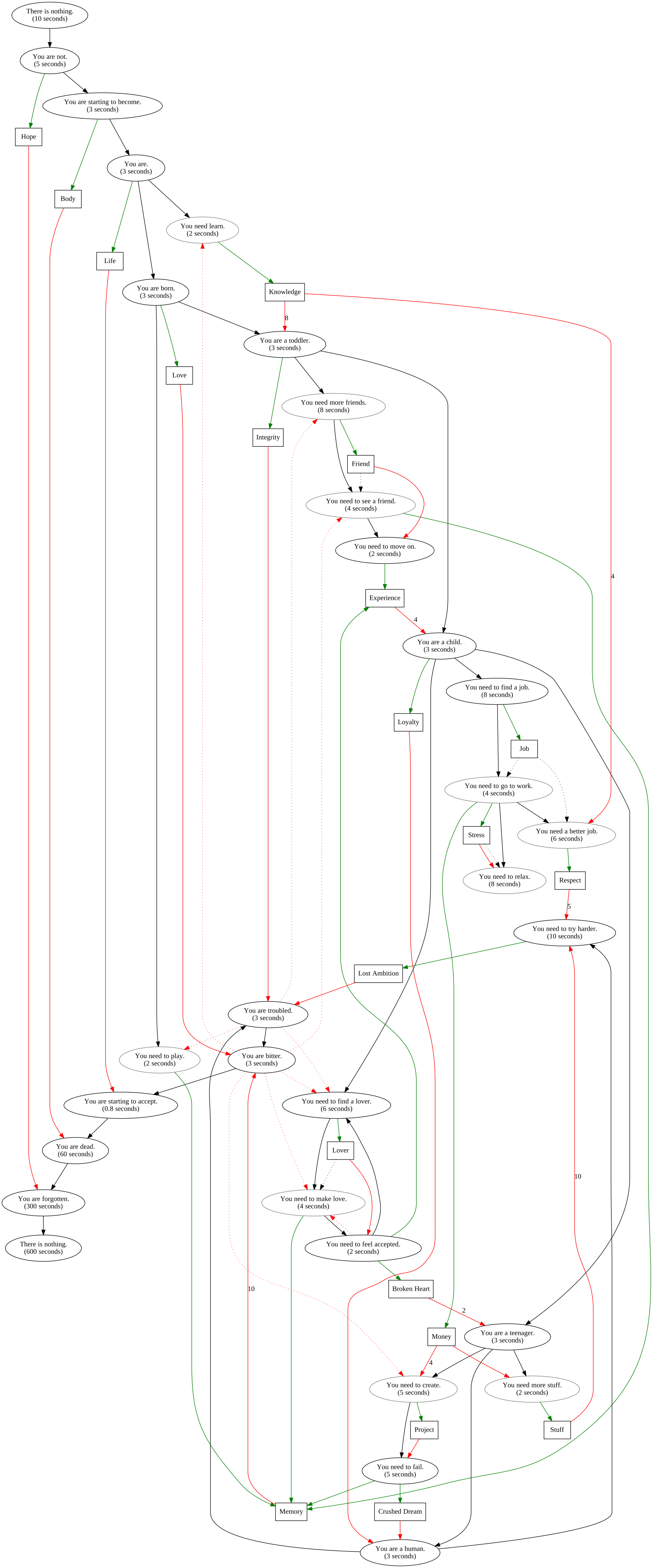
> I wasn't aware that clicking different things in different orders affected the outcome. I don't think it does. Here's the relevant part of the (dart2js'd but slightly cleaned-up) code: https://gist.github.com/CyberShadow/11329584 Edit: I made a full graph of the entire game: https://news.ycombinator.com/item?id=7652770
Will you drown?
81–90 of 145 posts
Re: Will you drown?
#82https://cdn.rawgit.com/CyberShadow/11329584/raw/5d295c9557d3...
Code: https://gist.github.com/CyberShadow/11329584
Legend:
- Round nodes are problems
- Rectangular nodes are things you can have
- Gray round nodes are problems that don't go away after solving them
- Green lines are things solving problems gives you
- Red lines are things needed to solve a problem
- Dotted black lines are things you need to have for a problem to appear
- Dotted red lines are problems that disappear when a problem is solvedRe: Will you drown?
#83Written in Dart. Can anyone familiar with Dart to JS explain what is going on with: var B=new dart delete B.x var C=new dart delete C.x ...
These hidden classes are built on the fly: say you add `x` to a instance to get an object with a configuration that was never seen before. In that case, the engine creates a new description with that new field and remembers the transition (so that further objects with similar configurations can reuse the same hidden class).
Keeping track of these hidden classes takes time and space. If you actually use the JS object as a hashtable, then there will be lots of unnecessary hidden classes, that will never be used again. However, there is a trick to tell the engine that an object is actually a hashtable (and shouldn't be optimized as if it was an instance of a class): when deleting a field from an object v8 (and probably all other engines) assume that the object is used as a hashtable and don't create these hidden classes anymore.
Dart2js uses this trick to avoid this cost some important big hashtables (`B`, `C`, ...).
Re: Will you drown?
#84Very reminiscent of Passage ( http://hcsoftware.sourceforge.net/passage/ )
Re: Will you drown?
#85What if you're Plato or Aristotle? Presumably then you never get forgotten.
Re: Will you drown?
#86What a simple and profound game.... I hope Notch is feeling ok.
> I hope Notch is feeling ok. That was my first thought, and I suspect that's not the case at the moment :-\
Re: Will you drown?
#87Play automatically: setInterval(function(){ $("a").click() }, 100) (Edit: Yes, this leads you through a very fast, very bad life. Play manually and have a better life.)
setInterval(function({[].slice.call(document.querySelectorAll("a")).forEach(function(a){a.click()})},100)
It feels great to know there are some more people who think of automating first, a better life second =)
Re: Will you drown?
#88Earlier quoted context omitted.
It has potential, but I had a hard time relating to my character. I need a lover as a teenager? And 2 broken hearts to stop being a teenager? And the only way to get experience is by losing friends.
ages may differ but our stories are all so similar maybe the age isn't what matters. "And 2 broken hearts to stop being a teenager? And the only way to get experience is by losing friends." i'm not sure i directly relate to this either, but it really doesn't sound too crazy or unfamiliar.
Re: Will you drown?
#89This is even duller than that borefest.
Re: Will you drown?
#90Boiling every experience in life to make it nearly meaningless and lack any glimpse of context will eventually become depressing and appear highly relatable to others. Someone get this man some help.