Sorry I didn't realize I was talking to somebody with a completely made up and fantastical worldview, where hard problems are instantly solvable with fairy dust and dream juice.
No wonder you feel like you can invent any future you wish whole cloth and in just a couple years, reality will bend to your will and products will appear on the market that bring your future to life at a price so cheap as to basically be commodities.
If thinking about how things work in the real world, identifying the problems and doing the hard grunt work to solve them is cynicism, I want some of what you're smoking. Because nothing happens as easy or as quick as you optimistically imply.
You've probably never brought a product to market, even one with zero R&D cost. Gone from idea to box on store shelves. It's hard. A few words of pithy advice and hard wishing don't cut it.
If it did we'd have hard-AI, FTL, jetpacks, and would live full-time in the metaverse from our isolation tanks on an orbital platform around Venus or Proxima Centauri fed only by our immersion in a pool of reconfigurable nanoparticle nutrients. We'd live lives as long as we care to in a post-monetary society.
We've been doing VR for the better part of 30 years and still barely understand the interaction models. I've used state-of-the-art haptic feedback systems intended for VR that are so new that there haven't even been articles written about them. They're the result of a hundred million dollars of nation state level R&D by teams of PhD researchers and they're still impossibly crude approximations of what real-life interaction feels like. The time-to-market on just this kind of device is expected to be 30 years at best. The expected cost in 2013 dollars when that happens is $150k-200k per limb.
Things have to be possible on the technology curve we're already on and have to respect physics. You can't waive your hands and insist that in your fantasy world it should just be possible. They have to be something that can be taken from nascent R&D to market at a cost consumers can actually buy. More importantly they have to be useful, non-fatiguing interfaces that don't take up half of somebody's living room. Most importantly, they have to be socially acceptable enough that the majority of the population won't feel weird participating.
Even the smallest of practical concerns, like will the headset smudge a woman's makeup can make or break something. Sweeping social change, where everybody on the planet suddenly stops what they've been doing for a lifetime (or in a larger context for thousands of years in their culture) and suddenly adapts to whatever fantasy product you've placed out are among the hardest things to push forward. Look at the near panic about somebody walking around with a near invisible screen on their face and a single low-resolution camera -- Google glass.
> such as an observation that we already have head-mounted displays that do not block faces
Like what, Glass? It also doesn't provide the necessary optics via physics to provide VR. If what you're talking about are two Glass-like displays, positioned like Glass, no matter the resolution or latency, you are no loner talking about VR and we're in a different discussion.
Here's a even did a mockup for you http://i.imgur.com/njToujz.jpg
Glass isn't even capable of AR, let alone stereoscopic VR. So let's shift the displays down a couple inches. Then what's the point? I may as well just be looking at a 3d monitor. This buys me nothing and doesn't buy me convenience. You won't be walking around with this gear on, there's no camera to shoot your face and nobody wants to talk around with a quad copter taking video all day. And then you're literally obscuring your face because the displays are literally in front of your eyes. Physics is a ruleset we can't wave our hands at and get around.
> or that real-time 3d face scanning is a potential advancement
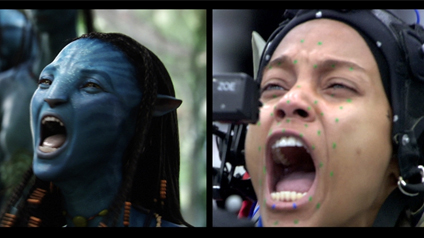
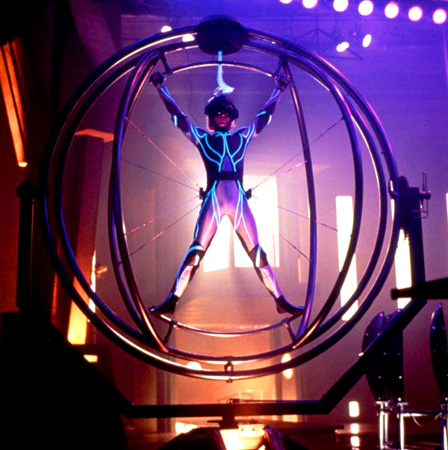
There's only two possible interaction models for the kind of virtual communication, the glass one which is trivial to demonstrate isn't a good model and the fully VR model which then requires you to be modeled and your conversation partner to be modeled to you each have something to look at. Presumably people will want to use their actual faces and a static model isn't very interesting to talk to. So you either need a model that's fully rigged and a device to recognize your expressions and translate them into controls for the rig.
https://cdn.tutsplus.com/ae/uploads/legacy/637_vfx/AvatarFac...
http://metalarcade.net/wp-content/uploads/2013/02/Resident-E...
Which we already do have, but it kind of sucks for any kind of general use.
Let's pretend for a minute that you don't have to markup somebody's face with dots to track, and some kind of near-term kinect-like system solves this.
Is this your vision of what people will be walking around with on their head? Except with two Google glass-like displays in front of their eyes?
Here's I did another mockup of your vision. Sorry for the shitty photoshop skills.
http://i.imgur.com/BaPV2Va.jpg
Is this really better than just video conferencing? Do I get anything out of this at all?
You can call me a cynic, and sorry if I killed your fantasy buzz, but not a single thing I've said here or before isn't true. Today or tomorrow.
Yeah sure, I read Snow Crash and got into the notion of the Metaverse. I think it's cool. I'm on board with the idea in principle. I'm just as upset as the next guy that the closest we've gotten to that vision is Second Life, EVE or WoW. It feels really close, but there are lots of gotchas that need lots of work to get past. Fantasy speculation isn't going to cut it.