Live data from Hacker News

Peelian Principles

en.wikipedia.org

31–40 of 48 posts

Re: Peelian Principles

#31
Wow, this is exactly what we need in Turkey, where there is deep political conflict going on. Recently, there have been ongoing protests (http://en.wikipedia.org/wiki/2013_protests_in_Turkey). There is a long history of police brutality in Turkey (http://en.wikipedia.org/wiki/Police_brutality#Turkey), but at least recently we had thought that the police was largely supportive of the current political party (AKP), as key positions were manned largely by AKP supporters, placed there by the government.

Now, the government is having a conflict (http://en.wikipedia.org/wiki/2013_corruption_scandal_in_Turk...) with the Gulen Movement (http://en.wikipedia.org/wiki/G%C3%BClen_movement), which they used to be buddy-buddy with, and now no one seems to trust the police anymore, not even the government themselves. The government has been sacking police chiefs and reassigning commanders all over the country, in an attempt to break up any Gulen supporters, and to seize power over the police again.

Looking at the Peelian principles, they've failed 1 many times before by taping over helmet identification numbers (http://www.ataturk.org/wp-content/uploads/2013/07/same-story...) and they've also failed 3 many times by engaging in cronyist tactics to avoid prosecution and accountability, even with evidence.
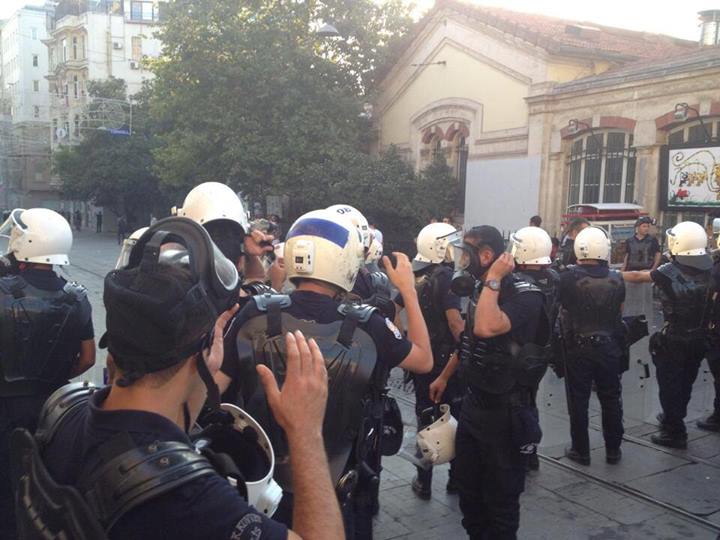
Looking over the principles of policing, they've failed #2 since there has been widespread condemnation of police brutality, and the force is still there. They failed #4 when riot police attacked a camp of sleeping peaceful protesters at 4am with tear gas and batons. They failed #5, since the police chiefs are appointed by the current political party, and thus are not impartial. #6 is the same as #4. #8 goes along with #5, and also when police have been seen attacking people of specific political leanings, or refusing to carry out orders to arrest people of their own political leanings.

My two main observations from all this are: First, like the judiciary, I believe the police force should also be completely isolated from the executive branch in terms of receiving orders and in terms of placement, hiring and firing of personnel. This prevents them becoming cronies of the current political power, and follows separation of powers.

Second, I believe that the police should be paid at least average salary (way above poverty level) and be required to have at least average education (not merely primary school education). Otherwise, it becomes difficult to have the sorts of people who can meditate on concepts like cronyism, whistleblowing, consent of the governed, blindly following orders, etc. It becomes easier to have the sorts of people who are poor and likely to accept bribes, politically fired up and filled with hatred, power tripping.

Re: Peelian Principles

#32

I wouldn't say all these principles are in force in the UK today. The very fact that our police is routinely used to break up peaceful demonstrations, to stop demonstrations from occurring in areas were our politicians might see them is kind of a perversion of one of the key points. The officers do still wear the numbers but they are routinely covered up to hide their identities, especially when they are dealing with…

I don't think things were necessarily that much better in the past - there is no Riot Act anymore (which was pretty draconian) and we haven't had tanks on the streets recently either...

http://en.wikipedia.org/wiki/Riot_Act

http://en.wikipedia.org/wiki/Red_Clydeside

Re: Peelian Principles

#33
post #22

Let's link that to HackerNews: How could we revisit those rules at the age of Internet?

No more anonymous downvotes and flagging, for one?

> Every police officer should be issued an identification number, to assure accountability for his actions.

Re: Peelian Principles

#34
post #6
post #5

Earlier quoted context omitted.

It's a book ideal that doesn't recognize reality: the fallibility and self-interests of individuals.

So kindly explain what's wrong, in principle, with defining book ideals and then using these as criteria to evaluate the success of organizations? The Peelian principles have been largely obscured or ignored in recent decades, and arguably they were always a bit hollow -- but the history of British policing since the 1830s has had significantly less emphasis on raw offensive firepower than other police systems: even…

I like that you called them ideals.

A lot of what I consider weirder political thought seems to come from treating some set of principles as inviolate. It's harder to make that mistake of thought with an ideal.

(and any system involving more than 1 human seems likely enough to require compromise somewhere)

Re: Peelian Principles

#35
post #26

One thing people need to remember is that in France, UK, Australia, Canada etc guns are illegal. That makes a big difference since police know that provided they don't invade someone's personal space they aren't at risk of dying. And as such they are able to resolve issues without needing to act with a defensive posture. It may seem arbitrary but you will never think of a policeman as an ordinary citizen if they aren…

The only reason police need to fear a non-criminal gun owner is if the officer acts abusively. A criminal on the other hand could get a gun wether they are illegal in the area or not and might be more inclined to use it regardless of the police behavior. I doubt outlawing guns entirely makes a police officer's job safer it just allows free reign to harass law abiding citizens w/o serious risk.

Criminality is not an identity but a consequence of circumstances.

Put it another way, it could be you ...

Re: Peelian Principles

#36
post #21

Earlier quoted context omitted.

The real question is how we design robust institutional cultures that don't deteriorate over time, and adhere to the original mission goals. (And also how we free ourselves from the tyranny of low expectations, so that we can set good goals rather than accepting bad outcomes as inevitable.) Note that Peel's Principles were in no small part to address the public order aftermath of the Peterloo Massacre: http://en.wiki…

Kinda ironic that you describe the problem as "military style of public order enforcement", since one of the hallmarks and necessities of the very reforms was the centralization of policing, and the imposition of various military-like organization on the police in an attempt to increase visibility, accountability, and legitimacy. In fact, I don't think the question isn't so much how to design robust cultures that do…

In your country, are the Fire service, Ambulance service, or Coast Guard, necessarily military? Because they were uniforms, have rank structures, operate heavy equipment, and are government employees.

(Yes, this is a trick question. In some countries these are paramilitary organizations and services -- or provided by private corporations. But in the UK, they're civilian government agencies that are explicitly non-military. It's possible to have a centralized, hierarchical uniformed state agency that isn't militaries and isn't there to point guns at the public. That's the point I'm trying to make here.)

Your secondary point about systems needing to be amenable to reform is a good one. Too much rigidity and inflexibility makes reform hard: but it may also help prevent corruption. Which aspect wins out probably has something to do with the type of people the organization recruits -- are they dedicated to public service, or are they attracted to a role where they get to carry a gun and wear a uniform and are feared by the public? My gut feeling is that authoritarian followers (per Altermayer) are a really bad fit for community policing ... but unfortunately uniformed armed services are attractive to such personality types.

Re: Peelian Principles

#37

One thing people need to remember is that in France, UK, Australia, Canada etc guns are illegal. That makes a big difference since police know that provided they don't invade someone's personal space they aren't at risk of dying. And as such they are able to resolve issues without needing to act with a defensive posture. It may seem arbitrary but you will never think of a policeman as an ordinary citizen if they aren…

The first thing authoritarian states do is take the guns.

Presumably it's the first thing peaceful states do too.

Re: Peelian Principles

#38
post #12

I'd draw people's attention, in particular, to this principle: > Whether the police are effective is not measured on the number of arrests, but on the lack of crime. This is in contrast to the US, where a cop's career prospects largely depend on his arrest record. To see where this has led, read Arrest-Proof Yourself by Dale C. Carson. (By the way, I don't actually live in the US, so if you want to tell me I'm an idi…

Thank-you, I've spent a pleasant morning researching and actually reading Carson's entire book in PDF.

Pretty much confirms what is pretty obvious. You don't want to be stopped, and if you get stopped, don't piss off guys that have lots more power than you do.

Re: Peelian Principles

#39
post #6

Earlier quoted context omitted.

So kindly explain what's wrong, in principle, with defining book ideals and then using these as criteria to evaluate the success of organizations? The Peelian principles have been largely obscured or ignored in recent decades, and arguably they were always a bit hollow -- but the history of British policing since the 1830s has had significantly less emphasis on raw offensive firepower than other police systems: even…

UK police officers don't want to carry guns because they really don't need to. The most likely threat they are going to face is from a youth carrying a knife (gangs are an issue in outer London boroughs). And since police officers are wearing protective vests a knife attack isn't going to be hitting major organs.

If you notice though, everywhere, including the UK, now has vans full of armed SWAT-type cops, ready to roll at a moments notice.

Un-armed my foot! (pun intended)

Re: Peelian Principles

#40
post #36

Earlier quoted context omitted.

Kinda ironic that you describe the problem as "military style of public order enforcement", since one of the hallmarks and necessities of the very reforms was the centralization of policing, and the imposition of various military-like organization on the police in an attempt to increase visibility, accountability, and legitimacy. In fact, I don't think the question isn't so much how to design robust cultures that do…

In your country, are the Fire service, Ambulance service, or Coast Guard, necessarily military? Because they were uniforms, have rank structures, operate heavy equipment, and are government employees. (Yes, this is a trick question. In some countries these are paramilitary organizations and services -- or provided by private corporations. But in the UK, they're civilian government agencies that are explicitly non-mil…

I readily accept your first point. I guess I messed up my delivery of the first point. It wasn't meant so much as a rebuttal or counterpoint, but something of a "random aside". The point wasn't that they "militarized" the police, especially in the way militarized is often used today in the context of American law enforcement (with the implications of increased use of aggressive force), but rather that its kinda funny that their solution to trying to back off on the level of violence was to impose aspects of military like control.

Of course, in the long view it's pretty obvious why that happened. Consider why modern western militaries are structured and organized the way they are. The state has a monopoly on force, which requires not just the owning the army, but to be able to control the application of force down to the level of individual soldier. Obviously the control can never be perfect, but I think its pretty clear that it typically works well enough.

I guess my point is that especially in the context of the 19th century, militarization has two orthogonal aspects, the first being the nature and quantity of force to apply, and the second being control of force, and that when faced with the problem of overly aggressive police action, they sought to apply control by applying aspects of military organization - aspects which the military could claim to "own" first, just because they were only groups around with that type of organization at that time.

Post reply on HN