Live data from Hacker News

Too Many Cops Are Told They’re Soldiers Fighting a War. How Did We Get Here?

aclu.org

181–190 of 254 posts

Re: Too Many Cops Are Told They’re Soldiers Fighting a War. How Did We Get Here?

#181

"But whether it's with the ubiquity of these SWAT raids, stop-and-frisk, or the default geared-up, Robocop response to political protest, the relationship between police and the public on the whole is growing increasingly antagonistic -- and oddly, this comes during a period when both crime and on-duty police deaths are at historic lows." Author seems to completely miss the possibility that this is causal. Edit: Just…

I suspect that what you're intending to assert is the possibility that lower crime and higher police survival rates are due to the access the police have to better, "military-style" weapons, and you're accusing the author of missing that possibility.

But that's not what the thesis of the sentence you quoted above is. The thesis is "it is odd that the relationship between police and the public on the whole is growing increasingly antagonistic." For that relationship to be casual, that would mean that lower crime and higher police survival rates are due to the practice of responding to illegal poker games among retirees at the Elks Lodge with the same degree of force as they'd use to take down an international drug cartel.
Re: Too Many Cops Are Told They’re Soldiers Fighting a War. How Did We Get Here?

#182

Somewhat tangential: There has long been a tie-in between the military and the police. Former military members make an easier transition to the police, and a lot of policemen have a strong weekend-warrior, macho mentality and like big guns and things that go boom. Plus the rank system is similar, there's use of deadly force, and so on. The U.S. has also seen major mission creep in the military. Instead of going in an…

>Because of all of that, I think we need a new branch of the armed forces specifically set aside for nation-building, humanitarian relief, and so forth.

Maybe we could call it something like The Peace Corps?

Re: Too Many Cops Are Told They’re Soldiers Fighting a War. How Did We Get Here?

#183

Earlier quoted context omitted.

I fully agree with your point, but there is a union that contributes significantly to the prison-industrial complex: the various prison guard unions. (Also culpable are privatized prisons, which are often little more than slave labor camps.)

> (Also culpable are privatized prisons, which are often little more than slave labor camps.) As opposed to regular prisons which are just slave camps? What exactly is the moral difference between the state of living between public and private prisons? (I take it that you were implying a difference exists, but I could be mistaken.)

Don't get me wrong, they're both awful. Prisons as we know them are a travesty of both efficacy and human decency no matter who runs the show.

But whatever perverse incentives and moral hazards already exist for state prisons, they are double when there is a profit motive for maximizing headcount. Moreover, the taxpayer still ends up footing most of the bill for private prisons; in state-run institutions, they at least have a budgetary incentive to moderate sentences, rehabilitate, and reduce recidivism. In a private prison, an inmate who finds Jesus/Buddha/etc and becomes an honest citizen is a blow to the bottom line.

Re: Too Many Cops Are Told They’re Soldiers Fighting a War. How Did We Get Here?

#184
post #129

Earlier quoted context omitted.

"Today in the US, if you call 911 about an emergency medical condition, they will often send a fire engine along with an ambulance [...]" This is SOP (Standard Operating Procedure). 1. Imagine a scenario where an ambulance arrives as a first responder, and the EMTs [1] find that they cannot gain access to the emergency scene, because the home or other structure is locked or otherwise blocked. In this case, a firetruc…

How about a HazMat team? Imagine a scenario where the EMTs cannot gain access to the emergency scene because there are toxic substances in their way. You can't rely on the incoming 911 calls to decide on a case by case basis so you might as well send a HazMat team alongside the ambulance and firetruck for each and every call. And what about an anti-terrorist unit? Imagine a scenario where...

If those were as common as fires and doors being deadbolted closed with child 911 callers, we might do it. You act as if the scenarios outlined by the parent are as rare as biohazard emergencies.

Re: Too Many Cops Are Told They’re Soldiers Fighting a War. How Did We Get Here?

#185
post #177

It's interesting to contrast the approach taken in different countries. I spent the majority of my life in New Zealand but the last 9 years in the UK so I've witnessed it first hand. Within the first couple of months of arriving here (London) I had attended several large gatherings, for example festivals in and out of London, and there was a marked difference in the police handling. I was genuinely surprised when I r…

What city were you in? I haven't experienced anything like this - but I've always been in Auckland. That sounds bad.

Re: Too Many Cops Are Told They’re Soldiers Fighting a War. How Did We Get Here?

#186
post #66

Earlier quoted context omitted.

Gang-related murders are the result of gang activity, and gang-activity is very scary for a community. First, lots of teenagers and young people are gang members, and gangs have major presences in inner-city schools, so even a "gang-related murder" isn't like some mobster getting killed, but something that hits really close to home in the community. Second, this activity is very geographically segregated, which makes…

> Gang-related murders are the result of gang activity, and gang-activity is very scary for a community. First, lots of teenagers and young people are gang members, and gangs have major presences in inner-city schools, so even a "gang-related murder" isn't like some mobster getting killed, but something that hits really close to home in the community. Second, this activity is very geographically segregated, which mak…

>Of course, the solution for this is not policing but rather to address the fundamental social inequalities that make gangs thrive.

I disagree that the fundamental reason for gangs is social inequality. The feature that general makes gangs distinct from clubs is their use of force. They use force for the same reason society at large uses force, to protect property /enforce contracts/ensure fair play. Society at large has conceeded this force to the government (specifically the police department), however when the police fail to protect a certain group of people, then those people may be forced to take enforcement into their own hands, which is exactly what gangs do.

This problem stems largly from the war on drugs. There is a huge economic force pushing for drug sales, so capitalism tells us that drugs will be sold. However, the people engaging in the drug trade cannot rely on the legal system for the protections any other business has, so they have to do it themselves.

Re: Too Many Cops Are Told They’re Soldiers Fighting a War. How Did We Get Here?

#187
post #93

Earlier quoted context omitted.

I think part of the reason for UK police not wanting guns is primarily what the UK police see as their mission: It is community policing, where UK police try to work within and with the permission of the community because they feel they're most effective that way (also called "policing by consent"). http://www.civitas.org.uk/pubs/policeNine.php Police carrying guns makes them "scary" to the general public, and as suc…

In a sick and twisted way, this whole US militarization of the police reminds me of Judge Dredd. And due to the laws in which police are not subject to, they many time ARE the judge, jury, and executioner. I would much prefer the UK style police, where they work with the citizens (cause, who wants a rundown shack of a drughouse next door). But I believe that is untenable, due to the prevalent amount of guns in our co…

I don't think the guns make it untenable. If the police approached people in a professional, friendly manner (even with a gun around their waste), then most people even if they own a gun, or even are carring one, would not think to use it. The problem comes when the police start a situation as a confrontation, their is no good way out of it.

The bigger barrier to solving this issue isn't the guns, but the fact that the police have a big reputation that they would need to overcome.

Re: Too Many Cops Are Told They’re Soldiers Fighting a War. How Did We Get Here?

#188
post #91
post #55

Earlier quoted context omitted.

Actually, it was a 20-year-old college student with a 12-pack of water, and they failed to break her windows because she drove away when the crowd of large men ran up and started beating on her car, and then they charged her with assault.

The charges were dropped.

After she spent a night in jail. More relevantly, she called 911 and fled because she was scared of people who (unknown to her) were active law enforcement agents. This aggression as a first resort is precisely what is being discussed here.

Re: Too Many Cops Are Told They’re Soldiers Fighting a War. How Did We Get Here?

#189
post #129

Crime is at an all-time low yet spending on police is near an all-time high. (Those factors could have a causal relationship, but I doubt it's the primary cause based on reading "The Better Angels of Our Nature".) http://www.usgovernmentspending.com/spending_chart_1950_2010... Having big budgets but less crime means these swollen budgets end up being wasted on a lot of "fun" things like military gear. (Did you know t…

"Today in the US, if you call 911 about an emergency medical condition, they will often send a fire engine along with an ambulance [...]" This is SOP (Standard Operating Procedure). 1. Imagine a scenario where an ambulance arrives as a first responder, and the EMTs [1] find that they cannot gain access to the emergency scene, because the home or other structure is locked or otherwise blocked. In this case, a firetruc…

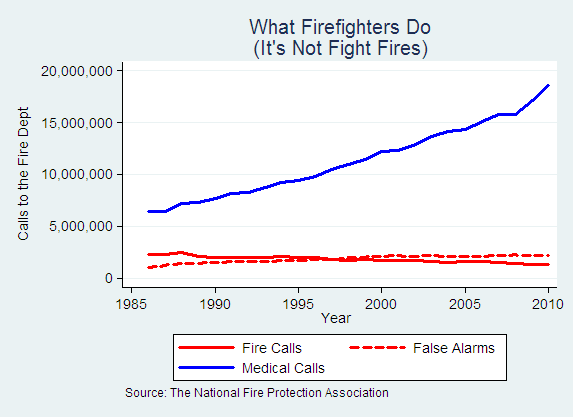
Check out this chart: http://marginalrevolution.com/wp-content/uploads/2012/07/Wha...

There may even be a happy middle-ground with regards to firefighters. In eastern King County, they don't send out a firetruck and three firefighters for non-lethal medical emergencies anymore -- they just send a single firefighter in an SUV.

Re: Too Many Cops Are Told They’re Soldiers Fighting a War. How Did We Get Here?

#190

Earlier quoted context omitted.

> (Also culpable are privatized prisons, which are often little more than slave labor camps.) As opposed to regular prisons which are just slave camps? What exactly is the moral difference between the state of living between public and private prisons? (I take it that you were implying a difference exists, but I could be mistaken.)

Don't get me wrong, they're both awful. Prisons as we know them are a travesty of both efficacy and human decency no matter who runs the show. But whatever perverse incentives and moral hazards already exist for state prisons, they are double when there is a profit motive for maximizing headcount. Moreover, the taxpayer still ends up footing most of the bill for private prisons; in state-run institutions, they at lea…

OK. I thought you were referring to the morality of working while in person as opposed to idling. Given your comment, it seems like you weren't---and yet your previous comment seems to imply it. So why refer to private prisons as "nothing more slave labor camps" while public prisons could just as easily be "nothing more than slave camps"?

I now understand that you were criticizing the incentive structure of prisons, but it didn't seem that way.

> Moreover, the taxpayer still ends up footing most of the bill for private prisons

I would therefore not call them private prisons. Perhaps, crony prisons or quasi-public prisons?

> In a private prison, an inmate who finds Jesus/Buddha/etc and becomes an honest citizen is a blow to the bottom line.

How can this be true while tax payers are simultaneously footing the bill? Moreover, isn't a large part of the comments in this thread about how there is an incentive structure in public prisons to keep more prisoners? (The correctional officer unions.)

> in state-run institutions, they at least have a budgetary incentive to moderate sentences, rehabilitate, and reduce recidivism.

That kind of makes sense. But when there are unions, and the jobs of union members depends on the number of prisoners, it becomes much less clear.

Post reply on HN