I missed the explanation for how the SSDs are connected. Maybe a dumb question.
SSDs are connected via Thunderbolt 5 enclosures. I have one Gen4 and three Gen5 ssds inside enclosures. You can see specs here https://github.com/argonautlabsai/deltafin/tree/main/k3-publ...
Kimi K3 (2.8T) at 1 token/s on a MacBook Pro, streamed from four SSDs
81–90 of 153 posts
Re: Kimi K3 (2.8T) at 1 token/s on a MacBook Pro, streamed from four SSDs
#82Re: Kimi K3 (2.8T) at 1 token/s on a MacBook Pro, streamed from four SSDs
#83Earlier quoted context omitted.
SSDs are connected via Thunderbolt 5 enclosures. I have one Gen4 and three Gen5 ssds inside enclosures. You can see specs here https://github.com/argonautlabsai/deltafin/tree/main/k3-publ...
So if this all streamed from the internal NVME would you expect better performance?
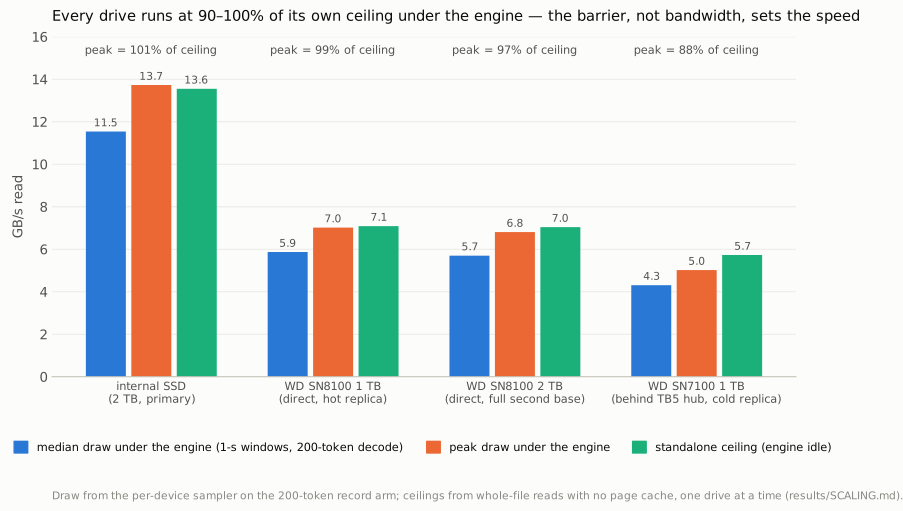
(0.535 vs 1.038 tok/s at 128 tokens), since one fast drive still has to serve all 16 reads per layer while four drives split the load
https://raw.githubusercontent.com/argonautlabsai/deltafin/ma...
Re: Kimi K3 (2.8T) at 1 token/s on a MacBook Pro, streamed from four SSDs
#84Author here. Some context and the caveats up front. The model is Kimi K3, 2.78T parameters, ~1.45 TB of expert weights. It does not fit in memory, so the experts stream from disk: one 17.5 MB file per (layer, expert), read with pread + F_NOCACHE, 16 of 896 per layer. The machine is an M5 Max MacBook Pro with 128 GB and three Thunderbolt 5 enclosures plus the internal SSD. Expert weights are untouched at their release…
Re: Kimi K3 (2.8T) at 1 token/s on a MacBook Pro, streamed from four SSDs
#85Earlier quoted context omitted.
My parents learned to program on punch cards. They told me it was a day of preparing the program, an hour of running it, just to get a syntax error.
Write the program, punch the cards, send the cards to another building to be loaded, program runs, printout comes out in another building, somehow this takes 2-3 days
Re: Kimi K3 (2.8T) at 1 token/s on a MacBook Pro, streamed from four SSDs
#86I missed the explanation for how the SSDs are connected. Maybe a dumb question.
SSDs are connected via Thunderbolt 5 enclosures. I have one Gen4 and three Gen5 ssds inside enclosures. You can see specs here https://github.com/argonautlabsai/deltafin/tree/main/k3-publ...
Re: Kimi K3 (2.8T) at 1 token/s on a MacBook Pro, streamed from four SSDs
#87Earlier quoted context omitted.
Maybe. Do you have an example of a prompt you've done recently? I don't think it's valuable at all to try and craft a specific prompt to "one-shot" a task, I'm way faster just doing small asks and guiding it. At 1t/s, how would you even know your prompt was insufficient? It would take you 7 hours to see it.
Stuff along the lines of implement controller service and tests for the following endpoints: - list of many endpoints with the JSON they receive and return and description of what they need to achieve Stuff you could probably do in a single work day if you lock in and enter flow state, but in a typical job takes like half a week. And the vast majority of times the AI one shots it with no bugs, where I would have copy…
Re: Kimi K3 (2.8T) at 1 token/s on a MacBook Pro, streamed from four SSDs
#88Earlier quoted context omitted.
The future of inference is likely in ASICs, so we'll get the inverse, a bit less capable than frontier but super fast models. Like this 14k tok/s beast https://chatjimmy.ai/ from Taalas (who got acquired by AMD recently). GPT-6-astra runs at like ~40 tok/s, I have a hard time imagining what could be accomplished with that type of model at 10k+ tok/s when in the hands of the public. Will certainly make cybersecurity a…
This is incredible! Are there other big players in this space (freezing models to silicon)?
Re: Kimi K3 (2.8T) at 1 token/s on a MacBook Pro, streamed from four SSDs
#89Author here. Some context and the caveats up front. The model is Kimi K3, 2.78T parameters, ~1.45 TB of expert weights. It does not fit in memory, so the experts stream from disk: one 17.5 MB file per (layer, expert), read with pread + F_NOCACHE, 16 of 896 per layer. The machine is an M5 Max MacBook Pro with 128 GB and three Thunderbolt 5 enclosures plus the internal SSD. Expert weights are untouched at their release…
If it's (nearly) all streamed from disk can you use an intel/amd machine and a big fat gpu and use the SSDs (nvme for faster throughput) as your virtual vram? Or something like that?
Two things carry over: the experts are read from disk per token either way, and the barrier model — a layer waits for the slowest of its 16 reads — is platform-independent.
Two things don't: the 50 GB resident trunk lives in unified memory here, so on a discrete GPU it would need to fit in VRAM or be streamed too; and a desktop's PCIe lanes let you put NVMe drives on the bus directly rather than behind a ~7 GB/s Thunderbolt enclosure, which is our per-drive wall.
Whether that ends up faster is exactly the kind of thing that wants measuring rather than guessing.
Re: Kimi K3 (2.8T) at 1 token/s on a MacBook Pro, streamed from four SSDs
#90Earlier quoted context omitted.
At 1t/s it's still faster than humans for a lot of tasks, basically doing overnight what could take humans half a week. Plus you can always parallelize.
I would agree, but I want to add that I have real issues with combination of opencode plus slow inference (4-5tok/s). I get weird interruptions. I can only guess its related to some kind of timeouts in the harness or something. Its not a problem of the model of course, but it seems impractical atm. I wonder if anyone else had this kind of thing happening.