Live data from Hacker News

US beef prices have soared but farmers aren't making more money

bbc.com

81–90 of 136 posts

Re: US beef prices have soared but farmers aren't making more money

#81
post #5

My father-in-law grew up on a small-time farm and then went into environmental engineering as a professor, and briefly worked on the Secretary of Agriculture's staff in the Biden administration. He has told me that there are 3-5 (can't remember the number) colossal meatpacking corporations in the US that have laid waste to smaller-time competition, and now that the market is captured their owners and shareholders can…

> In Arkansas 20% of people tested on a big free testing day were sensitized to the galactose-alpha-1,3-galactose molecule What effect does this have on the person?

I wouldn't take the 20% figure at face value. If you only test for antibody reaction, you get an implausibly high number.

>A study of blood samples from military recruits, taken between 2001 and 2007, found that nearly half the recruits from south-central Missouri, where Ellison lives, had allergy antibodies for alpha-gal. [...]

>Only a fraction of people with antibodies to alpha-gal become allergic to it, and those who are often don’t realize it. Some react only to red meat. Some also react to milk, cheese, and other animal products that have alpha-gal. The symptoms are so delayed that people often blame them on food poisoning, irritable-bowel syndrome, gluten intolerance. In the U.S., according to the Centers for Disease Control and Prevention, as many as half a million people have alpha-gal syndrome, but other researchers suspect that the number is higher.

https://www.newyorker.com/magazine/2026/07/06/the-tick-that-...
Re: US beef prices have soared but farmers aren't making more money

#82

Earlier quoted context omitted.

The "greed" aspect is always bullshit unless there is a specific instance of market failure like monopoly power or collusion. This has definitely happened, so I'm not discounting it, but in those cases folks should just say the issue is monopoly concentration or collusion. Saying "greed" comes from people who fundamentally believe economics doesn't exist, or don't understand it. Everyone in the economy is "greedy". C…

Because markets are neither rational nor perfectly elastic.

Which was also true before COVID. So what has changed?

Re: US beef prices have soared but farmers aren't making more money

#83

Earlier quoted context omitted.

Because markets are neither rational nor perfectly elastic.

Which was also true before COVID. So what has changed?

Shock moved the price equilibrium to new higher price point. And big enough share of demand accepted that new price point.

Re: US beef prices have soared but farmers aren't making more money

#84
post #78

Earlier quoted context omitted.

So it was just a non-sequitur? Nobody was suggesting communism. (Also communism doesn't follow the same rules as monopolies.)

No it wasn't a non-sequitur. Instead of repeating myself I'll just link to this good explanation: https://news.ycombinator.com/item?id=49197575

That explanation doesn't work.

They advocated for competition instead of ogliopoly. You decided to talk about a completely different and irrelevant way there could be a lack of competition. Even if your conclusion is right, that they would be against communism if it was a realistic threat here, there was no reason to bring it up.

I could say that a bunch of badly placed volcanos would reduce competition and they must be against those volcanos. Such a statement is technically true but it's a non-sequitur.

Re: US beef prices have soared but farmers aren't making more money

#85
post #75

> A new pick-up truck that once cost $40,000 now runs to $100,000. A wooden fence post has gone from about $6 to as much as $19. A quarter-mile roll of barbed wire has doubled, from $60 to $130. Everything he uses day to day, he says, has jumped in price since the Covid pandemic. I know why pick-ups have gone up in cost (though I don't think it's quite to 2.5x levels like suggested here since the pandemic), but woode…

I am starting to think that there might be lot less competition on free markets than we think. And many markets tend to be established with big enough players. So they have stopped competing. If new entrants try to come well they might be undercut or simply bought out.

It is highly unlikely that big players are even able to emerge in a free market. All big businesses we know are big because they found a so-called moat. But I suppose we'll never know for sure as you have a greater chance of winning the lottery while simultaneously being struck by lightning than ever seeing a free market.

Re: US beef prices have soared but farmers aren't making more money

#86

> A new pick-up truck that once cost $40,000 now runs to $100,000. A wooden fence post has gone from about $6 to as much as $19. A quarter-mile roll of barbed wire has doubled, from $60 to $130. Everything he uses day to day, he says, has jumped in price since the Covid pandemic. I know why pick-ups have gone up in cost (though I don't think it's quite to 2.5x levels like suggested here since the pandemic), but woode…

I assume the posts come from Canada, so are heavily tariffed. And the barbed wire might be produced in the US, but steel producers have raised their prices to match the level of tariffed imported goods.

Re: US beef prices have soared but farmers aren't making more money

#87

Earlier quoted context omitted.

According to the Economist magazine, the global problem is Chinese people eating more meat.

That's a deeply biased stance though, isn't it? It seems to say that USA and Brazil eating vast amounts of beef, the latter clearing the Amazon to do so, isn't a problem, it's only a problem now because of the Chinese.

The word "problem" lacks nuance here. But it's a reasonable stand-in for "the factor that shifted and is the root cause".

Re: US beef prices have soared but farmers aren't making more money

#88

> A new pick-up truck that once cost $40,000 now runs to $100,000. A wooden fence post has gone from about $6 to as much as $19. A quarter-mile roll of barbed wire has doubled, from $60 to $130. Everything he uses day to day, he says, has jumped in price since the Covid pandemic. I know why pick-ups have gone up in cost (though I don't think it's quite to 2.5x levels like suggested here since the pandemic), but woode…

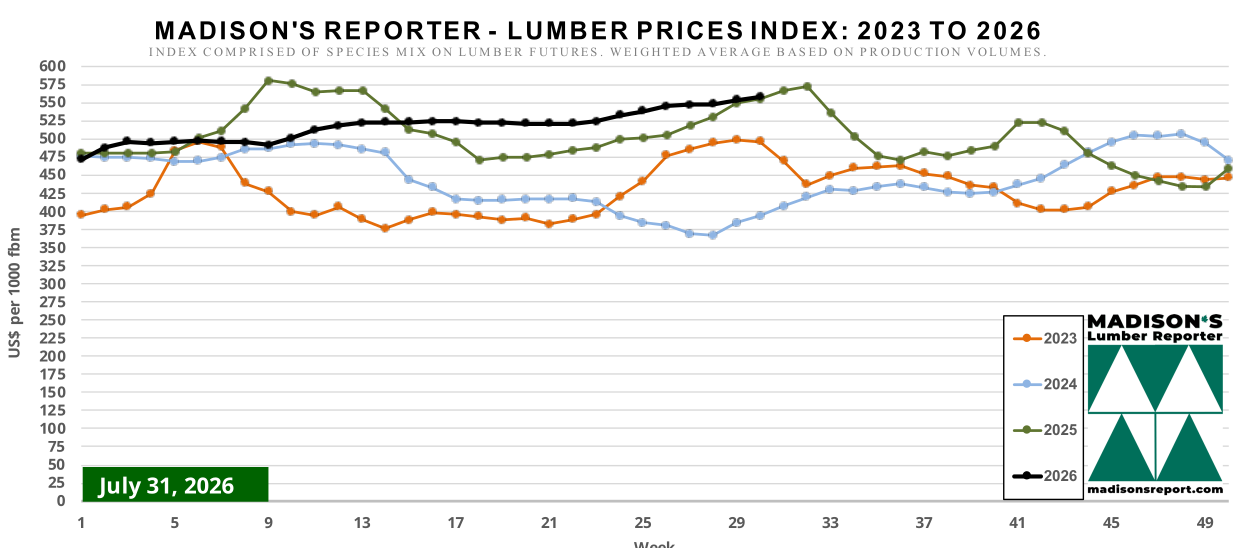
For lumber, data at [1] indicates much volatility in North American lumber prices from January 2023 to February 2026. Trough-to-peak prices for 2023, 2024 and 2025 have been over 30% across a given year. The main difference for 2026 so far is the stability of prices which have remain peaked for half a year.

Now is the perfect time for someone being overly dramatic to say "In the 2 years since July 2024, lumber prices have increased 47%, significantly higher than inflation".

But someone else could also say "Lumber prices are the same as July 2025 even though inflation has risen" or "Lumber prices are up just 10% in the 3 years since July 2023, lower than the rate of inflation across these 3 years".

[1] https://madisonsreport.com/wp-content/uploads/2026/07/IndexG...

Re: US beef prices have soared but farmers aren't making more money

#89

Earlier quoted context omitted.

>It's basically, because everything else has gotten more expensive. Labor + fuel + wear and tear on equipment + raw materials. Don't forget taxes (tariffs) have also increased substantially. Even if a supplier isn't paying tariff's, if their competitors are they can often just raise their prices, or their prices go up due to the supply/demand shift.

Inflation from Covid spending is what got us. It was horrible before tarrifs.

Sorry, I didn't mean to imply tariff's were the exclusive cause, just a reminder that an additional factor is large tax increases.

Re: US beef prices have soared but farmers aren't making more money

#90

Animal agriculture is a key driver of climate change: https://sentientmedia.org/how-does-livestock-affect-climate-... Along with the high price, that's one more reason to not buy it.

There’s research now that high density rotational grazing does the opposite.

You have to cut out feedlot finishing to get those benefits on a macro scale, which would drastically reduce beef output. It's the same problem organic has, but maybe even worse since 99%? of cows are feedlot-finished.

Which isn't really a negative to me, but I think people should be honest about what is actually necessary to get the benefits of this form of beef production.

Post reply on HN