Live data from Hacker News

After the AI Crash

potsandpansbyccg.com

211–220 of 244 posts

Re: After the AI Crash

#211
post #183

Earlier quoted context omitted.

If people dont buy, company does not have money nor income. Simple as that. There will be no need to use those machines, because you cant sell the output of those machines. So, you have starwing hopeless population not buying your products. Which means you cant produce. Which means, you eventually become part of that starwing population (or they kill you in some outburst).

You are still thinking in terms of monetary economics about a situation where money is no longer needed. In a monetary economy, if you need X, you need the money to buy it. In a post-AGI economy, if you need X, you ask your human-level robots to make it (including making more robots). No money involved at all.

Like they will magically create metal and food from nothing? Of course not, you will need to barter for those if there are no money.

Will they create also water that will be getting more expensive due data center consumption?

This is absurd.
Re: After the AI Crash

#212
post #145

Earlier quoted context omitted.

Yeah. Uber's a successful company and they raised a J round. Therefore the rule (D means Death) is not real. I'm not sure what you're implying, or if you just misunderstood the original comment?

>or if you just misunderstood the original comment? Did you? If you keep on reading, the parent comment further implies that both AI companies and uber are "vibes based". But that's hard to square with the fact that 7 years since IPO the share price is up 75%. Of course, you can argue we're still in the irrational exuberance stage, but that just creates a situation where you can never be called wrong.

> Did you?

I don't think so. They say the rules are vibes-based (or just wrong). That means you cannot use the rule to draw conclusions. That does not mean "the opposite of the rule is true" or anything like that. Nor does it mean that the AI companies resemble Uber in any significant way. They are just saying that since the rules are not real, you cannot say something like "this business will obviously fail, because it has bad fundamentals". The fundamentals are only part of the equation.

Re: After the AI Crash

#213
post #83

Earlier quoted context omitted.

It's probably a safe assumption that openrouter prices for Kimi K3 are "real".

If they're hosted in China next to a coal power plant and maintained by people getting paid 1/10th of a US engineer sure. I doubt opanai and anthropic will go that road

[deleted]

Re: After the AI Crash

#214
post #184

Earlier quoted context omitted.

To compare, great depression had 25.6 unemployment rate. It helped the WWII to happen. It wont be the end of capitalism. But, it would mean major outbursts of violence and major civil war or revolution. Where AI companies will be (deservely) the hate targets. But my point really was that it is economic nonsense.

> Where AI companies will be (deservely) the hate targets. That depends on what those companies do in response. Giving away robot-produced stuff for free could quicky earn them praise, instead of hate. If human-level robots enable massive increases in efficiency and production, at least one of the companies will decide to mitigate any risks in this way.

You are severely underestimating how much free stuff would 349,163,268 of American citizens need to make a small difference. To achieve that, they would need to steal farms from current owners.

And they will be hated, because they stripped people of future and bought in violent hellscape for literally everyone.

Re: After the AI Crash

#215
post #14

AI investment will crash but AI itself (the technology) will continue thriving, learning, improving and there is absolutely no way to stop it. The only reading on the crystal ball is if US companies fail, China will take the lead by leaps and bounds, so the only solution is to keep pushing the cart until the wheels come off or we all cross the finish line, together.

It can't 'learn' on its own. Models only get better with mountains of RnD for data, training, and lots of fine tuning. So the moment investment dries up, models stop improving. However, it's likely we'll get good 80/20 solutions where you get most of the performance of the then-unsustainable high end models for significantly less compute.

and lots and lots and lots of cash

Re: After the AI Crash

#216
post #81

These days, I find it hard to predict the future. Things feel too complex, and the times seem different. People say the AI bubble will burst, and I also think it will. But I want to think about how it might differ from other bubbles. One positive factor is that during the internet startup era, there was almost no revenue. But now, big tech companies are generating profits and can absorb AI-scale losses. The dot-com b…

Previous bubbles were characterised by "mass participation in the relevant markets"

This hasn't happened yet for AI, and there's a good chance it won't happen. Ie neither OpenAI nor Anthropic go public, or if they go public, the reception is "meh"

Nevertheless, independent of wider market sentiment, imho there is still a bubble in "closed models". One could, eg, pay attention to OpenAI/Anthropic/Copilot/Google's monthly new consumer subscriptions (Oversubscribed but in a hyperhyperreal sense lol. It seems that there are too many people queuing for this new restaurant, and those that have tasted the food all think it's ok but not healthy enough ("productivity mirage"). but people on the street can't see it because the bookings are all online. It may be that Gemini pro's subscriptions may be the last one to fall off the cliff. When that happens even the "open cloud models" bubble may pop (after everyone sees Google sunsetting Gemini, or making it exclusive to Apple lol)

US, not Korea https://archive.ph/WBSCj

Re: After the AI Crash

#217
post #147

> analysts have estimated that it will take $2 trillion a year in revenue to pay for the infrastructure that has already been built I doubt any credible analyst has claimed that. What's the total AI capex that's already been spent? About $1T? It's a pretty absurd idea that those DCs need to make $2T/year for 5-7 years -> $10T-14T over their lifetime to break even. (Yes, this is nitpicking in the sense that there are…

I agree a lot of the dooming is from people who don't really do the maths. Total capex so far is probably about $1T. Recent annual earnings are $132bn at Google, $101bn at msft, 60bn at Meta, $120bn nvda adding up to $413bn after tax. They could pretty much write down the whole capex to zero against two years earnings from those. It's not that out of whack.

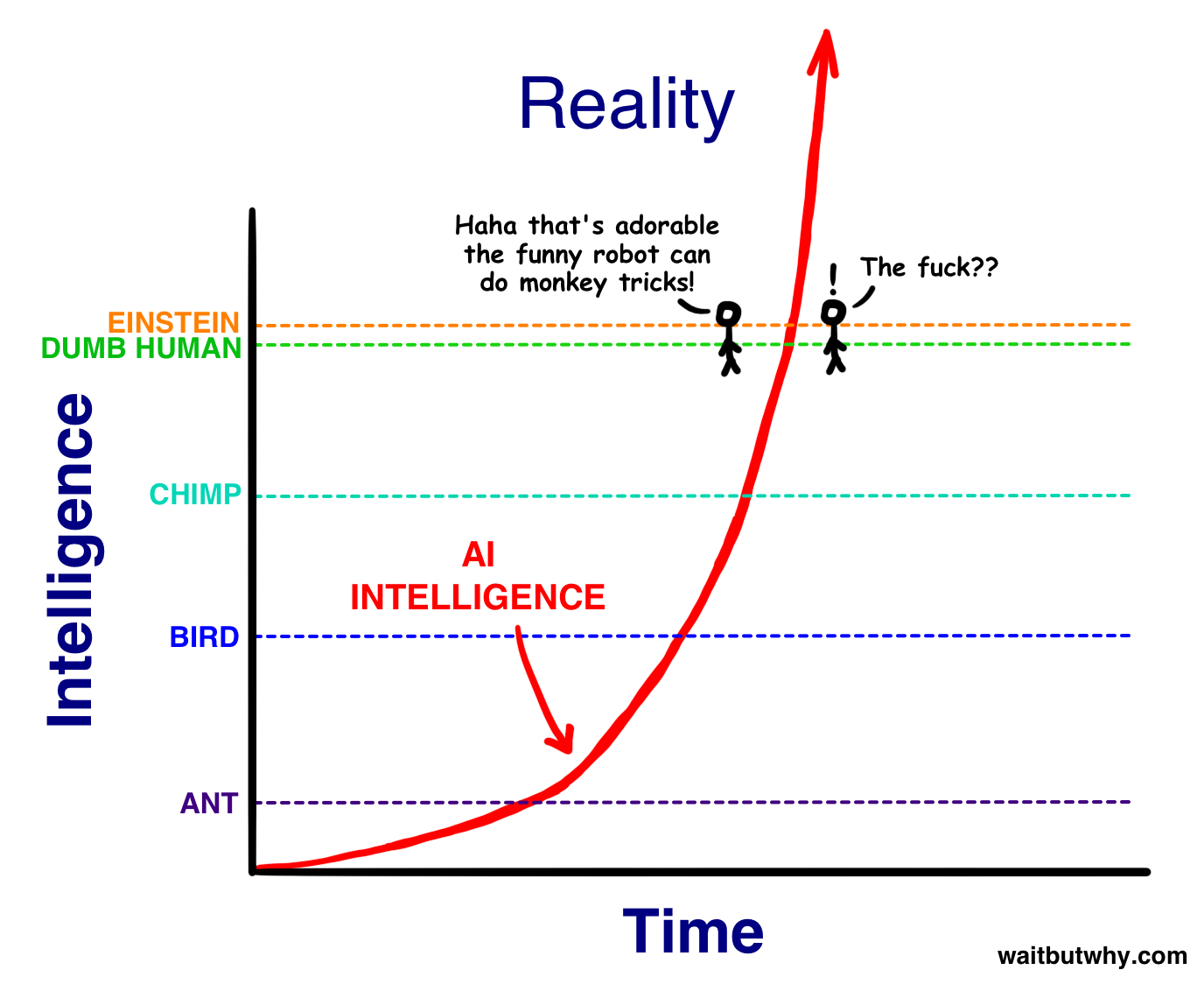
Not mentioning that we are kind at the point in the Wait but Why cartoon between that's cute and wft https://waitbutwhy.com/wp-content/uploads/2015/01/Intelligen...

From the article from ten years ago https://waitbutwhy.com/2015/01/artificial-intelligence-revol...

It's interesting that it shows human level at 2025 and we've just seen a wtf story on HN https://news.ycombinator.com/item?id=49048681

Re: After the AI Crash

#218
post #211

Earlier quoted context omitted.

You are still thinking in terms of monetary economics about a situation where money is no longer needed. In a monetary economy, if you need X, you need the money to buy it. In a post-AGI economy, if you need X, you ask your human-level robots to make it (including making more robots). No money involved at all.

Like they will magically create metal and food from nothing? Of course not, you will need to barter for those if there are no money. Will they create also water that will be getting more expensive due data center consumption? This is absurd.

> Like they will magically create metal and food from nothing?

Not from nothing. How do humans create metal and food? Mining and farming. You ask your human-level robots to do the same. Human-level robots can by definition do everything humans can do, including gathering basic resources and growing food.

> Will they create also water that will be getting more expensive due data center consumption?

Data center consumption of water is miniscule compared to other uses. But yes, you ask the robots to make you water, for example by building desalination plants.

Even if there is still monetary economy, and you come to the conclusion that buying something is the best way to get it, you simply ask your robots to think of a way to earn you money by performing work for others, or making things to sell on the market. If they are truly human-level, they can do it.

> This is absurd.

This is the reality, if human-level AI and robotics is developed.

Re: After the AI Crash

#219
post #210

Earlier quoted context omitted.

money is just an abstraction over value, it is not value itself. if AGI is achieved, the AI labs will just use AGI to produce what they need instead of trading for it, which would include full vertical integration on all products.

No they wont, because producing requires more then just "intellingence". AGI itself produces nothing. Also, if there are no money so 80%-100% of people move to barter instead of money to trade stuff. Same thing, just less effective.

> No they wont, because producing requires more then just "intellingence".

What more does it require?

Spoiler: now you tell me what more is needed, and I would then tell you how to use intelligent robots to obtain it.

Re: After the AI Crash

#220

Earlier quoted context omitted.

money is just an abstraction over value, it is not value itself. if AGI is achieved, the AI labs will just use AGI to produce what they need instead of trading for it, which would include full vertical integration on all products.

They will still need land, energy and resources. They will also be subject to the wrath of voters and angry unemployed mobs.

> They will still need land, energy and resources.

Human-level robots can mine resources and build power plants.

Perhaps you need some initial land to build your first robotic base, but robots can also perform work to earn you money to buy more land afterwards.

Post reply on HN