Live data from Hacker News

What Ozempic does to the gut-brain axis

psychologytoday.com

401–410 of 555 posts

Re: What Ozempic does to the gut-brain axis

#401
post #265

Earlier quoted context omitted.

People can get fat by eating too much healthy food.

Wasn't there just a study, that many fat kids are fat because of fruit juices? Healthy in a way, but surprisingly a lot of sugar ( either added or from the fruits)

There was a study comparing big and small eaters with and without obesitas. Turns out that skinny people who eat a lot eat also eat a lot of fat and protein and that fat people who eat almost nothing eat mostly carbs and sugar.
Re: What Ozempic does to the gut-brain axis

#402
post #283

The "gut-brain axis" is mostly bullshit invented to cope with the fact that doctors have sent patients to shrinks for decades with real sicknesses. Everybody knows you feel bad when your digestive is out of balance. It's the same english word for "I'm sick" and "I feel sick" since forever. No magical newly found "gut-brain axis" needed. Eating junk food, especially sweetened food is a drug. You can do a withdrawal an…

But the drug feeds the flora in your gut, which tells your brain to crave more of it.

Like if you completely cut off sugary foods for 2-4 weeks you won't crave them as much. Why? The gut flora that feeds off sugar specifically dies off and can't send as strong signals to your brain.

Thus: gut-brain axis. It's a thing and will become more important when we study it more. Your brain isn't as much in control as you think.

Re: What Ozempic does to the gut-brain axis

#403

What’s the downside to this magical drug. There has to be a downside…

the downside is it allows us to continue to avoid solving the real problem

ideologues will tell you this is that all mankind suddenly lost their ability to exert self-discipline a few decades ago

science points to a broad combination of things like corn syrup and seed oils simply making food too addictivly-rewarding and calorie rich for our nervous and endocrine systems to handle.

so, do we reform the farm bill and fast food industries, or do we take the antidote?

Re: What Ozempic does to the gut-brain axis

#404
post #344

Earlier quoted context omitted.

For many people, the "underlying issue" is fundamentally just being too hungry for how they live. GLP-1s absolutely treat that.

Sounds like they eat the wrong things. So learning to eat properly and stopping with GLP after a while sounds more reasonable to me. Also that's how my mum got it in the swiss test run. It was never supposed to be long term, just to help change eating habits.

Is this advice coming from personal experience of significant diabetes and weight reversal or just online reading informed opinion? Physiology & psychology are quite complex and individualized and "just do this.." doesn't quite work at any sustainable level when people have jobs, families, mortgage, sick children & sick parents to also manage at the same time.

Re: What Ozempic does to the gut-brain axis

#405
post #371
post #335

Earlier quoted context omitted.

Because usually you can't study long-term effects before releasing a drug, and even then it can take a long time for them to surface. I took antihistamines basically throughout my 20s. My allergy specialist said there's no reason not to. I developed some other issues and wanted to stop taking antihistamines to see if that would help (or get a hint whether they were causing it) - but that got me into itching hell for…

I personally believe you are right to be weary about holding off on long term use before the long term efficacy and risk profile of a drug has been established, but GLP1 class drugs have been around for a long time now. GLP1 agonist type incretins have been available for over 20 years at this point. The first marketing approval was in 2005 for exenatide (Byetta), indicated for T2DM. Exenatide was the first in class f…

Are there any cases of people upregulating too much in response to those agonists?

Re: What Ozempic does to the gut-brain axis

#406
post #122

Earlier quoted context omitted.

Who is lying? I was fat because I ate too much. Why I ate too much is uninteresting to me. I also don’t have some moral hang up over it. Give me that easy button all day long so I can focus on shit in my life that actually matters. If it makes someone feel better about themselves to believe in woo-woo science that violates the laws of physics and ascribe magical properties to GLPs, why do you care?

>If it makes someone feel better about themselves to believe in woo-woo science that violates the laws of physics and ascribe magical properties to GLPs, why do you care? Why we should not care about putting people on drug who do can benefit from making lifestyle changes, being less sedentary and leaning about maintenance calories and how calorie surplus and deficit works? if there is no resistance, simply prescribin…

I have a hard time imagining an actual human being as hateful as you are. Why would you spending so much energy trying to make people feel bad about an issue they have?

I spent every ounce of effort I could muster last year to lose weight and dropped 36 kg, however there was never a point where that got easy to maintain, where my body wasn't screaming at me to eat. Crying oneself to sleep from hunger after walking 20000 steps per day is not how I could live the rest of my life. I understand that that is not the case for you, but you must understand that hunger and food cravings are not the same for all people.

There are people literally starving to death because they can't force themselves to eat and of course many more people eating until it kills them. How can you not realize that you happen to be naturally in between these two extremes?

Re: What Ozempic does to the gut-brain axis

#407
post #67

Earlier quoted context omitted.

changing habits do have lasting effects, I'm not part of this "we" that doesn't know that.

If you succeed at changing your habit, it works. However, all the evidence is that the vast majority of people fail at changing their habits in ways that produce lasting weight loss, so it does not generally work as advice for reducing your weight. So you're technically right, but it is irrelevant, because we don't know how to actually get people to change habits with any meaningful rate of success. At this point it…

You didn't say "trying to change your habits" don't work. You said changing habits don't work. This is false, harmful and wildly unethical.

Re: What Ozempic does to the gut-brain axis

#408

Earlier quoted context omitted.

>my body and mind are no longer is in starvation mode What does it mean? If a drug reduces your desire to eat food, wouldn't it also decrease your desire to eat food beneficial for your body? I think the effect most people want is to stop craving junk food but still eat nutritious food required for muscle growth and health.

considering what we have been learning about the importance of a working gut brain axis I'd be highly worried about Ozempic harming this connection.

whatever we learned about gut brain axis dysfunctionality? I thought most of the biggest findings were in that it exists in the first place.

Re: What Ozempic does to the gut-brain axis

#409

Earlier quoted context omitted.

I posted this elsewhere too but i'll add it here: I've helped many people lose weight, become jacked, and go from underweight to a healthy weight. I regularly hear from overweight and obese people who come to me, “I’m genetically predisposed to being fat.” Yet after a few months, we often make significant progress. Many of them have also tried “deficit dieting,” and it didn’t work for them. But when I looked more dee…

I think you are ignoring the selection bias, when looking at people who seek out professional help for losing weight, even more so when it's about people who can then become jacked. Note that I'm not speaking as someone who has just accepted being overweight/obese. I was hovering around 105kg in my early 20s, then I gathered the motivation to go down to ~75kg over the course of a year, then maintained myself around 8…

OMAD can be used with calorie tracking.

From my experience stuff like Intermittent fasting, OMAD is not really needed.

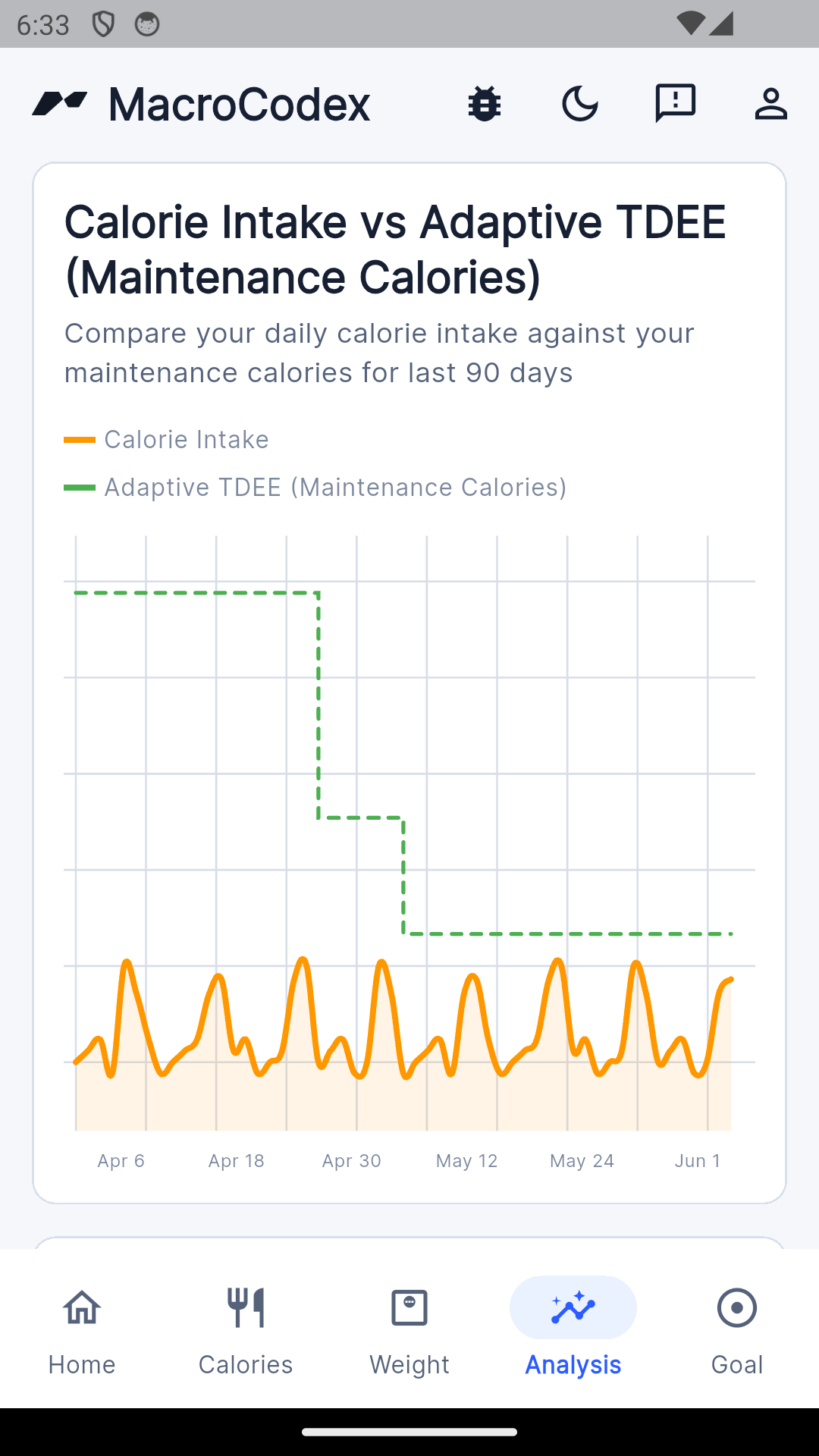
Something especially useful to many people is being able to visualize, their maintenance calories vs calorie intake, see this: https://macrocodex.app/assets/hero-tdee-line.png

When dieting properly, you should focus on long term weight trends rather than daily fluctuations.

Re: What Ozempic does to the gut-brain axis

#410
post #171

Earlier quoted context omitted.

I had the same experience, but not with GLP-1 drugs, but by upping my protein intake to about 0.7g per pound of body weight. Night and day, stopped always being hungry... I've tried Noom before (eating highly filling, low calorie foods, but filling, not satiating), but that only worked while I was tracking (and always forcing myself to keep it up)... Losing weight required work on top of that, but the protein just ma…

I had a similar experience bringing down my A1C. People talk a lot about meat, but not enough about dairy. My prayers were answered at the altars of feta, greek yogurt, half and half, butter, cottage cheese, etc. They made salads not suck. They opened up a ton of lower carb dessert options. My gut health improved. All of my health improved. I no longer treat these humble foods as optional extras. They perfectly fill…

How'd your LDL?
Post reply on HN