Live data from Hacker News

All of human cooking compressed into 2 megabytes

arxiv.org

71–80 of 181 posts

Re: All of human cooking compressed into 2 megabytes

#71
post #49
post #5

Earlier quoted context omitted.

Ahh - the dependency graph recipe card. These are excellent. I've imagined something like this forever. Always annoyed that recipes put ingredients in a giant undifferentiated list and then give an instruction like "mix the dry ingredients in a deep bowl". For a while I expected there could be a good return on a good implementation of this, but now as soon as a strong interface itself is created it seems easy to copy…

Feels like one might be able to get an llm to convert an annoying to read recipe into a mermaid dependency graph following this example. Might be worth a try!

Just tried https://www.mlynn.org/tools/generate-diagram and it didn't work.

FWIW though most recipes are basically ~10 steps long so a simple list suffice.

Still it could be an interesting experiment as I imagine that precisely recipes that are less sequential are (on average, with as challenging steps, e.g. excluding making caramel which has a high chance of burning) perceived as more complex.
Re: All of human cooking compressed into 2 megabytes

#73

The work is very interesting. The title is misleading. A better title would be: "all of human ingredients compressed into 1,800 primitives" There is little to substantively nothing about the actual cooking: preparation methods, proportions, etc. But the idea that tomato goes well with beef the whole world over is very interesting and useful for creating flavors that will go together, perhaps surprisingly. It will be…

Unless I'm missing something, there's also nothing in the paper to indicate this is "all of human ingredients"? It looks like it's 11 data sources covering a bunch of common cuisines, with the English + Chinese sources accounting for 90% (!) of the dataset. Among others, Africa and the Arab world are not present in the data (good for about 25% of the global population).

Also, all non-English terms were AI-translated to English which is methodologically understandable but surely leaves room for error.

Re: All of human cooking compressed into 2 megabytes

#74

The work is very interesting. The title is misleading. A better title would be: "all of human ingredients compressed into 1,800 primitives" There is little to substantively nothing about the actual cooking: preparation methods, proportions, etc. But the idea that tomato goes well with beef the whole world over is very interesting and useful for creating flavors that will go together, perhaps surprisingly. It will be…

+1. On a side note (and maybe off topic), I am thinking about food pairing which is based on the idea that two ingredients sharing volatile aroma compounds or certain molecular families may have a potential sensory compatibility (broccolis and strawberries for example). I'd love to test those ingredients and find some unknown food pairings. But .. time is what it is (for now).

I think it's a lot simpler than that. A common pattern for sauces is fat + acid + salt

- (Mexican) avocado and lime/lemon + salt

- (Chinese-southwestern) chili oil and vinegar + salt/fermented bean paste

- (Italian) olive oil and tomato + salt

- (Turkish) olive oil and lemon + salt

- (Thai) coconut milk and lime + salt

...

Re: All of human cooking compressed into 2 megabytes

#75

Neat. I'm trying to compress recipes into little schematics https://leontrolski.github.io/recipes.html

That's a very cool site! I enjoyed the hand-drawn graphs.

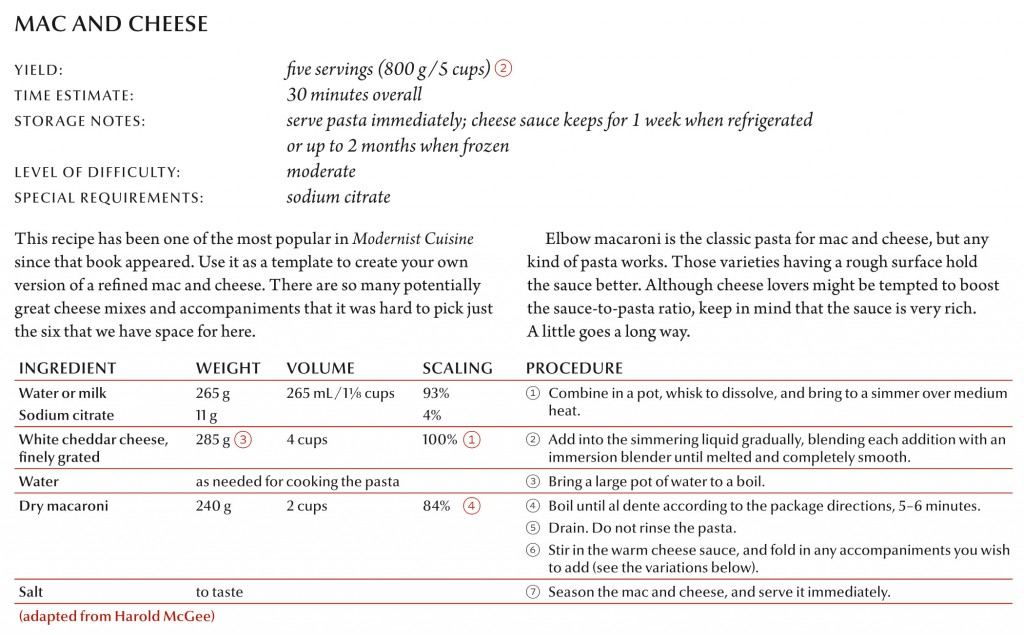
Your tables remind me of recipes in Modernist Cuisine. They all have ingredients grouped by the procedures together with weight, sometimes volume, and ratio.

Example: https://modernistcuisine.com/wp-content/uploads/2013/01/Mac-...

Re: All of human cooking compressed into 2 megabytes

#77
post #74

Earlier quoted context omitted.

+1. On a side note (and maybe off topic), I am thinking about food pairing which is based on the idea that two ingredients sharing volatile aroma compounds or certain molecular families may have a potential sensory compatibility (broccolis and strawberries for example). I'd love to test those ingredients and find some unknown food pairings. But .. time is what it is (for now).

I think it's a lot simpler than that. A common pattern for sauces is fat + acid + salt - (Mexican) avocado and lime/lemon + salt - (Chinese-southwestern) chili oil and vinegar + salt/fermented bean paste - (Italian) olive oil and tomato + salt - (Turkish) olive oil and lemon + salt - (Thai) coconut milk and lime + salt ...

[deleted]

Re: All of human cooking compressed into 2 megabytes

#78

The work is very interesting. The title is misleading. A better title would be: "all of human ingredients compressed into 1,800 primitives" There is little to substantively nothing about the actual cooking: preparation methods, proportions, etc. But the idea that tomato goes well with beef the whole world over is very interesting and useful for creating flavors that will go together, perhaps surprisingly. It will be…

I have a wonderful book that explores this idea of an atlas of flavours that work together. The flavor bible. I can assure you that it does not contain 1800 ingredients in all of there combinations, but it does a remarkable job of covering a widely used selection of herbs spices vegetables and meats. I doubt a compressed version of the text would even be very large. The trouble I find with LLM generated recipes is th…

Sounds like the flavour theaurus

Re: All of human cooking compressed into 2 megabytes

#80
post #39

>from 11 sources spanning seven languages, English, Chinese, Russian, Vietnamese, Spanish, Turkish, Indonesian, German, and Indian-English So hardly "all of human cooking"...

That does represent 70% or so of the current world population. It isn't 100% coverage but it is most of the many of the biggest groups.

It is missing the Italian, Japanese, Greek and Mexican cooking - that are incredibly popular worldwide and it is incomplete without them, and nothing from Africa at all or Middle East.

Post reply on HN