Earlier quoted context omitted.
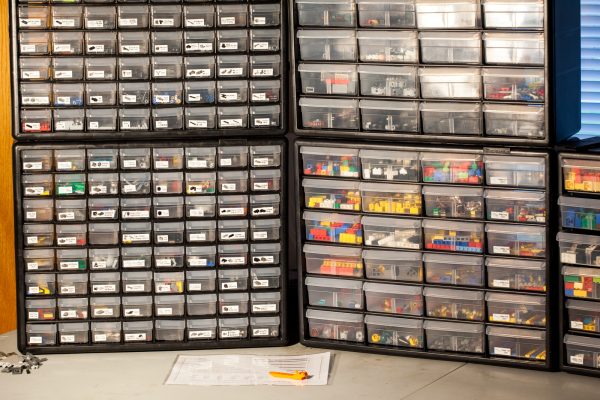
> ... and sort LEGO bricks by colour You never sort by color, ever! You sort by form, and then throw every color of that specific form in one bin. If you throw every red brick in the same bin, you'll never find a specific formed red brick because to many red bricks. But if you first search by form and then by color, you are much faster.
As someone who tried to sort many lego sets lately, I do like this. The problem lies that modern lego has so many unique forms that it feels like you'll have many bins with one or two pieces in.
We've raised $17M to build what comes after Git
371–380 of 785 posts
Re: We've raised $17M to build what comes after Git
#372Earlier quoted context omitted.
As someone who tried to sort many lego sets lately, I do like this. The problem lies that modern lego has so many unique forms that it feels like you'll have many bins with one or two pieces in.
You need to get some bins that have a top shelf like a toolbox. The low item counts go in the top shelf, segregate the bottom for efficiency. Bin by color.
Anyone have a solution for another annoying problem: 1 missing piece.
Somehow got lost halfway through the build.
Re: We've raised $17M to build what comes after Git
#373I feel like I really need to learn how to raise money. For $17M, one could probably build a vacuum robot prototype that’ll also clean up all of the kids toys and sort LEGO bricks by colour and size. Parents worldwide would love it. But instead, we get a replacement for Git. And I didn’t even bother to click the link because I’m fine with how Git works. On the list of pain points in my life, “what comes after Git” has…
Re: We've raised $17M to build what comes after Git
#374I feel like I really need to learn how to raise money. For $17M, one could probably build a vacuum robot prototype that’ll also clean up all of the kids toys and sort LEGO bricks by colour and size. Parents worldwide would love it. But instead, we get a replacement for Git. And I didn’t even bother to click the link because I’m fine with how Git works. On the list of pain points in my life, “what comes after Git” has…
Re: We've raised $17M to build what comes after Git
#375Earlier quoted context omitted.
Can agents not checkout different branches and then work on them? It's what people also do. I have a hard time to understand what problem is even solved here.
Yes, this is the obvious solution. Multiple agents working on multiple features should use feature branches. Can’t believe how this whole AI movement seems to want to reinvent software engineering, poorly.
Re: We've raised $17M to build what comes after Git
#376I'm reminded of a comedy album, "The First Family", from the 1960s where Bobby Kennedy impersonator wanted to form a new political party. He named it something like "Major Affiliate For an Independent America" (I might have that wrong.) Or the M-A-F-I-A.
He said their first order of business was to change the name of the organization.
https://www.youtube.com/watch?v=Xwu8S6Ekx9w
EDIT: I'm not positive that's the correct album but have a good laugh anyway.
Re: We've raised $17M to build what comes after Git
#377Re: We've raised $17M to build what comes after Git
#378Earlier quoted context omitted.
As any DBA worth their salt knows. Index the many valued column, not the column with few discrete values.
Are you sure that's a good strategy if every unique index value requires you to buy a physical container?
Re: We've raised $17M to build what comes after Git
#379Earlier quoted context omitted.
What's the difference between "snapshots" and git commits? In my mind a git commit is already a snapshot of the repo and the changes one staged. In what way can you move around more freely than what one can do with magit, deciding for files, hunks, or even single lines of code, whether or not they get staged and committed?
Technically, nothing. But psychologically git commits represent a unit of completed work, whereas with AI agents what's needed is a kind of agent-wise undo history such that you can revert back to the state of the repo 1 minute ago before Claude did an oopsie all over your repo. You can definitely use git as a backend for building such a system, but some extra tooling is necessary.
That way you get the best of both worlds. The buggy code is still there in case it's needed but it's not in the main branch
Re: We've raised $17M to build what comes after Git
#380I feel like I really need to learn how to raise money. For $17M, one could probably build a vacuum robot prototype that’ll also clean up all of the kids toys and sort LEGO bricks by colour and size. Parents worldwide would love it. But instead, we get a replacement for Git. And I didn’t even bother to click the link because I’m fine with how Git works. On the list of pain points in my life, “what comes after Git” has…
> But instead, we get a replacement for Git. [...] Why is nobody solving actual problems anymore? While I personally doubt that for $17M one could build such a vacuum robot prototype (for a vacuum cleaner company, investing this amount of money - if it worked - would be a rounding error), I will rather analyze the point that you raised: It is a very common situation that the workflows of companies is deeply ingrained…
The problem is that the cost of replacing git isn't measured in money, it's measured in time.
It's one of the few programming projects that no amount of money can buy, and ironically getting more money often means having less time.
At the same time, you just can't scale up a company then decide to disruptively innovate on your core tech. You either put your nose to the grindstone or you let yourself play and explore but you can't do both at once.