Earlier quoted context omitted.
Thanks! Notice 12MB steak sandwich is the biggest of them all. Rest are Fancier compression methods are coming (e.g SOGS). This is 30MB! https://vincentwoo.com/3d/sutro_tower/
How much of the huge file size is because you need tons of splats to simulate a hard surface? Conceptually the splats seems flawed because gaussians don't have hard edges - they literally go to infinity in all directions, just at vanishingly small densities. So practically everybody cuts them off at 3 sigma or something, which covers 99.7% of the volume. But real-world objects have hard edges, and splats don't. Would…
Show HN: Spark, An advanced 3D Gaussian Splatting renderer for Three.js
71–80 of 90 posts
Re: Show HN: Spark, An advanced 3D Gaussian Splatting renderer for Three.js
#72I'm still highly skeptical of gaussian splatting as anything more than a demo. The files are too large. The steak sandwich is 12meg (as just one example) There was a guassain splat based Matterport port clone at least year's siggraph. To view a 2 bedroom apartment required streaming 1.5gig Cool demo
Re: Show HN: Spark, An advanced 3D Gaussian Splatting renderer for Three.js
#73Re: Show HN: Spark, An advanced 3D Gaussian Splatting renderer for Three.js
#74Wish I could see this! My iPhone 16 blocked viewing because of, I think, expired certificate. At least, that’s the error I think I got initially and now it just says the page belongs to a category that is blocked. :(
Re: Show HN: Spark, An advanced 3D Gaussian Splatting renderer for Three.js
#75Earlier quoted context omitted.
Personaly I have been using babylonJs for five years. And I just love it. For me it's so easy to program ( cleanest API I have ever seen) and my 3D runtime is so light, my demos work fine even on my android phone.
Web browsers add a lot of unnecessary overhead, and require dancing with quarterly changes in policies. In general, most iOS devices are forced to use/link their proprietary JS vm API implementation. While Babylon makes it easier, it often had features NERF'd by both Apple iOS, and Alphabet Android. In the former case it is driven by a business App walled garden, and in the latter it is device design fragmentation. I…
Would you have any suggestions on what JS/TS package to use? I built a quick prototype in three.js but I am neither a 3D person nor a web dev, so I would appreciate your advice.
Examples:
- https://audiolabs-erlangen.de/media/pages/resources/MIR/2024...
- https://images.squarespace-cdn.com/content/v1/5ee5aa63c3a410...
Re: Show HN: Spark, An advanced 3D Gaussian Splatting renderer for Three.js
#76And then select one-meter square patches of land... and one-meter cubes of spots with bushes...
And then make a "Minecraft-looking" world, repeating the grass block all over the place, with occasional dirt and bushes?
I'm guessing I'd need some pretty beefy hardware to render thousands of blocks...
Re: Show HN: Spark, An advanced 3D Gaussian Splatting renderer for Three.js
#77Re: Show HN: Spark, An advanced 3D Gaussian Splatting renderer for Three.js
#78Earlier quoted context omitted.
Web browsers add a lot of unnecessary overhead, and require dancing with quarterly changes in policies. In general, most iOS devices are forced to use/link their proprietary JS vm API implementation. While Babylon makes it easier, it often had features NERF'd by both Apple iOS, and Alphabet Android. In the former case it is driven by a business App walled garden, and in the latter it is device design fragmentation. I…
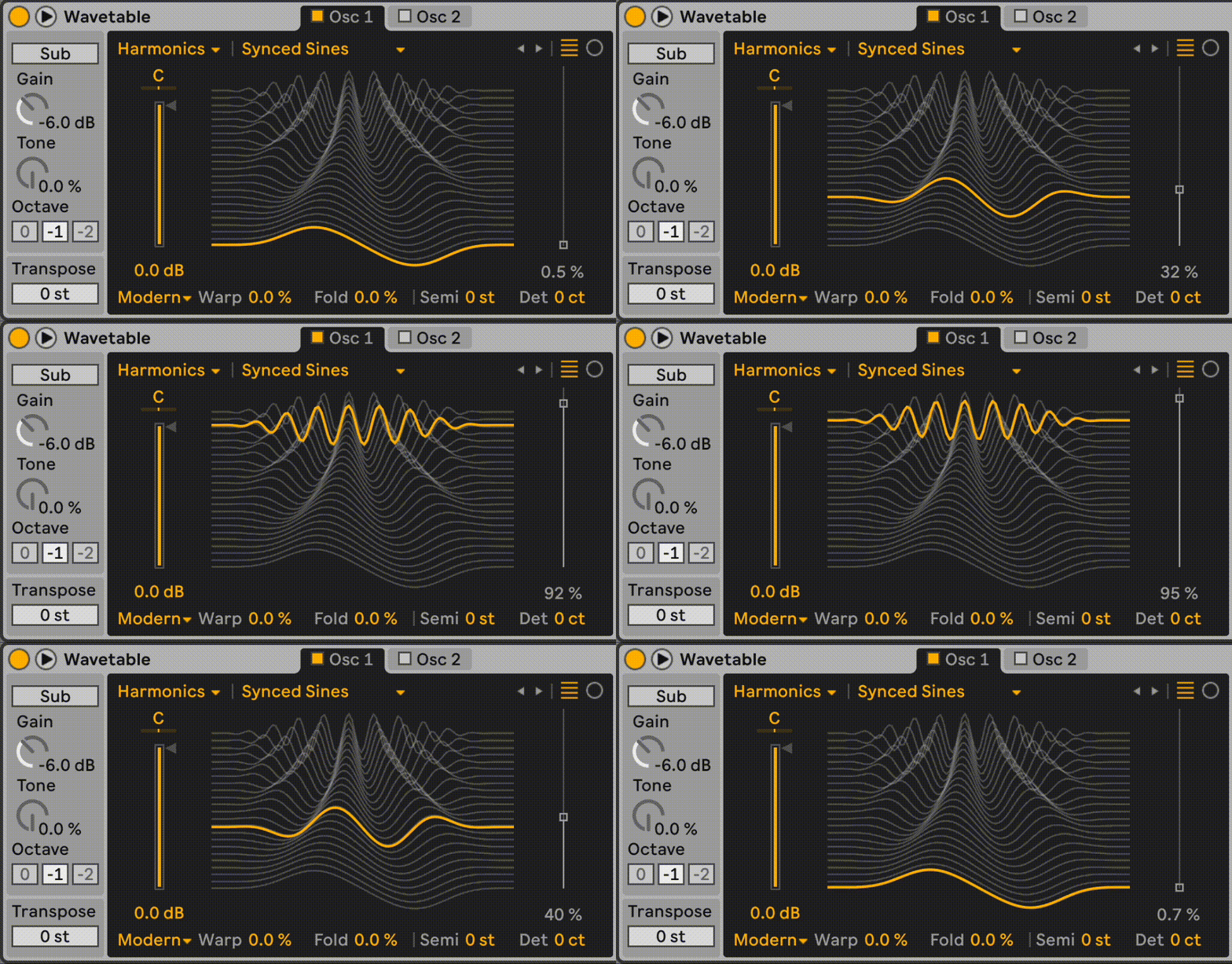
One component of my hobby web app project is a wavetable. Below are two examples of wavetables. I want it to not tax the browser so that other, latency sensitive, components do not suffer. Would you have any suggestions on what JS/TS package to use? I built a quick prototype in three.js but I am neither a 3D person nor a web dev, so I would appreciate your advice. Examples: - https://audiolabs-erlangen.de/media/pages…
1. Use global fixed 16bit 44.1kHz stereo, and raw uncompressed lossless codec (avoids gpu/hardware-codec and sound-card specific quirks)
2. Don't try to sync your audio to the gpu 24fps+ animations ( https://en.wikipedia.org/wiki/Globally_asynchronous_locally_... ). I'd just try to cheat your display by 10Hz polling a non-blocking fifo stream copy. ymmv
3. Try statically allocated fifo* buffers in wasm, and software mixers to a single output stream for local chunk playback ( https://en.wikipedia.org/wiki/Clock_domain_crossing )
* recall fixed rate producer/consumers should lock relative phase when the garbage collector decides to ruin your day, things like software FIR filters are also fine, and a single-thread output pre-mixed stream will eventually buffer though whatever abstraction the local users have setup (i.e. while the GC does its thing... playback sounds continuous.)
Inside a VM we are unfortunately at the mercy of the garbage collector, and any assumptions JIT compiled languages make. Yet wasm should be able to push io transfers fast enough for software mixers on modern cpus.
Best of luck =3
Re: Show HN: Spark, An advanced 3D Gaussian Splatting renderer for Three.js
#79Earlier quoted context omitted.
The food scans are just photos from a Pixel phone processed with postshot ( https://www.jawset.com/ ) to generate the splats
Out of interest, to what extent do splats recorded in this manner have reliable/measurable dimensions?
Probably an interesting use for a pretrained model to estimate scale based on common items seen in scenes (cars, doorframes, trees, etc…)
Re: Show HN: Spark, An advanced 3D Gaussian Splatting renderer for Three.js
#80Earlier quoted context omitted.
It does work in VR! We'll have a demo available soon.
Oh that's fantastic!
Make sure to enable hand tracking so you can "touch" the Gaussian splats :). (tap your wrists together to toggle spotlight hands mode)