Live data from Hacker News

Rust’s dependencies are starting to worry me

vincents.dev

201–210 of 593 posts

Re: Rust’s dependencies are starting to worry me

#201
post #10

> dotenv is unmaintained. How much maintenance could you possibly need to load secrets from .env into the environment.

after testing that that very small fixed functionality you provide is correct

non

small "completed" well tested libraries being flagged as security issues due to being unmaintained seem to be starting to become an issue

Re: Rust’s dependencies are starting to worry me

#202
post #85

IMO any system where taking a dependency is "easy" and there is no penalty for size or cost is going to eventually lead to a dependency problem. That's essentially where we are today both in language repositories for OSS languages and private monorepos. This is partly due to how we've distributed software over the last 40 years. In the 80s the idea of a library of functionality was something you paid for, and painsta…

As far as I'm aware, LTO completely solves this from a binary size perspective. It will optimise out anything unused. You can still get hit from a build time perspective though.

Everywhere in this thread is debating whether LTO "completely" solves this or not, but why does this even need LTO in the first place? Dead code elimination across translation units in C++ is traditionally accomplished by something like -ffunction-sections, as well as judiciously moving function implementations to the header file (inline).

Re: Rust’s dependencies are starting to worry me

#203
post #123

Earlier quoted context omitted.

I agree that relying on unknown dependencies is a risk, but this misses the point IMO. Number of dependencies and disk space are kind of arbitrary. > Meanwhile, the heaviest JavaScript parser implemented in JavaScript is more lightweight. The lightest weight javascript program relies on V8 to run, which has multiple orders of magnitude more dependencies. Most of which you have never heard of. At least cargo makes it…

Number of dependencies isn't exactly arbitrary... If you have one huge dep it's easier to keep track you're on the latest update, also it's much less likely you'll fat finger it and import something typosquatting. Also if you're in enterprise you'll have less 100 page SBOM reports.

What is more likely to be vulnerable, a 100k LoC project developed by ten people, or ten 10k LoC single maintainer projects.

Keeping track of the latest version is trivial with cargo.

Re: Rust’s dependencies are starting to worry me

#204
post #87

Earlier quoted context omitted.

That proposal is not exactly this; that seems to propose a "blessed crates" namespace which includes popular open-source libraries. I read this proposal as a Python-style batteries-included stdlib.

What the OP proposes is not exactly a bigger stdlib, because they mention it should have "relaxed stability guarantees". Or is python allowed to change their stdlib in backwards-incompatible ways?

Yeah, they do so regularly. Every version removes several old stdlib features (after the last version in which they were not deprecated goes EOL)

Re: Rust’s dependencies are starting to worry me

#205
post #166

Earlier quoted context omitted.

Wouldn't that mean they were poorly implemented. If no one uses something correctly, seems like that isn't a problem with the people but the thing.

I don't think so. Software is maybe the only "engineering" discipline where it is considered okay to use mainstream tools incorrectly and then blame the tools.

Do the “mainstream” tools change every five years in other disciplines?

Re: Rust’s dependencies are starting to worry me

#206
post #129

Earlier quoted context omitted.

Because most dependencies are either manually installed by the user, or are dynamic libraries that are provided and audited by the distro maintainers. The dependencies are there, they're just harder to see - https://wiki.alopex.li/LetsBeRealAboutDependencies

Sure, there are various dependencies, but it's nothing like "cargo install crate-name". Cargo makes it so effortless to joink the dumbest dependency for the simplest thing.

so what's the option??? I don't think this is only cargo-rust problem since you can do it too in another language

Re: Rust’s dependencies are starting to worry me

#207
post #33
post #10

> dotenv is unmaintained. How much maintenance could you possibly need to load secrets from .env into the environment.

On the other hand loading .env from the environment is critical (since you are usually passing secrets through .env). I wouldn't want to maintain that myself and not share it with a xxK other projects in case there is a vulnerability.

the issue is loading and setting env (which is the default for dot env libraries)

_is fundamentally unsound thanks to unix/posix_

no way around that

hence why set env wasn't marked as unsafe _even through it not being fully save being known since extremely early rust days maybe even 1.0_

it not being unsafe wasn't a oversight but a known to not be fully sound design decision which had been revisited and changed in recently

Re: Rust’s dependencies are starting to worry me

#208
Excuse me for not having much to add to the discussion but two interesting references for people to check out, if so inclined of course:

a) Ginger Bill (the Odin language creator, no affiliation) stated on a podcast that Odin will never have an official pkg manager, since what they're, in his opinion, mainly automating is dependency hell, and this being one of the main reasons for rising software complexity and lower software quality; see https://www.youtube.com/watch?v=fYUruq352yE&t=11m26s (timestamped to the correct position) (they mention Rust explicitly as an example)

b) another programmer rather seriously worried about software quality/complexity is Jonathan Blow, who's talk "Preventing the Collapse of Civilization" is worth watching in my opinion: https://www.youtube.com/watch?v=ZSRHeXYDLko (it's not talking about package managers specifically, but is on topic regarding software complexity/quality as a whole)

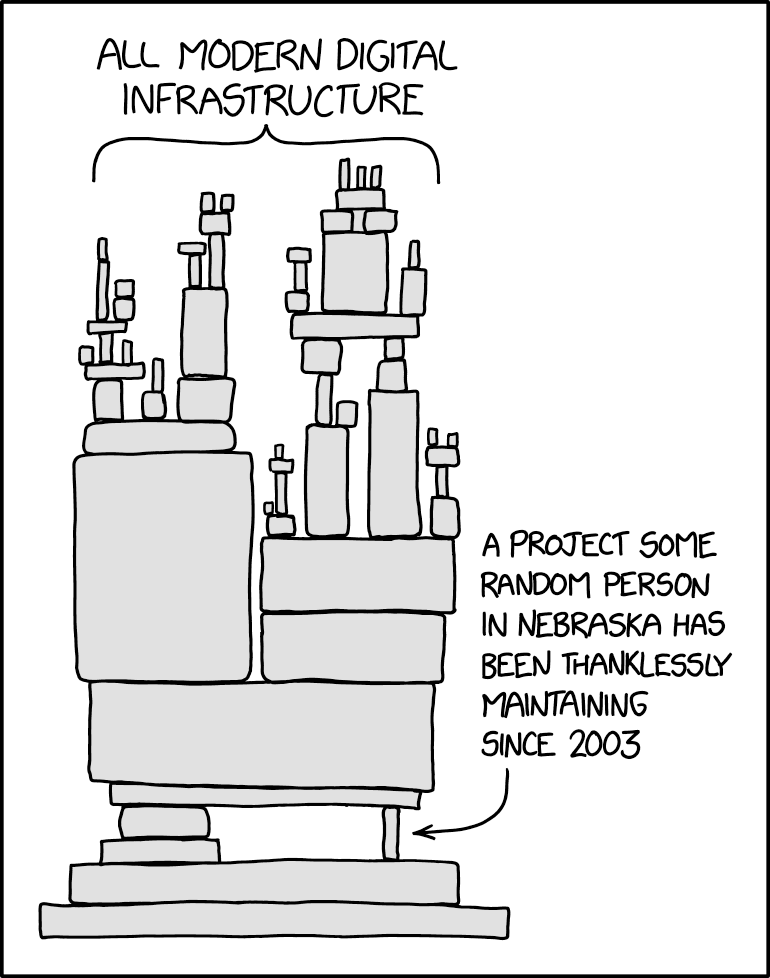
Addendum: And sorry, I feel like almost everyone knows this xkcd by now, but since no one so far seems to have posted it; "obligatory xkcd reference": https://imgs.xkcd.com/comics/dependency_2x.png
Re: Rust’s dependencies are starting to worry me

#209
post #129

Earlier quoted context omitted.

Because most dependencies are either manually installed by the user, or are dynamic libraries that are provided and audited by the distro maintainers. The dependencies are there, they're just harder to see - https://wiki.alopex.li/LetsBeRealAboutDependencies

Sure, there are various dependencies, but it's nothing like "cargo install crate-name". Cargo makes it so effortless to joink the dumbest dependency for the simplest thing.

On the other hand, C/C++ makes it attractive to reinvent the wheel, or vendor the dependency instead. Rather than a single well-tested implementation in the ecosystem for something like sha256, you end up with every application having its own slightly-different, mostly untested, and essentially unmaintained version.

Applications still need the functionality. The need doesn't magically disappear when installing dependencies is a pain. If a crate has a bug, the entire ecosystem can trivially get the fixed version. If the Stackoverflow snippet a C app is vendoring has a bug, that fix is never getting in the app.

Re: Rust’s dependencies are starting to worry me

#210

This is just a modern problem in all software development, regardless of language. We are doing more complex things, we have a much bigger library of existing code to draw from and there are many reasons to use it. Ultimately a dependency is untrusted code, and there's a long road to go in hardening entire systems to make running arbitrary dependencies safe (if its even possible). In the absence of a technical soluti…

Gilad Bracha has a really interesting approach to sandboxing third party libraries: Remove imports, and do everything with dependency injection. That way if you never inject say the IO subsystem, the third party code won't be able to break out. And there's no overhead, since it's all based on capabilities.

Even cooler, if you want to only expose read operations, you can wrap the IO library in another library that only exposes certain commands (or custom filtering, etc).

EDIT: I should say this doesn't work with systems programming, since there's always unsafe or UB code.

Post reply on HN