Earlier quoted context omitted.
Although what about from a human health perspective? Can humans survive in a gravity that weak for a long time? What about animals?
What's long? a year? twenty? And to answer that question and others is why we(humans) have bothered with Space Lab, Mir, IST. You can Google answer.
First full-resolution images of the Martian surface
101–110 of 150 posts
Re: First full-resolution images of the Martian surface
#102I absolutely love this stuff. The photos to me are strangely eerie, and even perhaps a little sinister. I have trouble comprehending the size of other planets, photos like these make me feel uneasy (in an exciting way) because they are strikingly similar to landscapes we might find here on earth - yet it's a completely different planet! I'm no longer looking at mars as a red circle as shown in textbooks, but now as v…
The Venera program is definitely one of the "unsung heroes" of planetary exploration. Perhaps the best resource for surface images of Venus (along with fascinating image reconstruction) is Don P. Mitchell's page: http://mentallandscape.com/C_CatalogVenus.htm Another fascinating tidbit: the Soviets also performed the first (and to date, only) deployment of a balloon probe on another planet: http://en.wikipedia.org/wik…
Re: First full-resolution images of the Martian surface
#103Earlier quoted context omitted.
It has only a 2 megapixel sensor, which is a shame. I am sure that it has something to do with radiation hardening and the other environmental factors. It would be good though if NASA did catch up with sensor technology. I suspect the 2MP sensor was approved years ago when it was state of the art.
Yup, this mission has been in the works for ~10 years so I would imagine that they chose the specific sensor at least 6-7 years ago. Also NASA is notoriously risk averse (for good reason). Apparently it is very common for them to rely on old but proven technology. Some of this has to do with risk aversion, but I imagine some of it also has to do with budget. It pains me to think what NASA could be doing with 10x more…
Re: First full-resolution images of the Martian surface
#104Earlier quoted context omitted.
>> The bandwidth from Curiosity directly to Earth is about 8 kb/s. Curiosity has a high bandwidth link to the Mars Odyssey Orbiter, a Mars satellite, which has a 256 kb/s link to Earth. The early pictures are from a low resolution camera with a clear dust cover still attached. This camera is used to determine if Curiosity is about to land in a crater. A higher resolution camera will be activated later. (taken from ht…
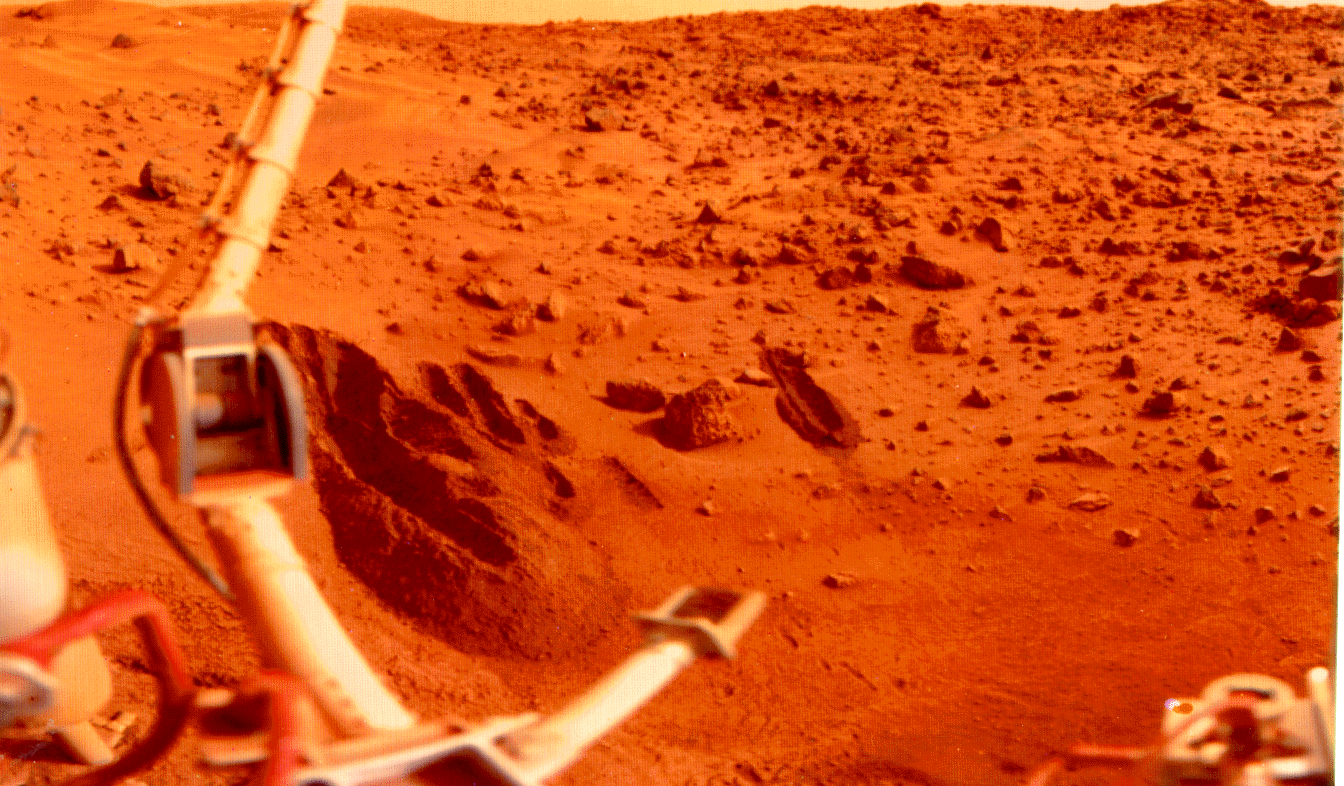
While yes, the original pictures from the low res camera look bad, the new raw pictures from the higher-resolution cameras aren't really that much better. Better than the images from the iPhone 1, probably. But better than Viking 1 images from 1976? Honestly, it doesn't look like it. http://upload.wikimedia.org/wikipedia/commons/1/1b/Mars_Viki... Just look at the detail per pixel. It's amazing. You can see tiny detai…
http://nssdc.gsfc.nasa.gov/imgcat/hires/vl1_11d128.gif
when Mr Van der Hoorn "used the original 11d128.blu, 11d128.grn and 11d128.red images from the NASA Viking image archive, converted them to .png, manually removed the noise and finally merged them into one image"
Details: http://en.wikipedia.org/wiki/User:Van_der_Hoorn/Viking/Filte...
The Viking 1 camera(s) were of the Vidicon type: http://en.wikipedia.org/wiki/File:Vidicon.png
Re: First full-resolution images of the Martian surface
#105Earlier quoted context omitted.
> That said, the Apollo missions took a not-very-modified Hasselblad camera with them that worked fine, which is why we have much higher resolution pictures of the moon, despite it being decades ago. That and the fact that they used sneakernet, which is still much higher bandwidth than wireless, especially in space.
Also, it was easier to do on a sound stage.
Re: First full-resolution images of the Martian surface
#106I absolutely love this stuff. The photos to me are strangely eerie, and even perhaps a little sinister. I have trouble comprehending the size of other planets, photos like these make me feel uneasy (in an exciting way) because they are strikingly similar to landscapes we might find here on earth - yet it's a completely different planet! I'm no longer looking at mars as a red circle as shown in textbooks, but now as v…
Re: First full-resolution images of the Martian surface
#107Earlier quoted context omitted.
While yes, the original pictures from the low res camera look bad, the new raw pictures from the higher-resolution cameras aren't really that much better. Better than the images from the iPhone 1, probably. But better than Viking 1 images from 1976? Honestly, it doesn't look like it. http://upload.wikimedia.org/wikipedia/commons/1/1b/Mars_Viki... Just look at the detail per pixel. It's amazing. You can see tiny detai…
That image was taken in 1977. Actually, this is how people saw it until 2009 http://nssdc.gsfc.nasa.gov/imgcat/hires/vl1_11d128.gif when Mr Van der Hoorn "used the original 11d128.blu, 11d128.grn and 11d128.red images from the NASA Viking image archive, converted them to .png, manually removed the noise and finally merged them into one image" Details: http://en.wikipedia.org/wiki/User:Van_der_Hoorn/Viking/Filte... Th…
I made an image to illustrate this: http://f.cl.ly/items/0k2w2d1C1O3w3e0t300f/NASAQualityDegreda...
Re: First full-resolution images of the Martian surface
#108I absolutely love this stuff. The photos to me are strangely eerie, and even perhaps a little sinister. I have trouble comprehending the size of other planets, photos like these make me feel uneasy (in an exciting way) because they are strikingly similar to landscapes we might find here on earth - yet it's a completely different planet! I'm no longer looking at mars as a red circle as shown in textbooks, but now as v…
If you do like video games, one that had such an intended effect on me was the first Mass Effect. There are a number of side missions where you descend onto planets in a multi-terrain vehicle and are supposed to check some things out (you can get out of the rover as well). Although for the most part the planets are barren (much like Mars), I found them incredibly effective at sending the scale message across. The most incredible one though, was a side mission on the Moon, with Earth right up above you. Though the scale wasn't 100% accurate, it still made for one of the most impressive moments in video games for me.
Re: First full-resolution images of the Martian surface
#109I absolutely love this stuff. The photos to me are strangely eerie, and even perhaps a little sinister. I have trouble comprehending the size of other planets, photos like these make me feel uneasy (in an exciting way) because they are strikingly similar to landscapes we might find here on earth - yet it's a completely different planet! I'm no longer looking at mars as a red circle as shown in textbooks, but now as v…
Personally I think Venus is the more interesting planet to be exploring
Re: First full-resolution images of the Martian surface
#110It's ridiculous to travel across the system and not being able to send good images.