Live data from Hacker News

First full-resolution images of the Martian surface

nasa.gov

91–100 of 150 posts

Re: First full-resolution images of the Martian surface

#91
post #13

i hate to be critical of an image sent from millions of miles away but I have an honest question: Why do images from landers like this always look like there were taken from a iPhone 1's camera?

>> The bandwidth from Curiosity directly to Earth is about 8 kb/s. Curiosity has a high bandwidth link to the Mars Odyssey Orbiter, a Mars satellite, which has a 256 kb/s link to Earth. The early pictures are from a low resolution camera with a clear dust cover still attached. This camera is used to determine if Curiosity is about to land in a crater. A higher resolution camera will be activated later. (taken from ht…

While yes, the original pictures from the low res camera look bad, the new raw pictures from the higher-resolution cameras aren't really that much better. Better than the images from the iPhone 1, probably. But better than Viking 1 images from 1976? Honestly, it doesn't look like it.

http://upload.wikimedia.org/wikipedia/commons/1/1b/Mars_Viki...
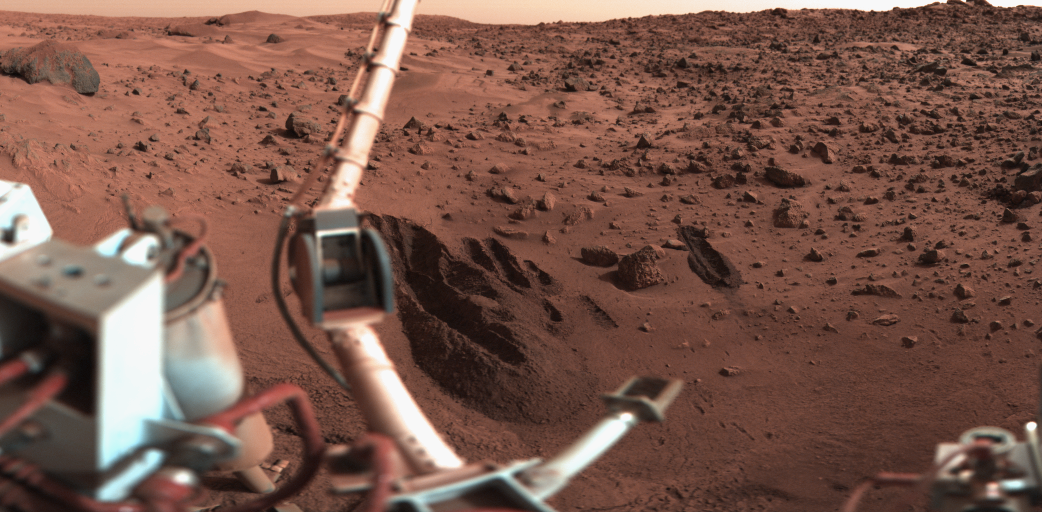
Just look at the detail per pixel. It's amazing. You can see tiny details in the sand. It's looks like if you took an image on a 20 megapixel DSLR with a high-quality lens, then scaled the image down to web size. The resolution isn't higher than a camera-phone, but the detail is remarkably better. And that's from nearly 40 years ago.

Re: First full-resolution images of the Martian surface

#92

Earlier quoted context omitted.

Are there any examples of a picture taken on Earth with the main camera?

Here's a full-resolution picture taken by the descent imager as the heat shield fell away: http://www.nasa.gov/mission_pages/msl/multimedia/pia16021.ht... The descent imager uses the same sensor as the main mast cameras, but with different optics.

If that camera works for 10+ years, I'll take that resolution any day! Beautiful!

If you want to blow up a giant printout wait for the stitched-together shots, I suppose.

Re: First full-resolution images of the Martian surface

#93
post #26
post #20

Earlier quoted context omitted.

I might well be wrong, but I assumed that white spot was just the sun reflecting off of that part of the rover.

I had to actually stop and think "hang on, does 'sun' mean THE sun, or....". It's cool thinking about a little robot on mars cruising around doing stuff for us, still showing reflections from THE sun.

Worth noting that this particular "little robot", unlike the previous set, is about the size of a car. That's why they could fit more equipment on it. :D

Re: First full-resolution images of the Martian surface

#94

Random question: Is it silent on Mars? I'm looking at this picture and can't help but wonder what it sounds like. Just curious if Martian weather tends to be windy or calm.

There are winds. The wind is what would clear dust off the solar panels of the other rovers. I think that is what allowed them to run so long - the winds were stronger than expected, and cleaned off the solar panels better than expected, so more power was available. If I'm not mistaken, the engineers originally expected the solar panels to get covered by dust in a matter of months, at which point the rovers would stop working.

Re: First full-resolution images of the Martian surface

#95
post #5

i hate to be critical of an image sent from millions of miles away but I have an honest question: Why do images from landers like this always look like there were taken from a iPhone 1's camera?

It has only a 2 megapixel sensor, which is a shame. I am sure that it has something to do with radiation hardening and the other environmental factors. It would be good though if NASA did catch up with sensor technology. I suspect the 2MP sensor was approved years ago when it was state of the art.

More megapixels isn't necessarily better. The sensor was probably chosen for a specific reason, one reason may be that the sensor was matched to the optics (lenses) they decided to use...

Re: First full-resolution images of the Martian surface

#96
post #48

I thought it was interesting to learn about the different ways we get data back from mars. Excerpt from [1]: The data rate direct-to-Earth varies from about 500 bits per second to 32,000 bits per second (roughly half as fast as a standard home modem). The data rate to the Mars Reconnaissance Orbiter is selected automatically and continuously during communications and can be as high as 2 million bits per second. The d…

Some one has a link with more technical data about the communication stack? algorithms, modulation, etc.

Re: First full-resolution images of the Martian surface

#97
post #17

Earlier quoted context omitted.

Yup, this mission has been in the works for ~10 years so I would imagine that they chose the specific sensor at least 6-7 years ago. Also NASA is notoriously risk averse (for good reason). Apparently it is very common for them to rely on old but proven technology. Some of this has to do with risk aversion, but I imagine some of it also has to do with budget. It pains me to think what NASA could be doing with 10x more…

>It pains me to think what NASA could be doing with 10x more money. Me too, but pretty much it all ends going to Lockheed anyway whether it comes via the DoD or Nasa. I don't mean that conspiratorially either, even JPL people joke that JPL stands for "Just Procure Lockheed". The subcontractors rarely get mentioned in Nasa PR, but Nasa is really a whole bunch of different project offices spread over a few campuses wit…

Which would explain the >10x success SpaceX seems to be having (shooting for something less ambitious than Curiosity so far, but I wouldn't be at all surprised if they put a man on Mars in 12 years for less than 10% the cost of a NASA mission.)

Re: First full-resolution images of the Martian surface

#98

Earlier quoted context omitted.

My thoughts exactly - Venus seems like a better place to start interplanetary exploration with - as I understand, if you could cool it down to an acceptable temperature, you could walk on the surface with just a breathing apparatus, right?

> as I understand, if you could cool it down to an > acceptable temperature, you could walk on the surface > with just a breathing apparatus, right? Sadly, probably not. Cooling it down is already a very tall order, and even then, you would need to find a way to remove most of the atmosphere in order to reduce the pressure (~90 atm at the surface). Mars is a much better bet for human habitation in the short term. Che…

I always kind of thought that Venus would be a neat place to preform "grey goo" experiments. Lots of matter and energy, and really the only thing you are going to do is make it a nicer place. Worse case is that it remains Venus.

Re: First full-resolution images of the Martian surface

#99

Earlier quoted context omitted.

> as I understand, if you could cool it down to an > acceptable temperature, you could walk on the surface > with just a breathing apparatus, right? Sadly, probably not. Cooling it down is already a very tall order, and even then, you would need to find a way to remove most of the atmosphere in order to reduce the pressure (~90 atm at the surface). Mars is a much better bet for human habitation in the short term. Che…

Although what about from a human health perspective? Can humans survive in a gravity that weak for a long time? What about animals?

What's long? a year? twenty?

And to answer that question and others is why we(humans) have bothered with Space Lab, Mir, IST. You can Google answer.

Re: First full-resolution images of the Martian surface

#100

Random question: Is it silent on Mars? I'm looking at this picture and can't help but wonder what it sounds like. Just curious if Martian weather tends to be windy or calm.

They didn't pack a microphone! Bastards! :P Considering the propensity for dust storms I'm going to say windy. But the atmosphere is thinner, so this makes it harder to hear? Or quieter?

There was a microphone sent to Mars once, but it was on a lander that crashed. http://en.wikipedia.org/wiki/Mars_polar_lander#Scientific_in...

Edit: Correction, twice, one was also sent on Phoenix but due to a design defect it was not used: http://en.wikipedia.org/wiki/Phoenix_(spacecraft)#Mars_Desce...

Post reply on HN