Earlier quoted context omitted.
One question we should ask ourselves is why a field would be dominated by men and not evenly split, or mostly women, etc. Does one feel as if they would face an uphill battle trying to get hired in a field that is 80% their other?
Because men and women have different interests. Even if you think that socialization is the cause, the law mandates that all applicants are treated equally with respect to gender. If gender discrimination is carried out in pursuit of a 50/50 gender split, that does not make it legal. > Does one feel as if they would face an uphill battle trying to get hired in a field that is 80% their other? What people feel is hard…
A good illustration of this concept is the "equality vs. equity" cartoon, with people of different heights trying to look over a fence. https://interactioninstitute.org/wp-content/uploads/2016/01/...
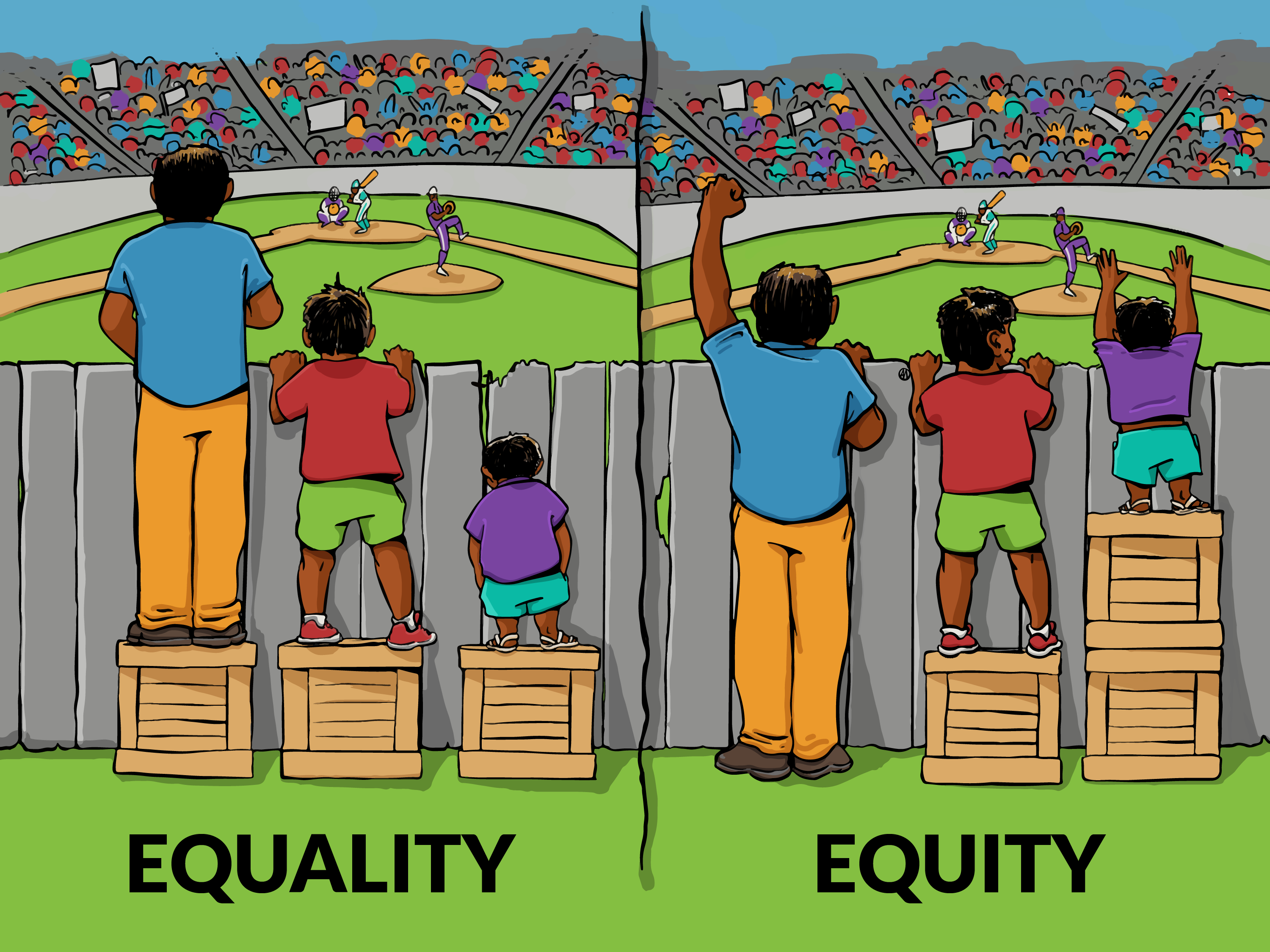
I understand why a lot of folks, especially technically-minded folks, bias for equality of opportunity exclusively. This is essentially what a meritocracy is. There's lots of good things about equality of opportunity and meritocracies, but they also have problems, and one of those problems is that, generalizing, they both tend to reflect and reinforce pre-existing biases, and in particular implicit biases. This is exactly the kind of problem that DEI initiatives are trying to address.
I don't really want to litigate the pros and cons of these two concepts, I just want to point out that they both exist, and that initiatives like DEI can have as goals improving one or the other or both.
It's fine if you say, when doing hiring, you're only interested in equality of opportunity. That's probably the position that most people who are anti-DEI would take. But I think it's also fine if you say, when doing hiring, you're interested in both equality of opportunity and outcome. Both are valid.