Live data from Hacker News

Mark Zuckerberg blamed Sheryl Sandberg for Meta 'inclusivity' push: report

msn.com

51–60 of 98 posts

Re: Mark Zuckerberg blamed Sheryl Sandberg for Meta 'inclusivity' push: report

#51

Earlier quoted context omitted.

One question we should ask ourselves is why a field would be dominated by men and not evenly split, or mostly women, etc. Does one feel as if they would face an uphill battle trying to get hired in a field that is 80% their other?

Because men and women have different interests. Even if you think that socialization is the cause, the law mandates that all applicants are treated equally with respect to gender. If gender discrimination is carried out in pursuit of a 50/50 gender split, that does not make it legal. > Does one feel as if they would face an uphill battle trying to get hired in a field that is 80% their other? What people feel is hard…

The point of all of this stuff is to find a balance between evaluating applicants independently and objectively according to a well-defined set of critera -- equality of opportunity -- and producing an end result that is representational and fair in the societal sense -- equality of outcome.

A good illustration of this concept is the "equality vs. equity" cartoon, with people of different heights trying to look over a fence. https://interactioninstitute.org/wp-content/uploads/2016/01/...
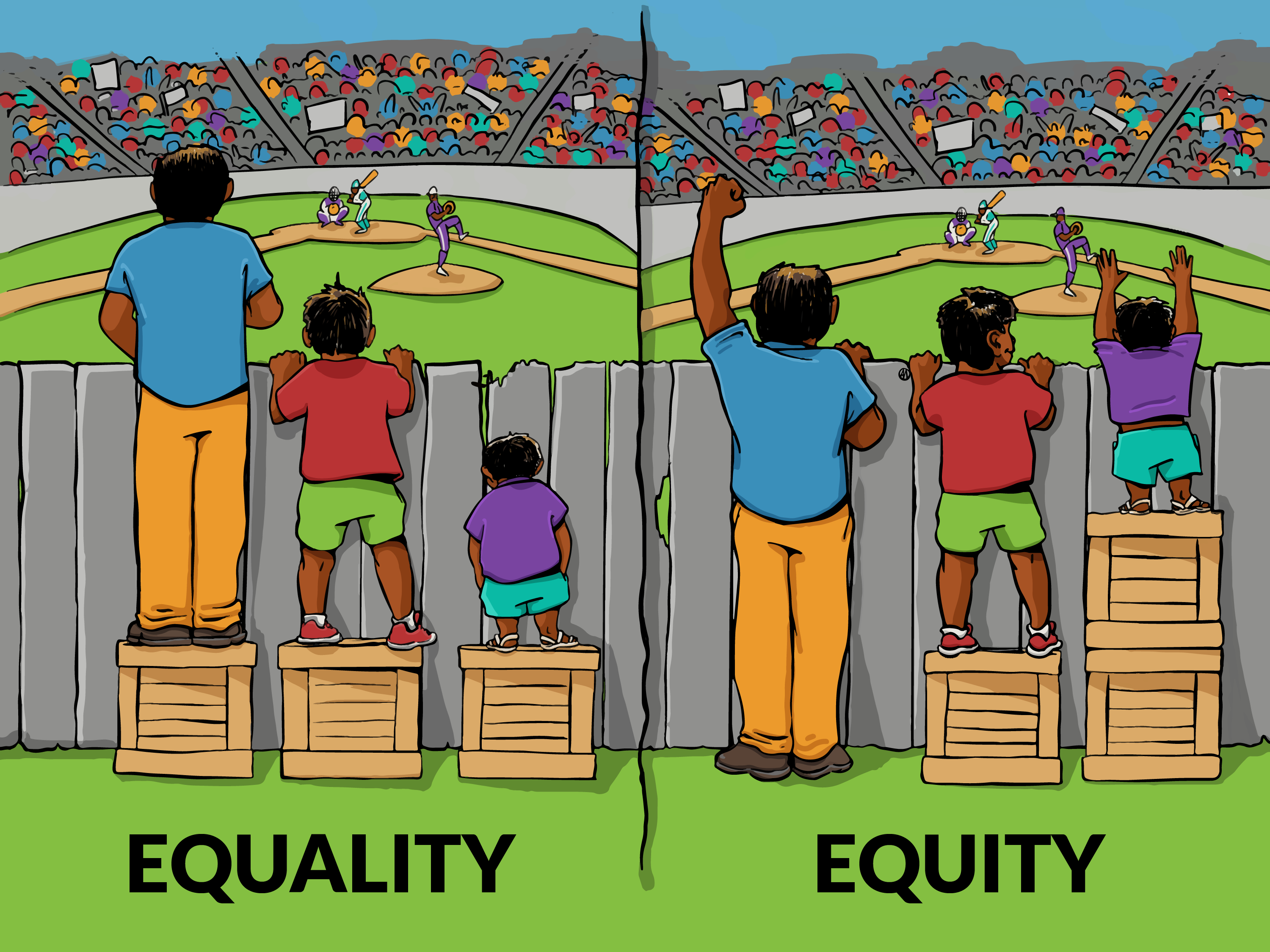
I understand why a lot of folks, especially technically-minded folks, bias for equality of opportunity exclusively. This is essentially what a meritocracy is. There's lots of good things about equality of opportunity and meritocracies, but they also have problems, and one of those problems is that, generalizing, they both tend to reflect and reinforce pre-existing biases, and in particular implicit biases. This is exactly the kind of problem that DEI initiatives are trying to address.

I don't really want to litigate the pros and cons of these two concepts, I just want to point out that they both exist, and that initiatives like DEI can have as goals improving one or the other or both.

It's fine if you say, when doing hiring, you're only interested in equality of opportunity. That's probably the position that most people who are anti-DEI would take. But I think it's also fine if you say, when doing hiring, you're interested in both equality of opportunity and outcome. Both are valid.

Re: Mark Zuckerberg blamed Sheryl Sandberg for Meta 'inclusivity' push: report

#52

Earlier quoted context omitted.

One question we should ask ourselves is why a field would be dominated by men and not evenly split, or mostly women, etc. Does one feel as if they would face an uphill battle trying to get hired in a field that is 80% their other?

This question only ever seems to be asked about "desirable" fields. There doesn't seem to be as much of a push to achieve gender parity in sanitation work[1], for example. The whole exercise feels like an effort to take attention off of the problem of income inequality by instead framing it as an issue of identity. Under this framing, "fair" means we have parity in male and female CEOs - never mind that those CEOs ar…

On Hacker news I see this question mostly asked about desirable fields. In education, there is a huge push to recruit more men. I can't speak for sanitation specifically, but I have seen efforts to get more women into stable, well paying blue collar professions.

Re: Mark Zuckerberg blamed Sheryl Sandberg for Meta 'inclusivity' push: report

#53
post #51

Earlier quoted context omitted.

Because men and women have different interests. Even if you think that socialization is the cause, the law mandates that all applicants are treated equally with respect to gender. If gender discrimination is carried out in pursuit of a 50/50 gender split, that does not make it legal. > Does one feel as if they would face an uphill battle trying to get hired in a field that is 80% their other? What people feel is hard…

The point of all of this stuff is to find a balance between evaluating applicants independently and objectively according to a well-defined set of critera -- equality of opportunity -- and producing an end result that is representational and fair in the societal sense -- equality of outcome. A good illustration of this concept is the "equality vs. equity" cartoon, with people of different heights trying to look over…

[deleted]

Re: Mark Zuckerberg blamed Sheryl Sandberg for Meta 'inclusivity' push: report

#54

Earlier quoted context omitted.

One question we should ask ourselves is why a field would be dominated by men and not evenly split, or mostly women, etc. Does one feel as if they would face an uphill battle trying to get hired in a field that is 80% their other?

This question only ever seems to be asked about "desirable" fields. There doesn't seem to be as much of a push to achieve gender parity in sanitation work[1], for example. The whole exercise feels like an effort to take attention off of the problem of income inequality by instead framing it as an issue of identity. Under this framing, "fair" means we have parity in male and female CEOs - never mind that those CEOs ar…

Rather than "desirable" I would maybe say something like "economically dominant". If the highest-paying and most-powerful careers in a society don't at least somewhat meaningfully reflect the demographics of that society, then, well, what does that demonstrate, and is that something we want to try to fix? Hopefully you can at least see the position where the answer to that last question is yes, even if you don't agree with it.

Re: Mark Zuckerberg blamed Sheryl Sandberg for Meta 'inclusivity' push: report

#55
post #51

Earlier quoted context omitted.

Because men and women have different interests. Even if you think that socialization is the cause, the law mandates that all applicants are treated equally with respect to gender. If gender discrimination is carried out in pursuit of a 50/50 gender split, that does not make it legal. > Does one feel as if they would face an uphill battle trying to get hired in a field that is 80% their other? What people feel is hard…

The point of all of this stuff is to find a balance between evaluating applicants independently and objectively according to a well-defined set of critera -- equality of opportunity -- and producing an end result that is representational and fair in the societal sense -- equality of outcome. A good illustration of this concept is the "equality vs. equity" cartoon, with people of different heights trying to look over…

Using protected class as a factor in employment is prohibited nation-wide under Title VII of the Civil Rights Act of 1964. There is no "balance" between equality of opportunity and equality of outcome. The former is required by law. Using protected class as a factor in hiring doesn't become legal just because it's done in pursuit of equality of outcome. They are not both valid concepts, at least not unless you're willing to violate people's civil rights. One is what employers are legally required to do. The other is illegal discrimination.

Also, think through the implications of this photo in the context of hiring: https://interactioninstitute.org/wp-content/uploads/2016/01/...

What's really the difference between having a group of candidates standing on a box, and lowering the bar for those candidates? At the end of the day, whether it's standing on a box or lowering the bar the end result is the same: some candidates are considered to have met expectations despite not reaching the same heights as others.

I highly encourage you to think through whether this is a good metaphor to use to justify DEI in a workplace setting.

Re: Mark Zuckerberg blamed Sheryl Sandberg for Meta 'inclusivity' push: report

#56

Earlier quoted context omitted.

Women didn't become the majority of pediatricians until the 2000s, so up until quite recently yes we did expect pediatricians to be 50% or more men. I get why the majority of jobs that require a lot of upper body strength (lumberjacks as you mentioned) would continue to be majority male, but in other jobs to me it seems like it's mainly networks and socialization that causes gender imbalances. There's no reason more…

I'd be more than happy to have an anonymized hiring process. If you're right that in-group preference is what drives the gender disparity, we should expect an anonymized hiring process to produce an employee base that's closer to gender parity. Some companies have experimented with this [1]. But interesting no tech DEI advocate I've met in real life has been supportive of anonymized hiring. More than a few have activ…

Of course, because the problem that's trying to be solved is that the tech industry has default, implicit biases in its hiring processes, which tend to favor the majority. Anonymization acts as a force multiplier for those defaults/biases.

Re: Mark Zuckerberg blamed Sheryl Sandberg for Meta 'inclusivity' push: report

#57
post #21

People for some reason have an inability to separate the goals of DEI/EDI from the practice. It's possible that the goals are important and correct, but the implementation sucks. I am of this belief for many DEI programs I've seen. But I'm still pro-DEI. It just gets implemented often too simplistically and naively, enabling the creation of more controversy and also likely many poor outcomes in organizations. As for…

The goals of most DEI programs can't be achieved without discrimination on the basis of protected class. If software developers are 18% women how can a company achieve 40% women software developers without discrimination? And that was a DEI goal a previous employer used. In fact they had the same goal for electrical engineer too despite being 10% women. Ambiguous goals like "make people feel welcome" doesn't require…

You say that 3/4 of companies you are familiar with used discrimination to achieve numeric thresholds of 40% women software developers. I can't name a single medium or large tech company that is 40% women software developers. Can you?

Re: Mark Zuckerberg blamed Sheryl Sandberg for Meta 'inclusivity' push: report

#58
post #56

Earlier quoted context omitted.

I'd be more than happy to have an anonymized hiring process. If you're right that in-group preference is what drives the gender disparity, we should expect an anonymized hiring process to produce an employee base that's closer to gender parity. Some companies have experimented with this [1]. But interesting no tech DEI advocate I've met in real life has been supportive of anonymized hiring. More than a few have activ…

Of course, because the problem that's trying to be solved is that the tech industry has default, implicit biases in its hiring processes, which tend to favor the majority. Anonymization acts as a force multiplier for those defaults/biases.

I don't understand. If gender discrimination is the cause of the disparity, anonymization should eliminate the disparity. Under an anonymous hiring process, you can't know the gender of the applicants and so you can't discriminate on the basis of gender.

If coding interviews were done with cameras off, and voice masked so gender can't be known, how would that be more subject to bias than with the camera on and the gender known to the interviewer?

When orchestras put a veil between the auditioner and the evaluators, that made the process more biased? That's new to me.

Re: Mark Zuckerberg blamed Sheryl Sandberg for Meta 'inclusivity' push: report

#59

Earlier quoted context omitted.

More than once it has happened where some NYT article will discuss some private meeting at the White House and attribute it to someone like, "According to a credible source at that meeting, blah blah". Later it is confirmed that that well placed source was the President, or the secretary of state, etc. Credible news organizations don't just repeat whatever some random guy claims to have heard.

The NYTimes has a history of fabricating and outright lying to serve their own corporate or affiliated agendas. See for eg: https://www.amazon.com/Gray-Lady-Winked-Misreporting-Fabrica...

The New York Times is probably the most trusted, and trustable, publication in all of journalism.

Re: Mark Zuckerberg blamed Sheryl Sandberg for Meta 'inclusivity' push: report

#60

Earlier quoted context omitted.

So it is two articles that both ultimately source from NYT? They are not commonly flat out incorrect, and when they are tend to correct the record. So I would say your statement is hyperbole and wrong. NYT sources are likely quite a bit more trustworthy than eight year olds whispering to each other for fun.

The NYTimes has a history of fabricating and outright lying to serve their own corporate or affiliated agendas. See for eg: https://www.amazon.com/Gray-Lady-Winked-Misreporting-Fabrica...

The New York Times is probably the most trusted, and trustable, publication in all of journalism.
Post reply on HN