A bit of a tangent, but I've been shopping around for the best code based CAD software. I gave cad query a shot and had a few issues. Any recommendations? My use case is 3D printing.
replicad
41–50 of 57 posts
A bit of a tangent, but I've been shopping around for the best code based CAD software. I gave cad query a shot and had a few issues. Any recommendations? My use case is 3D printing.
Earlier quoted context omitted.
I've been using Studio as my primary way of generating models for 3D printing for years now, no OpenSCAD involved. Write some scheme, get an STL. I do wish Matt would cool it with his constant brilliant endeavors and go back and give Studio some love though. At this point I can't get it to build and can only launch an old version I compiled years ago that breaks if I'm not in some specific working directory in my Dow…
Does anyone know if Zoo/KittyCad uses the similar principles under the hood? https://zoo.dev/geometry-engine
A bit of a tangent, but I've been shopping around for the best code based CAD software. I gave cad query a shot and had a few issues. Any recommendations? My use case is 3D printing.
https://youtu.be/0wn7vUmWQgg?si=9Rc1tvbiQgQDgQzd&t=2766
I'm also developing one in Rust but I wouldn't say it's ready yet.
Sorry, tangential but is that rust in the web editor? Do you have a wasm compiler or something? It seems super fast! I was looking for a live-coding editor (or live preview? hot reloading with visualizer?) for doing creative coding with something like Nannou and after a bunch of searching I came up dry.
> is that rust in the web editor? From the post: > Fidget includes bindings for Rhai, an embedded scripting language for Rust https://rhai.rs/
Hi, this is my project :) I particularly love this corner of CS because there's something for everyone – data structures and algorithms, low-level performance work, compilers, rendering / computer graphics, UI/UX for design tools, GPGPU programming, and more! I'll be answering questions in the threads as I see them, but feel free to connect on social media ( https://mattkeeter.com/links/ ) or follow my blog's RSS fee…
Cheers
Here is a thought experiment. What if 3D printers support implicit representation natively. Resin printers are basically physical marching cube machines. FSM would need an algorithm for following contours but should be doable.
https://cdfam.com/3mf-consortium-volumetric-and-implicit-ext...
Hi, this is my project :) I particularly love this corner of CS because there's something for everyone – data structures and algorithms, low-level performance work, compilers, rendering / computer graphics, UI/UX for design tools, GPGPU programming, and more! I'll be answering questions in the threads as I see them, but feel free to connect on social media ( https://mattkeeter.com/links/ ) or follow my blog's RSS fee…
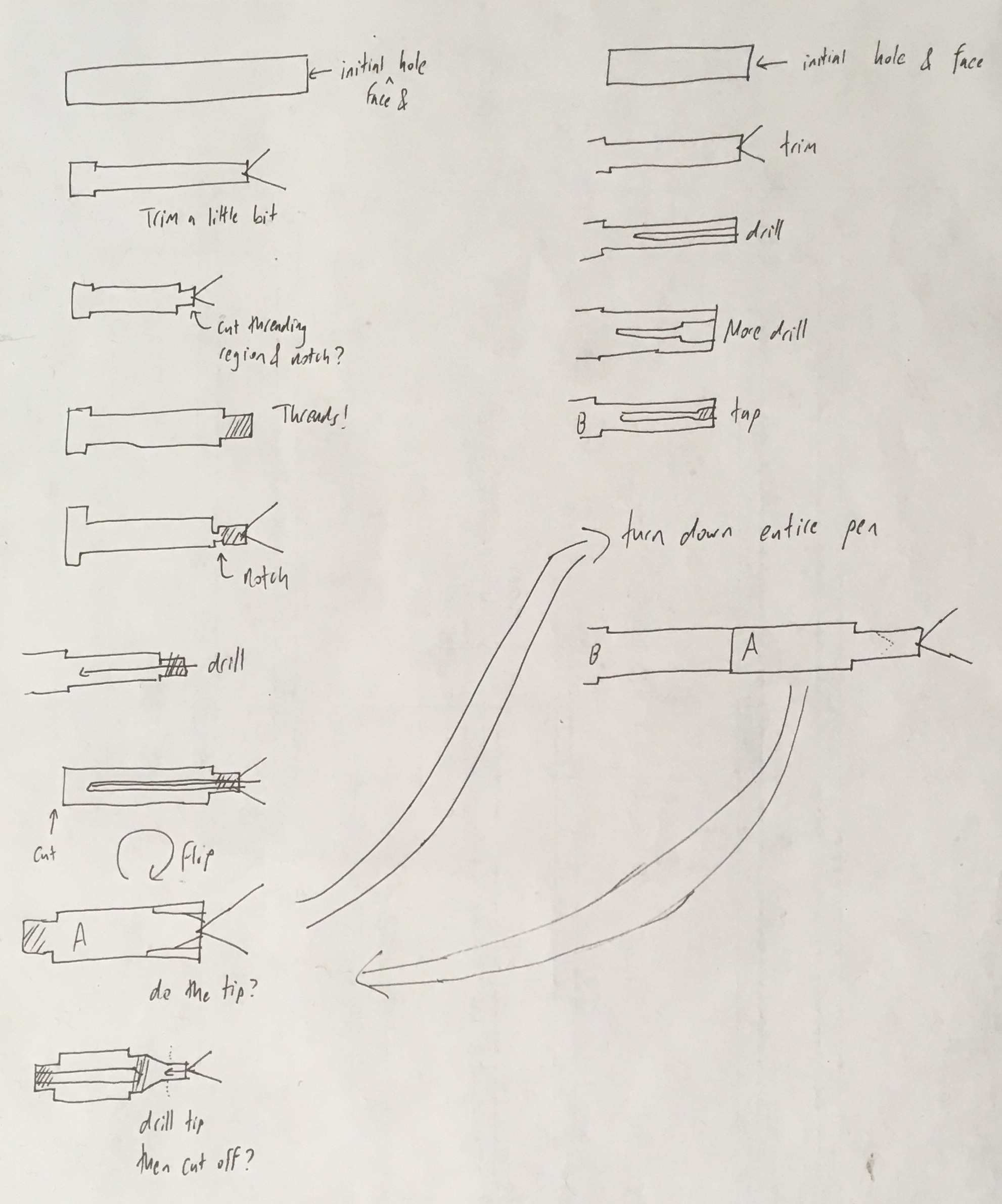
Tangentially, while browsing through your blog I found this: https://www.mattkeeter.com/projects/machined-pen/the_plan.jp...
This illustrates beautifully an idea that's been rattling around in my head for a while: what if the process you went through to design this manufacturing plan was the user facing cad api? When I approach a "making" problem--whether it's carpentry, plumbing, metal fabrication, machining--I naturally think about it in much the same way you did here. What raw materials am I starting with? What tools do I have? What sequence of operations do I need to perform to achieve the desired end result? The "cad api" (literally an api in the case of code cad tools or the visual representation thereof in traditional mouse driven interfaces) does not work this way, and forces me to think about how to represent the finished shape not about how I'll actually make it. All I care about in the end is making a thing, the modeling is just a tool to assist in that process but it makes itself way too visible.
Naively it seems like there would be so many benefits to having a more "reality based" modeling workflow. As someone who clearly has a lot more experience in the cad space than I do, do you think this concept could go anywhere or is it a dead end?
EDIT: also, a bit of feedback on the pen: you can maintain concentricity if you do something like this:
1. grab the bar stock in a 3 jaw chuck and turn it to a dimension suitable for a collet
2. cut off three blanks from the dimensioned rod, one for your cap and two for the body
3. do the rest of the work using a collet for work holding
The tradeoff is you'll waste a bit this way if you want a different final dimension than you have for your collet.
> libfive is 40K lines of mostly C++, and is extremely challenging to hack on, even as the original author. It's also frustrating to touch: if it's been a few months since I last compiled it, it's inevitable that the build will have broken, and I'll have to mess with CMake for 10 minutes to unbreak it. I'm a bit shocked at this. Is build breakage that much of an issue? Is this "we are merging in patches and then fixi…
This wouldn't be an issue if I locked my computer in a safe, but the rest of the system is changing underneath me: I may have a new laptop, a new CMake version, a new Qt install location, etc. Having everything managed through Cargo does a great job of isolating me from those kind of changes.
Here is a thought experiment. What if 3D printers support implicit representation natively. Resin printers are basically physical marching cube machines. FSM would need an algorithm for following contours but should be doable.
Earlier quoted context omitted.
Does anyone know if Zoo/KittyCad uses the similar principles under the hood? https://zoo.dev/geometry-engine
uses brep