Live data from Hacker News

How CD pregaps gained their hidden track superpowers

tedium.co

51–60 of 138 posts

Re: How CD pregaps gained their hidden track superpowers

#51
post #41

Earlier quoted context omitted.

You don't need a microscopic image of a disc to do that; a two-dimensional photograph is of essentially no advantage here. All you need is the unmolested data from that disc. The data is arranged on a singular spiral groove starting from the center and slowly winding its way towards the outside. The data is completely linear: It begins at the beginning, and continues to the very end without interruption. This is all…

The "unmolested data" would still have undergone error correction though, wouldn't it? I don't think a bin/cue rip would contain the redundant stuff, which GP seems interested in, nor the subcodes (of which some are represented in the cue file, while the bin file is PCM audio). And at the risk of taking us well beyond the rainbow books, I'll just leave this here: https://www.psxdev.net/forum/viewtopic.php?f=70&t=1266

There is a layer betwixt the optical reflection and the audio output that exists only as raw signals, before any molestation/error correction occurs.

There cannot not be this layer.

(And with a sufficiently-old-school CD player, it is probably not even challenging to get to it. The less-integrated the parts are, the better.)
Re: How CD pregaps gained their hidden track superpowers

#52
post #33
post #32

Earlier quoted context omitted.

It's abusing the standard, which can break compliant implementations. Especially bad since most Audio CD players are opaque hardware without update-able firmware.

Has this been shown to be actually-problematic in the three decades since Willy Nelson's album contained a song in the pregap of track 1?

Yes, there's been a serious issue recently reported. Apparently, it has triggered bureaucrats on the internet who can't acknowledge something innocuous that's never caused any problem for decades.

Re: How CD pregaps gained their hidden track superpowers

#53
post #43

Earlier quoted context omitted.

> At least until their perpetually cruddy remotes eventually failed. For me, Sony remotes were made of the same stuff as early Nokia phones - indestructible! Surprised to hear someone thought they were cruddy.

They were physically robust but the carbon button contacts always became dodgy for me. I tried to avoid Sony products for this reason because I encountered it so often in other people's gear. I have a remote from the late 00's that saw virtually zero use and it conked out with age alone.

Japanese called it Sony Timer...some call it urban legend but this seems like yet another independently verified data point

Re: How CD pregaps gained their hidden track superpowers

#54
post #25

This specification anomaly sounds like the polycarbonate equivalent of vinyl's multiple-groove capability. [0] I'd first heard of this for a Monty Python record (wikipedia notes this is in fact the most famous use case) but checked to see if people went for >2 grooves, and seemingly they did. I expect the casting for the pressing was horrendously expensive, which is why it didn't happen an awful lot. I suppose both m…

This is supremely cool, thanks for sharing. I'm probably missing something obvious but why would the casting be any more expensive than any other pressing?

Re: How CD pregaps gained their hidden track superpowers

#55
post #6

Earlier quoted context omitted.

As the article says its like an easter egg, putting a hidden song before the first track of a CD. If the song wasn't in the pregap it wouldn't be hidden. It's just for fun. (Sometimes songs can also be hidden in tracks at the end of the CD like 99, but that feels less mysterious.)

Sometimes CDs would have a long piece of silence at the end of the last song and then another song on the same track. Other CDs really experimented with the shuffle feature. They Might Be Giants’ Apollo 18 had a bunch of very short tracks that would usually play between songs when shuffle was used.

I remember getting surprised by one of those. I was at a friend's house and forgot to turn off the CD at the end.

It was funny at first, but when every other CD I bought had one, it became tacky.

Re: How CD pregaps gained their hidden track superpowers

#57
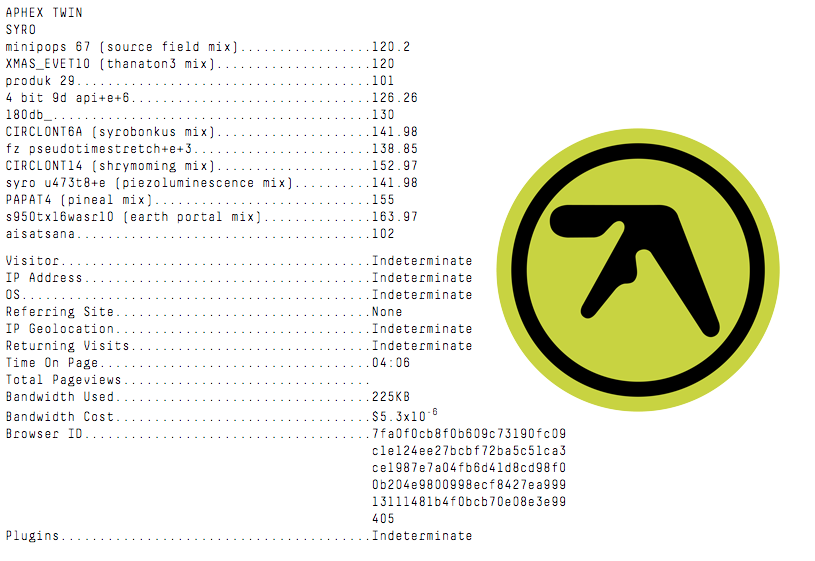
I was responsible for some of the first digital content ingestion for the world's record labels back in the late 90s, which was all based around trucks filled with retail CDs being fed into CD-ROM drives and an army of young folks grinding hundreds of track names into a database. (what happens when a truck full of East Asian CDs turns up? what about all those albums by Aphex Twin and Sigur Ros with untypeable names? https://www.treblezine.com/wp-content/uploads/2014/08/aphex-... )

I love these hidden tracks to death, especially the two hidden pregap tracks on Ash's first album, but they caused me unending pain and suffering.

Not only are they an absolute nightmare to rip, often with more than one song per track (so the WAVs have to be edited), the names of the songs are often totally unknown, even to the record labels. What do you even number the things in the metadata?

Added to that, you nearly always didn't even know they were there, so the negative numbered tracks would fail to get ripped and all the other ones in between or at the end would get ripped in weird ways and confuse all the data folk.

https://www.discogs.com/release/984235-Ash-1977

"Help, computer."

Re: How CD pregaps gained their hidden track superpowers

#58
post #23

This inspired me to read up on the low-level details of CD structure. I'm curious if anybody scanned an entire CD and shared the results, so that we could work with a raw image of disc that contains all its quirks, as opposed to the typical .iso format?

It's really difficult. Unlike floppy disks, where you tell the drive to seek and get back raw magnetic pulses (so you can produce raw flux images), or hard disks where you tell the drive to read an arbitrary sector and get a blob of data (so you can produce sector-level images), the protocol for talking to a CD ROM involves asking for track/sector addresses, which means you have to trust the drive to interpret all the track metadata and error-correction for you - you generally can't just dump the "raw" data and do the interpretation yourself.

That's why the most robust CD image format is the BIN/CUE format. The BIN file contains all the sectors the drive allows us to read, the CUE file contains the disc metadata as interpreted for us by the drive firmware.

There are some drives which support extra "raw read" commands, but they're incredibly rare and consequently in great demand by CD preservation projects like redump.org.

Some people have used the contents of BIN/CUE data to reconstruct what should actually be on the disk, but that's not quite the same thing. Here's a great explanation of the CD structure in all its complexity:

https://github.com/higan-emu/emulation-articles/tree/master/...

Re: How CD pregaps gained their hidden track superpowers

#59
post #29

One less-secretive way I've seen pregaps used is for live recordings. The crowd noise betwixt songs can be contained in a pregap, so that it is only ever heard when listening to the album straight-through (instead of in shuffle or track-program mode). --- Another fun feature of audio CDs is indexes. A disc can have 99 tracks, and each track can have some pregap (including track 1, as the article discusses). And each…

I mastered a CD in 2000 for a band that wanted a secret track at the end. I came up with a novel way to do it.

There were a dozen regular tracks. A bunch of empty ones. And the final track over about a dozen tracks of varying length with no gap. Used all 99 tracks.

I could only pull it off with this CD burning software that didn’t have a UI. It took a text file as input at the command line. But it could do everything from almost every color of spec (Red Book, Blue Book, etc) for CDs.

Re: How CD pregaps gained their hidden track superpowers

#60
post #37

Earlier quoted context omitted.

My personal CD ripping script is configured to leave all pregaps after track one at the end of the preceding track when splitting them out as individual files. It gets ripped in one DAO pass for guaranteed preservation of all samples when using gapless playback on live recordings. Track navigation then works just like a real CD without having to listen to an incongruous section of audio meant to link the previous tra…

That's probably the best way to do it, given common toolsets and players. I also rip pregaps as lead-outs (rather than the lead-ins that the structure may appear to suggest). It's things like this that make me wish that we'd landed on on a good, popular way to store albums (with metadata!) instead of individual tracks -- or to at least reassemble individual tracks' files properly into whole albums without glitches an…

I'd love a new solution that wasn't "break the CD data into pieces."

I've never looked inside a CUE file, but it's just text and I don't think it supports meta data, right?

We need like a new CUE file to go with the FLAC, right?

p.s. https://news.ycombinator.com/item?id=40923646

Post reply on HN