Mandatory comic: http://www.stirlingaudioservices.com/realitycheck.gif
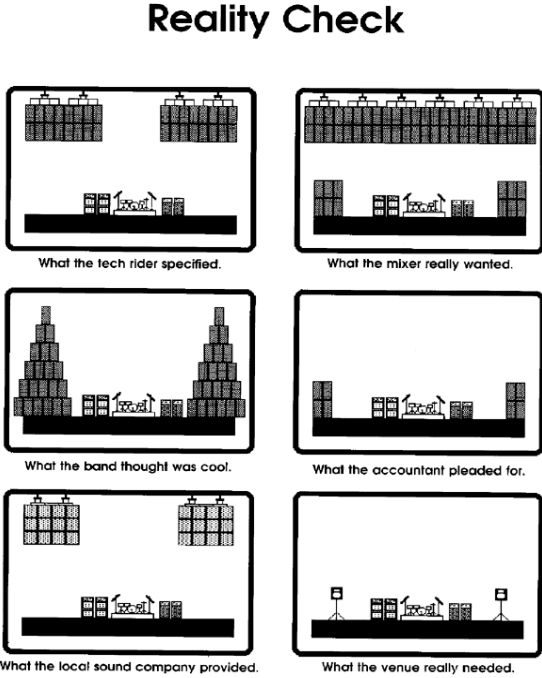
This image, addressing concert PA arrangements, has been floating around for decades, highly influenced by the GD setups.
121–130 of 130 posts
This image, addressing concert PA arrangements, has been floating around for decades, highly influenced by the GD setups.
Earlier quoted context omitted.
While it's true that they did that and why, I'd ultimately chalk it up as more of a flaw than a feature. Vocals never sounded great on wall of sound shows because they could never sing perfectly into one mic. This can be confirmed by listentng to soundboard tapes of the shows, and comparing them with ones a year or two either side - the full on Wall was only used for about a year. While the WoS laid much of the groun…
> It was totally impractical to tour with and they lost money doing so. The whole system travelled in two articulated lorries; but it took so long to set up that eventually they used four lorries, and two systems. One set would be for tonight's gig, the other would be on the road to tomorrow's gig, or starting to set up. I think the mikes for the vocals were three mikes, not two (you can see triple mikes in The Grate…
It's still very common to use largely-separate signal chains for the PA, and for recording (and/or broadcast). These days we often do it with analog or digital splits, but analog splits can [still] be problematic and digital splits didn't exist yet back then.
Analog splits might have been particularly problematic when the source is two microphones fighting eachother. And it's often [still] the case that a microphone that works well for PA is not a microphone that is ideal for non-PA use.
(Sure, we like to think of live recordings or broadcasts as being "being there," but that's almost never actually the case. When recording and/or broadcast is involved, those things are often handled as separately as is practical -- often with gear and engineers that are outside of the walls of the venue.
This allows the FOH folks to get it sounding good in the room, the recording folks to get it sounding good on tape/DAW, and the broadcast folks to get it sounding good on radio/TV. They're different goals, and they've each got different approaches.)
Earlier quoted context omitted.
The history of balanced lines (common mode rejection, differential pair, etc.) is fascinating. Apparently the first twists (as in "twisted pair" to pick up external interference as similarly as possible on each conductor) were achieved not within a bundled cable, but between utility poles. Every two spans would constitute a full twist, with two single wires alternating from left to right on the cross member. But as f…
The cable pairs within an ethernet cable have different twist rates, to reduce crosstalk.
Therein lies the difference between Cat5 and Cat5e: Cat5 pairs were all twisted at the same frequency, while Cat5e pairs must not be twisted at the same frequency.
(This is also how we were able to transition so quickly and cheaply from Cat5 to Cat5e: All that was needed to produce Cat5e on a line that had been producing Cat5 was just a relative speed change on the machines that twisted up the individual pairs.)
Earlier quoted context omitted.
hahaha, no better way to be snapped back into reality than hearing the wild calls of a screeching possum
I cannot read this comment without hearing "Playing in the Band". Now that part is stuck in my head all day, thanks.
Earlier quoted context omitted.
I cannot read this comment without hearing "Playing in the Band". Now that part is stuck in my head all day, thanks.
apologies for the lack of whoaaa yaaa yay ya a trigger warning
Earlier quoted context omitted.
It's been quite a few years since I last worked in live show production, but on any show at a venue where we couldn't be sure of access to clean power, humbuckers (not the guitar pickups, a nickname for what I believe was just a dumb 60hz notch filter or ground loop isolator inlined on house power taps) were a standard pack out in the road kit. I would have expected that this decades-old and well established componen…
Nonprofit and church auditoriums and halls are often about fifty years out of date and are somewhat around “barely working”.
Earlier quoted context omitted.
Duuuude yes! I adore your app. Do you have a tip jar or something?
Nope, we don't take donations. If you want to contribute back, we recommend donating to Archive.org as they do the bulk legwork that makes this all possible and are a valiant internet library worthy of the support. And of course, we always accept pull requests!
Earlier quoted context omitted.
Since balanced cables predate the GD, this strikes me as an acoustic implementation of an EE concept. Neat!
The history of balanced lines (common mode rejection, differential pair, etc.) is fascinating. Apparently the first twists (as in "twisted pair" to pick up external interference as similarly as possible on each conductor) were achieved not within a bundled cable, but between utility poles. Every two spans would constitute a full twist, with two single wires alternating from left to right on the cross member. But as f…