Earlier quoted context omitted.
I have reservations for the restaurant at the end of the universe.
If you look closely at the kitchen in the background, it’s all frozen microwave food.
So it's an Applebees?
191–200 of 310 posts
Earlier quoted context omitted.
Even Hubble images are false color as well. It uses filters and then recombines them to RGB channels. People naturally ask what they would actually see, but they actually wouldn't see much of anything. Using a telescope to look at things, one only sees a black and white image. We've been shown so much from sci-fi with space ships showing nebulas and nova remnants out their view screens, but that' just not what one wo…
No. A normal visible light telescope absolutely shows color. You can just point a DSLR with a zoom lens and no filters at the sky, take a picture of M42, and confirm that yourself.
Absolutely incredible. For a little bit of context for how impressive this is, here's my take on it with a consumer grade 8" Newtonian telescope from my backyard: https://www.astrobin.com/full/w4tjwt/0/
Your picture is itself quite impressive. Do you mind sharing more about the equipment and process it takes to capture something like that? Edit: Oh, you can click through the image and see technical details. Very cool.
1. The scope they used is roughly equivalent to shooting with an 800mm telephoto lens. But the fact that it's 8" wide means it can let in a lot of light.
2. The camera [2] is a cooled monochrome camera. Sensor heat is a major source of noise, so the idea is to cool the sensor to -10deg (C) to reduce that noise. Shooting in mono allows you shoot each color channel separately, with filters that correspond to the precise wavelengths of light that are dominant in the object you're shooting and ideally minimize wavelengths present in light pollution or the moon. Monochrome also allows you to make use of the full sensor rather than splitting the light up between each channel. These cameras also have other favorable low-light noise properties, like large pixels and deep wells.
3. The mount is an EQ6-R pro (same mount I use!) and this is effectively a tripod that rotates counter to the Earth's spin. Without this, stars would look like curved streaks across the image. Combined with other aspects of the setup, the mount can also point the camera to a specific spot in the sky and keep the object in frame very precisely.
4. The set of filters they used are interesting! Typically, people shoot with RGB (for things like galaxies that use the full spectrum of visible light) or HSO (very narrow slices of the red, yellow, and blue parts of the visible spectrum, better for nebulas composed of gas emitting and reflecting light at specific wavelengths). The image was shot with a combination: a 3nm H-Alpha filter captures that red dusty nebulosity in the image and, for a target like the horsehead nebula, has a really high signal-to-noise ratio. The RGB filters were presumably for the star colors and to incorporate the blue from Alnitak into the image. The processing here was really tasteful in my opinion. It says this was shot from a Bortle-7 location, so that ultra narrow 3nm filter is cutting out a significant amount of light pollution. These are impressive results for such a bright location.
5. They most likely used a secondary camera whose sole purpose is to guide the mount and keep it pointed at the target object. The basic idea is try to put the center of some small star into some pixel. If during a frame that star moves a pixel to the right, it'll send an instruction to the mount to compensate and put it back to its original pixel. The guide camera isn't on the technical card, but they're using PHD2 software for guiding which basically necessitates that. The guide camera could have its own scope, or be integrated into the main scope by stealing a little bit of the light using a prism.
6. Lastly, it looks like most of the editing was done using Pixinsight. This allows each filter to be assigned to various color channels, alignment and averaging of the 93 exposures shot over 10 hours across 3 nights, subtraction of the sensor noise pattern using dark frames, removal of dust/scratches/imperfections from flat frames, and whatever other edits to reduce gradients/noise and color calibration that went into creating the final image.
[1] https://www.astrobin.com/w4tjwt/0/
[2] https://astronomy-imaging-camera.com/product/asi294mm-pro/
Earlier quoted context omitted.
Your picture is itself quite impressive. Do you mind sharing more about the equipment and process it takes to capture something like that? Edit: Oh, you can click through the image and see technical details. Very cool.
You already noticed the technical card [1], but I can describe some of the details that go into this for those unfamiliar with the items on it. 1. The scope they used is roughly equivalent to shooting with an 800mm telephoto lens. But the fact that it's 8" wide means it can let in a lot of light. 2. The camera [2] is a cooled monochrome camera. Sensor heat is a major source of noise, so the idea is to cool the sensor…
Earlier quoted context omitted.
Your picture is itself quite impressive. Do you mind sharing more about the equipment and process it takes to capture something like that? Edit: Oh, you can click through the image and see technical details. Very cool.
You already noticed the technical card [1], but I can describe some of the details that go into this for those unfamiliar with the items on it. 1. The scope they used is roughly equivalent to shooting with an 800mm telephoto lens. But the fact that it's 8" wide means it can let in a lot of light. 2. The camera [2] is a cooled monochrome camera. Sensor heat is a major source of noise, so the idea is to cool the sensor…
> They most likely used a secondary camera whose sole purpose is to guide the mount and keep it pointed at the target object.
I did use a guide camera with an off-axis guider, I'm not sure why it wasn't in the equipment list. I've added it.
> The RGB filters were presumably for the star colors and to incorporate the blue from Alnitak into the image.
This is primarily an RGB image, so the RGB filters were used for more than the star colors. This is a proper true color image. I could get away with doing that from my location because this target is so bright. The HA filter was used as a luminance/detail layer. That gave me a bunch of detail that my local light pollution would hide, and let me pick up on that really wispy stuff in the upper right :)
> The processing here was really tasteful in my opinion.
Awe shucks, thanks :blush:
Absolutely incredible. For a little bit of context for how impressive this is, here's my take on it with a consumer grade 8" Newtonian telescope from my backyard: https://www.astrobin.com/full/w4tjwt/0/
I mean I don't know if I'm more impressed by their level of detail from a $10 billion telescope or your level of detail from a consumer-grade telescope!
Earlier quoted context omitted.
> it cannot be that nowhere else but here on Earth did this happen. > I don't know if this is statistics. It surely is gut feeling. It's possible that life emerging is so unlikely that it has never happened before anywhere even if it could happen again. We do not have the data to establish how likely and in fact we don't even have enough data to fill in all the gaps of how life on earth emerged in the first place. Ou…
But that's it. Life doesn't seem so unlikely, does it? There are things we still don't understand about it, but we understand some, and it's not magic. It can happen, given the right conditions, much like mold may grow on a piece of bread under the right conditions. What's difficult to comprehend is the immense vastness of the universe. It seems unlikely that nowhere else did the preconditions for life arise, and in…
> What's difficult to comprehend is the immense vastness of the universe.
We know a whole lot about ways life changes once it's there but we haven't observed life emerging from non-life and our hypotheses for how life emerged on earth has more holes than swiss cheese and it doesn't have to be magic in order to be exceedingly improbable. And magnitudes work in both ways, if it is sufficiently improbable for life to emerge, let's say 1 chance in 1E100 against then even if you had dice rolls in proportion to all the subatomic particles in the universe (~1E80) multiplied by the number of seconds since the big bang (~4E17) then it would still be about 3 orders of magnitude against the likelihood of life emerging even once. In this scenario if the probability was 4E97 then we'd expect for life to have emerged once. Until we have the data to infer what the probability actually is we can't determine which scenario is the case.
Earlier quoted context omitted.
You already noticed the technical card [1], but I can describe some of the details that go into this for those unfamiliar with the items on it. 1. The scope they used is roughly equivalent to shooting with an 800mm telephoto lens. But the fact that it's 8" wide means it can let in a lot of light. 2. The camera [2] is a cooled monochrome camera. Sensor heat is a major source of noise, so the idea is to cool the sensor…
One of my favorite comments ever on HN. I’m big into photography and yet learned something on nearly every bullet. Thank you!
Absolutely incredible. For a little bit of context for how impressive this is, here's my take on it with a consumer grade 8" Newtonian telescope from my backyard: https://www.astrobin.com/full/w4tjwt/0/
I mean I don't know if I'm more impressed by their level of detail from a $10 billion telescope or your level of detail from a consumer-grade telescope!
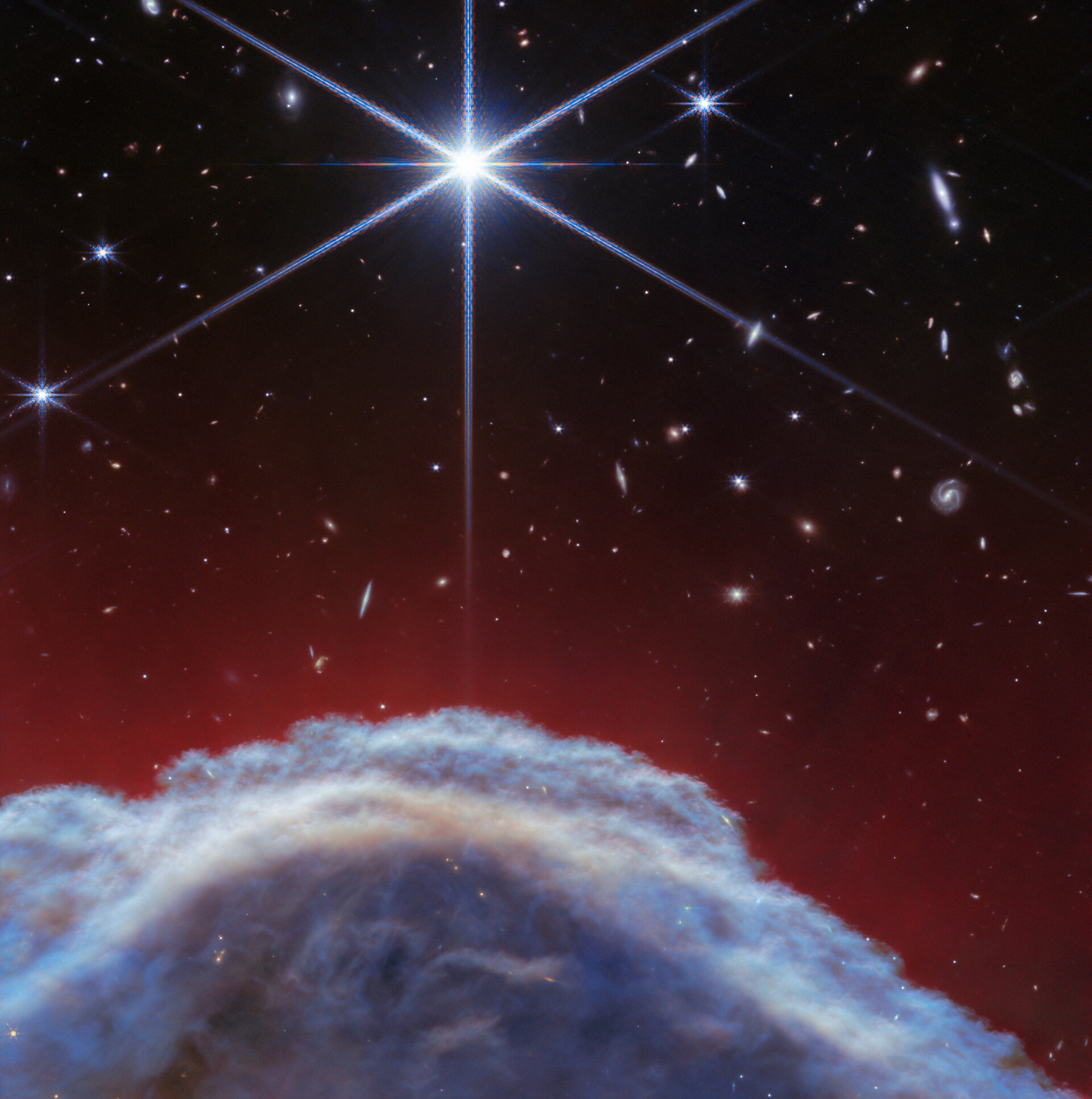
Here's the full resolution image:
https://www.esa.int/var/esa/storage/images/esa_multimedia/im...
Earlier quoted context omitted.
You’re assuming that space was compressed into a single point at the Big Bang. However, this is not implied by the Big Bang or cosmology. All we can truly infer is that the universe was very hot and dense and that spacetime experienced rapid expansion. We do not know the size, extent, or shape of space at that time, and we don’t even know how much matter and energy were present. We only have a notion of the density.
We may not know the exact size at the start, but we know it was infinitesimally smaller than it is today. So the size of the initial universe isn't a big factor in the equations about how big it likely is today. Weather it started as a few centimeters across or a few thousand light years across, both are functionally zero compared to the current size.
> We may not know the exact size at the start, but we know it was infinitesimally smaller than it is today. So the size of the initial universe isn't a big factor in the equations about how big it likely is today. Weather it started as a few centimeters across or a few thousand light years across, both are functionally zero compared to the current size.
Most things you're saying are correctly rooted except for what's beyond the observable universe. I'm not sure why the staunch belief that you can confidently claim this. To be clear, you aren't provably wrong - likewise not provably right either.
The replies to you are just fine, they represent a significant portion of the scientific community that says our universe is likely infinitely big and that, possibly, the big bang was infinitely small, yet still, still infinitely large. An infinite expanding into infinite still results not knowing what's out there.
PBS Space time talks about it in terms of "scale factor"[0] instead of absolute diameter.
Still, these are all debatable theories, so your take _could_ be valid, but generally, it points infinitely large.