Live data from Hacker News

Mental health in software engineering

vadimkravcenko.com

191–200 of 440 posts

Re: Mental health in software engineering

#191
post #39

Earlier quoted context omitted.

> Always doing shit themselves This is one of the most counterintuitive things about leadership roles IMO. If you get promoted there, it’s often because you got a lot of things done yourself in an IC role. And then the fewer things you do yourself, the better off you, the company, and your reports are once you’re in a leadership role. So you have to learn that feeling idle compared to what you used to feel like isn’t…

In addition as a leader your best use is often to be interrupted with questions from junior engineers. This means you can never (or rarely) get into a flow where you are productive, as you are getting close someone interrupts your thought with a question. As such if you have time to work on engineering (which you should make to stay sharp) it needs to be something unimportant to the business so that you can be late.…

> In addition as a leader your best use is often to be interrupted with questions from junior engineers.

I kinda disagree w/ this. I get better results from helping people understand this:

https://www.techtello.com/wp-content/uploads/2022/03/decisio...
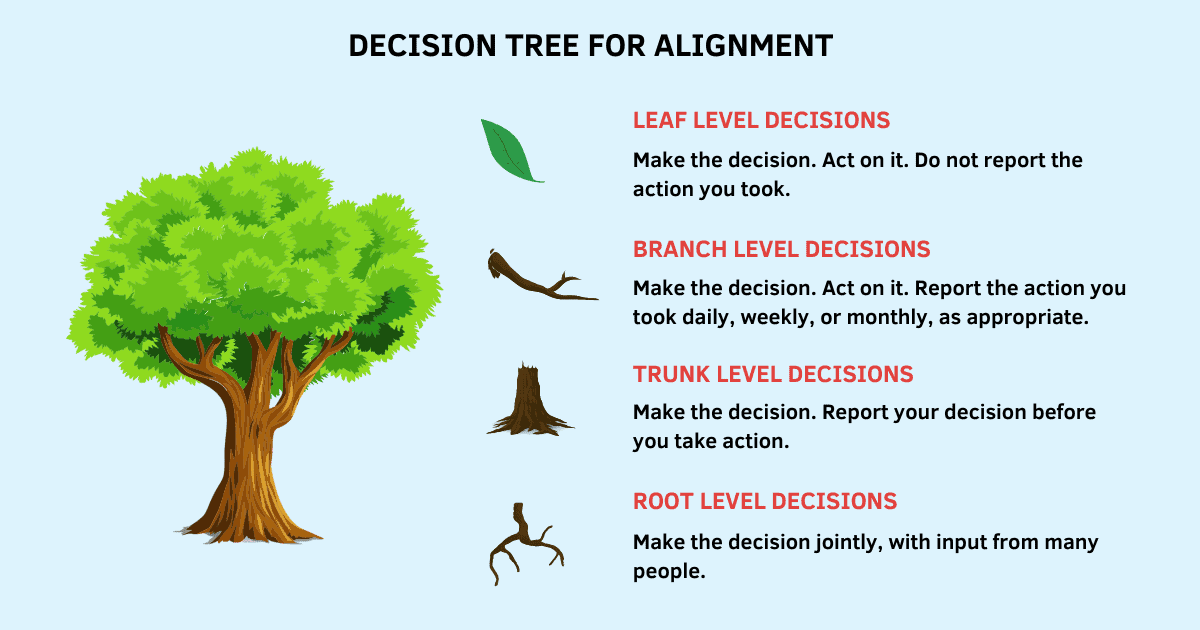
And then making sure that they're taking action when they should take action and getting help when they should be getting help. This means they are wrong sometimes but it's better for them to be wrong sometimes and learn than to be interrupting with too many questions when they should just be doing their best.

Admittedly at this point my only direct reports are bosses themselves, but they vast majority of questions they have for me go into a shared 1:1 doc that we address monthly. Everything else they take action on and report as needed.

Re: Mental health in software engineering

#192

Earlier quoted context omitted.

> Always doing shit themselves This is one of the most counterintuitive things about leadership roles IMO. If you get promoted there, it’s often because you got a lot of things done yourself in an IC role. And then the fewer things you do yourself, the better off you, the company, and your reports are once you’re in a leadership role. So you have to learn that feeling idle compared to what you used to feel like isn’t…

The best advice I heard about the switch from regular engineer to mgmt role was this: A software engineer works to build harmonious productive stable software systems. An engineering manager works to build harmonious productive stable people systems. The product is different. So many people who move into management don't make this mental shift and keep their hands on the steering wheel because that's how they got the…

Yeah this is a big point in High Output Management by Andy Grove. That to be a manager (or to do any job really) you need to understand what you're producing and how to measure the quantity and quality of that output – ideally identifying issues with output before they become costly to fix.

Much easier said than done but it was a real Aha moment for me as a boss.

Re: Mental health in software engineering

#193

I'm not terribly convinced that software engineering is harder on someone mental health than being a doctor, lawyer, sales, engineer, professional athlete, teacher, or any other white collar profession is. All of these have their specific stressors, all of these professions have loads of articles about how people are leaving these professions due to how hard they are. All of these jobs tend to lead to them consuming…

Doctor, lawyer, and athlete are "jock" professions, while software engineering is very much a "nerd" profession. These words represent status and general level of attractiveness and therefore access to attention and sex. Doctors, lawyers, teachers, and professional athletes all experience social reward and/or social contexts to their work. Software engineering is interfacing with an unthinking, unfeeling machine for…

It's weird, I've harped on a few of these points in conversations with others (usually when talking about "sexy careers", and why people don't hold coders in the same regard as doctors) but your words made me realize why I'm trying to become a developer. The dealing with the machine rather than people is something I'm willing to run with more than anything, right now. Not wholly a function of unmet needs, but addressing a specific change I'd like to make.

Re: Mental health in software engineering

#194

"An example of uncertainty in business is when your CEO tells you they promised a feature to your biggest client and it needs to be built ASAP as highest priority, so all hands on deck. Then a day later they tell you another feature, completely contradictory to the first one, needs to be built as well and is also highest priority. When you tell them they both can't be highest priority, the answer is: make it happen."…

That’s not an example of uncertainty in business, it’s an example of incompetence in leadership. The problem is not one of software engineering, it’s one of rampant bad management and business practices.

Re: Mental health in software engineering

#195
post #179

Earlier quoted context omitted.

The phenomenon of showing up at Stanford and telling some 21-year-old that he's Jesus Christ and that you're going to give him millions of dollars is a wen on the American business culture matched only by corporate raiding. It's the nerd version of college football/basketball recruiting.

Are you serious? That culture is why America still has high innovation while other Western and "culturally Western" countries that do not are largely stagnant. I'm amazed at how often I see people (largely Americans I'm guessing) criticize the very things that make their country a world superpower.

I'm still waiting for the USA to "innovate" on a way for everyone to get health care, although sometimes I suspect the lack of a solution there and general lack of regulation at large is part of why American has such "high innovation".

Re: Mental health in software engineering

#196

Earlier quoted context omitted.

How do you find gigs that actually pay like FTEs?

at least where I am at, the contractor rate is more than double the FTE rate.

> at least where I am at, the contractor rate is more than double the FTE rate.

But the big money in tech is in your options/RSUs, not base pay. And contractors don't get options. (Usually anyway; I've been given options as a consultant once but usually don't see that.)

Re: Mental health in software engineering

#197
post #179

Earlier quoted context omitted.

Are you serious? That culture is why America still has high innovation while other Western and "culturally Western" countries that do not are largely stagnant. I'm amazed at how often I see people (largely Americans I'm guessing) criticize the very things that make their country a world superpower.

I'm still waiting for the USA to "innovate" on a way for everyone to get health care, although sometimes I suspect the lack of a solution there and general lack of regulation at large is part of why American has such "high innovation".

We're pretty close. Obamacare covers a lot of people and employers are required to provide it if they have over 50 employees. Any hospital is required to treat anyone who comes in, regardless of ability to pay. It's sloppy and it's expensive if you don't qualify for ACA subsidies, but if you want healthcare/health insurance in the US, you can most likely get it if you try.

Re: Mental health in software engineering

#198
post #172

Earlier quoted context omitted.

I think Software Engineering attracts neurodivergent people. I am an adhd software engineer, and know a disproportionate amount of adhd software engineers. I think that level of executive dysfunction and “catchup” is problematic

I have a hypothesis about that, based on prior battles with depression. A characteristic of many people who struggle with depression is revisiting things over and over in your mind, looking for what is often a non-existent solution. This is a very, very useful trait in a software engineer. It helps us think of solutions to hard problems, to see options that are not initially obvious. But it also enables mental illnes…

I was born in a tiny village in a poor country where local politicians literally banned wifi in schools because apparently "radiowaves cause autism and homosexuality". I'm not joking. This was the official governmental position. In 2017. You can imagine technical literacy of anyone I had contact with as a child, years before that.

Today I work as an engineer at a known American corporation, slowly but surely moving up the ladder. Not everything goes smoothly, but I earn more than the rest of my elementary school peers combined and my prospects are bright.

I do not wish upon anyone the amount I work I had to put into achieving this position. Looking back, I'm in awe how this was possible. I basically dedicated 100% of my life to one goal. It's not just about studying all day all night. It's about tuning your core emotional responses to motivate you to keep reaching higher and higher at all costs. I can confidently say that I was right on the edge of going insane, and the entire experience caused irreparable damage to my mental health. It's only now that I'm learning to slow down.

It's strange. On one hand I don't think I'd change anything. I'm proud of the path I took. On the other hand, if I had a child, I just couldn't send it the same route, knowing how much it hurts.

Re: Mental health in software engineering

#199

I used to be in (moderate) awe of young college drop-out CEOs. Then I worked for a couple of them. Now I refuse to work for startups that have 20-somethings at the top, because they really do not know how to manage or lead. They are motivated by fear of failure and having accomplished nothing so far they treat others like garbage. Avoid.

Let me add: you never need to be in awe of someone who treats anyone else like garbage - whether they are 20 or 60. I’m just out an experience with a 49 year old founder/CEO. Will be looking for all signs of garbage in future opportunities.

Re: Mental health in software engineering

#200
post #174

Anyone else feel like agile is partially to blame? The constant treadmill of work items, the stress of getting things done before sprint end, the demos failing, the anxiety when you get a bug report?

yep, two week sprints with no break in between (I can't think of any sporting event where you sprint non stop!), and then we always say we'll "celebrate" when the project is done, but we never do

just on to the next project :/

Post reply on HN