I wish billionaires would spend their money on this, rather than the crap that the WEF comes out with.
Vesuvius Challenge 2023 Grand Prize awarded: we can read the first scroll
181–190 of 218 posts
Re: Vesuvius Challenge 2023 Grand Prize awarded: we can read the first scroll
#182Earlier quoted context omitted.
I think the quartz sand metaphor was to illustrate how advanced our silicon-based technology has become, not just the ML parts. Imagine all the stuff... transistors, Turing/Von Neumann machines, lithography, theoretical computer science, OS and compilers, the Internet... and lastly there's modern day machine learning that builds on top of all the above. The base level stuff isn't exactly protons and electrons, but gi…
The basic of concept how such a thing is powered (electricity) is so far removed from anything people did in ancient times that it would be hard to get them to understand that neither gods nor magic are invovled. Smart "intellectual" people would certainly be willing to challenge basically everything they assume about nature, but I don't think your run of the mill farmer would be able to do that.
Electricity isn't much different from water. The concept of a water mill has been around a long time. So understanding the functional ideas wouldn't be all that difficult. As far as Gods I think you will have a tough case minimizing their involvement even today.
Re: Vesuvius Challenge 2023 Grand Prize awarded: we can read the first scroll
#183The methods are incredible, but it seems like the text is ordinary and nothing to write home about
Sturgeon's law would imply that the overwhelming likelihood that any random unknown text we find from the ancient world _in situ_ is likely to be not be very good.
Most of what we have left from the ancient world is material that people felt worth copying for _centuries_ after they were written. That's a fairly amazing quality filter and gives people a skewed perspective on the overall quality of material written at the time.
A selection of work from a random library has also likely to be filtered for quality to an extent, and for the most part, the "good stuff" is going to be works that we _already_ have copies of or fragments from. Anything we don't already have a copy is is most likely going to be something that there weren't many copies made of, and usually there's a reason for that.
Which isn't to say that anything we find isn't going to be interesting for other reasons -- even bad writing is going to be incredibly useful for historical research.
Re: Vesuvius Challenge 2023 Grand Prize awarded: we can read the first scroll
#184Earlier quoted context omitted.
I’m now wavering a bit on my earlier dismissal of people freezing their bodies for an indeterminate future revival. I could probably get into a science fiction story with this premise: Instead of relying upon machinery, some zillionaire has their body dry frozen and stashed in a lunar south pole crater, with a foundation funding interstellar propulsion research to move the body to the coldest stable points discovered…
I kinda wanna write an horror story about people freezing their bodies or heads only to be revived in the future bat shit insane from the excruciating experience of existing for several decades in a sort of limbo...
read the jaunt by stephen king
Re: Vesuvius Challenge 2023 Grand Prize awarded: we can read the first scroll
#185This is the coolest thing I've read this year. It reads like science fiction. Who would even imagine it's possible to read text from a 2000 year-old rolled up burnt-crisp paper?
Speaking of "reading like sci-fi", what's that book where they scan an entire library of books, descructively, by feeding them into a "book chipper" like device that chops the books up into little pieces, vacuums those pieces up and scans the pieces as they flow through, reconstructing the original text by putting the scanned results together like so many jigsaw puzzles? It was a subplot of the book, but I can't for…
Vacuuming up an entire library of books, chopping them into little pieces, reconstructing the original text by putting together the little pieces like so many jigsaw puzzles?
That's not a sci-fi novel, that's OpenAI's business model!
Re: Vesuvius Challenge 2023 Grand Prize awarded: we can read the first scroll
#186TIL that I need to now shred my secret documents before throwing them into the burn barrel. Also, possibly, mix the resulting ashes into a slurry and dump into the sea.
Re: Vesuvius Challenge 2023 Grand Prize awarded: we can read the first scroll
#187Earlier quoted context omitted.
FAANG compensation range but no benefits and 100x the risk Make it $8m or $12m and FAANG employees can actually start to justify working on it seriously from a money perspective
Most of them are not good enough to make a dent in this task.
Most of the developers are. They might not have the right background and so it might take an extra year or two to get up to speed with the difficult areas of this project. However most developers I know have the "smarts" to switch to a different complex area and figure it out. Sure most of them are just doing standard CRUD apps that move a bit of data - but that is because that is what we need a lot of not because they can't do something else.
Re: Vesuvius Challenge 2023 Grand Prize awarded: we can read the first scroll
#188My initial concern was that the details may have been hallucinated but it seems they accounted for that as well!
Re: Vesuvius Challenge 2023 Grand Prize awarded: we can read the first scroll
#189Earlier quoted context omitted.
I think this suggestion of mine was downvoted last time too, but I don't get why! One would always want to test stuff in software development, especially if it was fraught and can easily be tested. Mostly there are no tests to be undertaken in history -hence it it's so much hearsay. But here is an opportunity to gain some genuine certainty, in a way that is normally unavailable! The implementors of this method should…
You're being downvoted because they literally did what you suggest already.
It does not say that in the article - this one and on a previous HN submission where I read about this.
However, you are right - if you go to Tutorials and Scanning there is reference to the creation of a 'campfire scroll'. And now we have some detail..... and the detail is problematic.
In tutorial 3, halfway down this page (https://scrollprize.org/tutorial3) there is a before and after comparison of the scroll. They ask a question "If you look back to the last page of the campfire scroll (before carbonization), can you see which area of the scroll this segment came from?".
This is mean to be obvious to answer - and one does have the 2 images to compare.
My thoughts on the comparison is - yes at a glance the there is a section that appears to match up - the 'angular squiggle' next to the @ symbol. However, if I look more closely at the 'angular squiggle' I see features and spaces in the generated image that do not correlate with the photo before carbonisation. The troughs are too deep, the spaces are too big. It seems to be a superficial similarity only.
I wish I could show what I mean by referencing the images.. But I will provide links for others to see what I mean when I say there is a superficial correlation only.
https://scrollprize.org/img/tutorials/vc-segment.png

https://scrollprize.org/img/tutorials/campfire-last-page.jpg
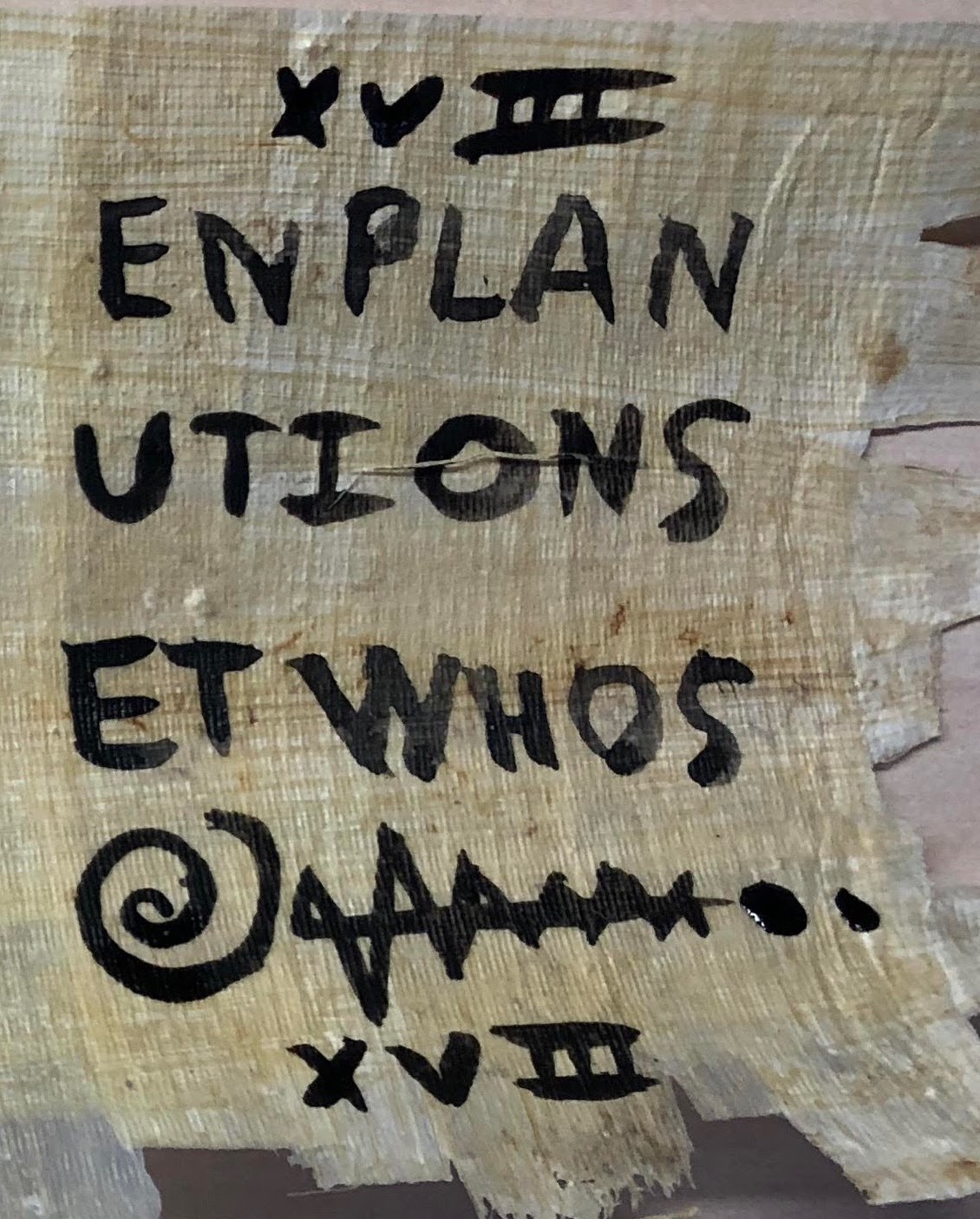
Final thought - why not map the 2 images one over the other on the site? Why ask a leading question rather than provide a proof? I hate that kind of presentation - it smacks of providing enough information for someone to make an incorrect snap judgement.
Re: Vesuvius Challenge 2023 Grand Prize awarded: we can read the first scroll
#190Earlier quoted context omitted.
> it will probably take years In the direction things are going ... maybe a few months :)
The biggest bottleneck is getting the experts to read it. You need a decade or so of graduate level education and interpreting things takes apparently quite a long time. Maybe that's another AI application.
I doubt it. Most universities have some professor in this area and a few graduate students. There is very little else for them to read (the entire of all classic books we have fits on a shelf), and most of them can read the original language. They will read this as soon as it is available just because it they don't have much else to read that is a primary source material. Thus everything new is of great interest because there is so little to work with.